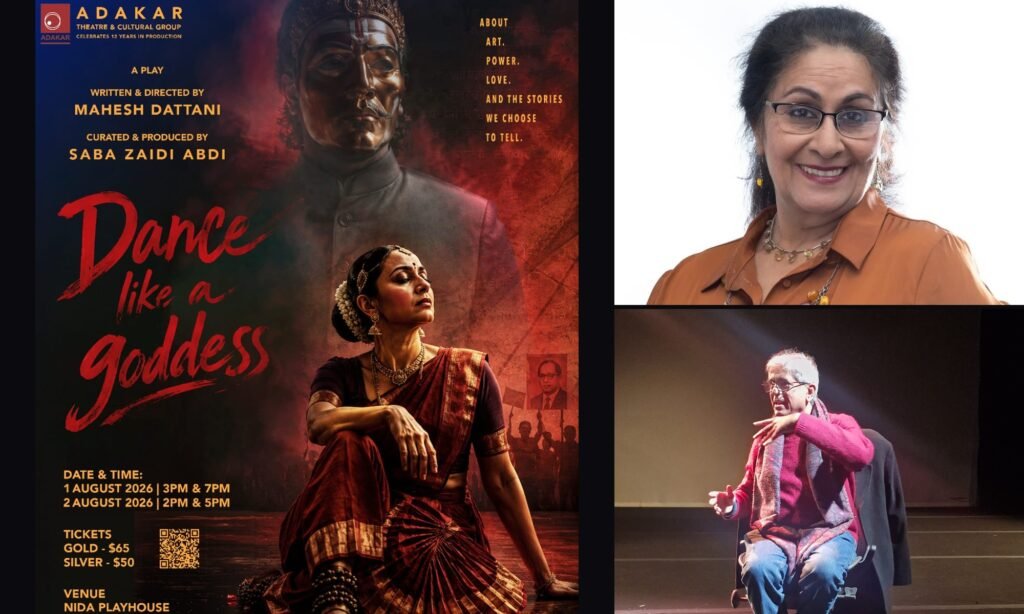
Adakar Theatre will stage the Sydney premiere of “Dance Like a Goddess,” written and directed by acclaimed Indian playwright Mahesh Dattani, at NIDA Playhouse on August 1 and 2, 2026. The production marks 12 years since Saba Zaidi Abdi founded Adakar in 2014, building it into one of Sydney’s most active community theatre groups focused on South Asian stories.
In an exclusive interview with South Asian Herald on July 29, 2026, Zaidi Abdi spoke about the production, her career, and what audiences can expect from the show.
The play centers on a Bharatanatyam dancer named Lata, celebrated for her portrayal of the Tridevi and revered by those around her almost as a living goddess. Zaidi Abdi described the story as one of power and its corrupting reach into art, politics, and family. She said the play examines “how power corrupts the way people think about the role of these art forms,“ and how that corruption extends into personal relationships.
As the story unfolds, Lata finds herself with no heir to carry forward her artistic legacy. Her son has turned away from classical dance toward theater of protest, while her husband, who has entered politics, leans on her fame and public standing to advance his own career. Abdi called it “quite a stark play, but it’s a very nice, very powerful play, thought provoking.”
Advertisement
“Dance Like a Goddess” revisits two characters from Dattani’s celebrated play “Dance Like a Man,” written around three decades ago, imagining where their lives have led in their sixties. Zaidi Abdi said the play reflects a broader concern about art becoming entangled with politics and religion, and that creative work should remain secular. She said the narrative also touches on the treatment of underprivileged communities within the world of classical art.
Aparna Tijoriwala takes on the central role of Lata. Zaidi Abdi said Tijoriwala was a natural fit for the role, bringing both the technical command of classical dance and the dramatic depth the part demands.
The production follows two earlier collaborations between Zaidi Abdi and Dattani for Adakar: “Where Did I Leave My Purdah,” a story about an actress’s life set against the partition of India, and “Dhundh.” Dattani also led scriptwriting and acting workshops with Adakar’s cast ahead of this production, part of a Zaidi Abdi’s long-standing commitment to mentor local writers and performers. That mentorship model has previously produced two original plays, “Packing” and “Mangal Sutra,” written by first and second-generation migrant writers and developed through an Adakar scriptwriting competition.
Adakar’s back catalogue includes Girish Karnad’s “Wedding Album,” an adaptation of “Dozakh,” a Molière-inspired production of “Kanjoos,” and “Pali Hill Ki Ek Raat,” based on a work by Urdu writer Qurratulain Hyder. In 2018, Adakar’s “Shri 420,” a Hindi adaptation of Molière’s “Tartuffe,” was invited to perform at the 8th Theatre Olympics in Delhi and Mumbai, India. Zaidi Abdi said staging the production at NIDA Playhouse reflected Adakar’s commitment to meeting professional theatre standards. “We are professionally trained people,” she said, explaining that staging productions at NIDA reflects Adakar’s commitment to professional standards.
A graduate of the National School of Drama, Zaidi Abdi went on to work at Doordarshan as a producer, director and commissioning editor, and later trained at the Film and Television Institute of India. She worked as a designer on feature films including “Mandi,” “Junoon,” a film centered on the 1857 Indian Mutiny and “Trikal,” where she collaborated with acclaimed filmmaker Shyam Benegal. Her work on “Trikal” earned her the National Film Award for Best Costume Design, presented by the President of India.
Alongside her theatre work, Zaidi Abdi continues to act, with credits including the ABC and Netflix series “The Unlisted” and “Summer Love.” Her short film “The Coconut,” about a Fijian grandmother and her musician grandson, has been selected for the Melbourne International Film Festival and is set to screen on August 13.
Ahead of the Sydney premiere, Zaidi Abdi had a simple message for audiences, “I would like them to come with an open mind,” she said, encouraging audiences to experience the play without preconceived notions or privilege and to draw their own conclusions.