
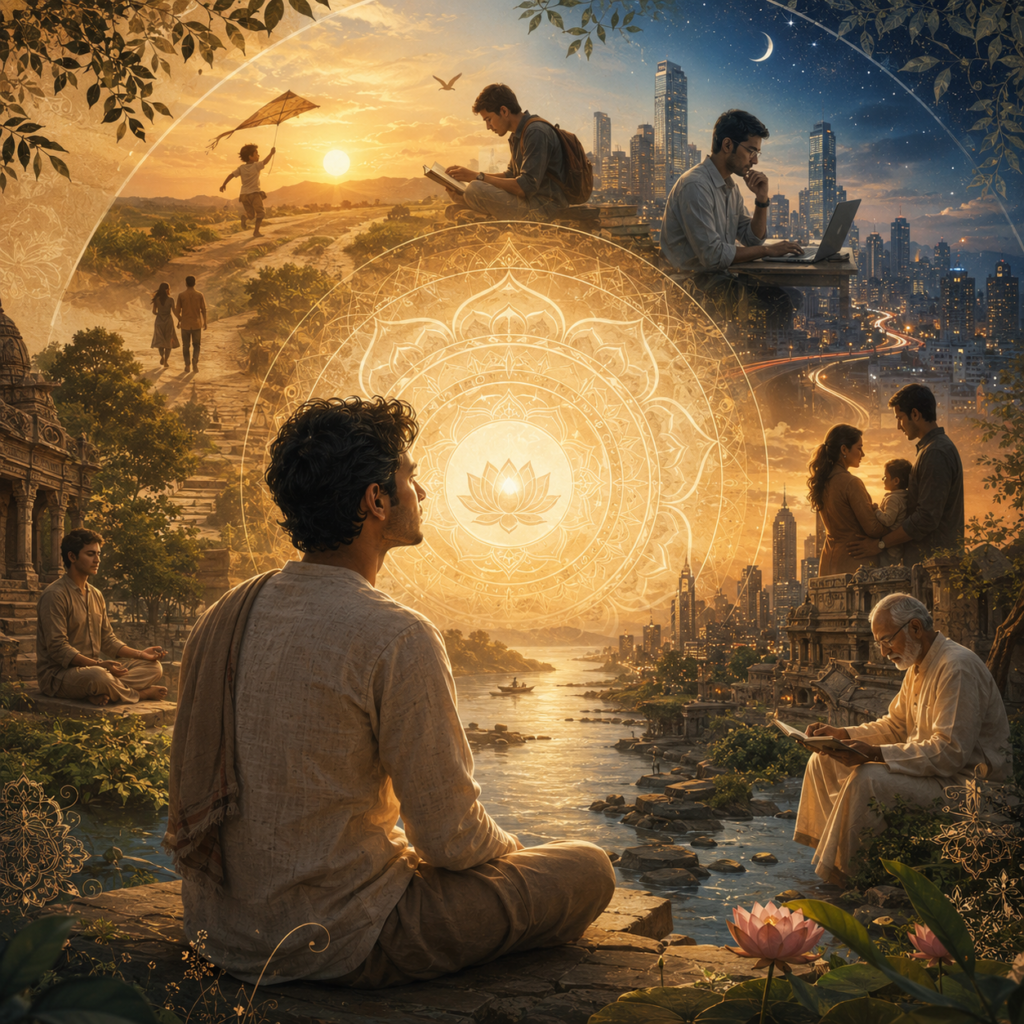
Tomorrow morning, when you open your eyes, try something. Do not think of it as the start of another day. Think of it as the start of another life.
This is not just a poetic metaphor. Indian tradition holds an old understanding of time that many of us grew up with but rarely stopped to notice. The Dharmashastra tradition divides life into four ashramas: Brahmacharya, the years of learning; Grihastha, the years of building; Vanaprastha, the years of turning inward; and Sannyasa, the years of release and rest.
Now think about your day. Indian tradition also divides it into four prahars, or watches — morning, noon, evening, and night — each with its own mood and purpose. This parallel is not decorative. It is precise. Each day holds the full arc of a life, compressed into hours. Once you see it that way, something shifts — not in the day itself, but in how you move through it.
Morning is your Brahmacharya. The sun rises, and so do you. The body is fresh, the mind is open, the world has not yet made its demands. Notice how children wake up: quick, curious, ready. That energy is not reserved for the young. It returns to you every morning. This is the time to learn, absorb, and set direction.
Noon is your Grihastha. The sun stands directly overhead — no shadows, nowhere to hide. This is the blaze of the householder years: peak energy, full engagement, the hours to build, create, earn, and work with purpose. Life asks everything from you now, and you answer. This is not the time to reflect. This is the time to act.
Evening is your Vanaprastha. The light softens and the pace slows — not from weakness, but from a quiet, earned wisdom. You begin releasing what you no longer need: urgency, ambition, the compulsion to prove. Vanaprastha was never about leaving life behind. It was about finding balance. The sky often does its finest work at dusk.
And then comes night — your Sannyasa. You return home, return to yourself. The world grows quiet. There is nothing left to chase. You are safe in your abode, and all that is asked of you is rest. This is not an ending to fear. It is a completion.
Now here is the thought that changes everything.
Every night, when sleep takes you, something ends. And every morning, when your eyes open, something new begins.
वासांसि जीर्णानि यथा विहाय नवानि गृह्णाति नरोऽपराणि। तथा शरीराणि विहाय जीर्णान्यन्यानि संयाति नवानि देही॥
— Bhagavad Gita, Chapter 2 (Sankhya Yoga), Verse 22
As a person discards worn-out garments and puts on new ones, so the soul discards the old body and moves into a new one.
You do this, in miniature, every night. Sleep is a small death — gentle, necessary, complete. Waking is a small birth — fresh, unburdened, full of breath.
Whatever yesterday held — the failure, the regret, the exhaustion — ended last night. It belonged to a life already finished. Every day is not just another day. It is a new life. And every morning is a gift: a fresh start and a new chance to live more truly than you did before.
Disclaimer: The opinions and views expressed in this article/column are those of the author(s) and do not necessarily reflect the views or positions of South Asian Herald.