Join WhatsApp Channel

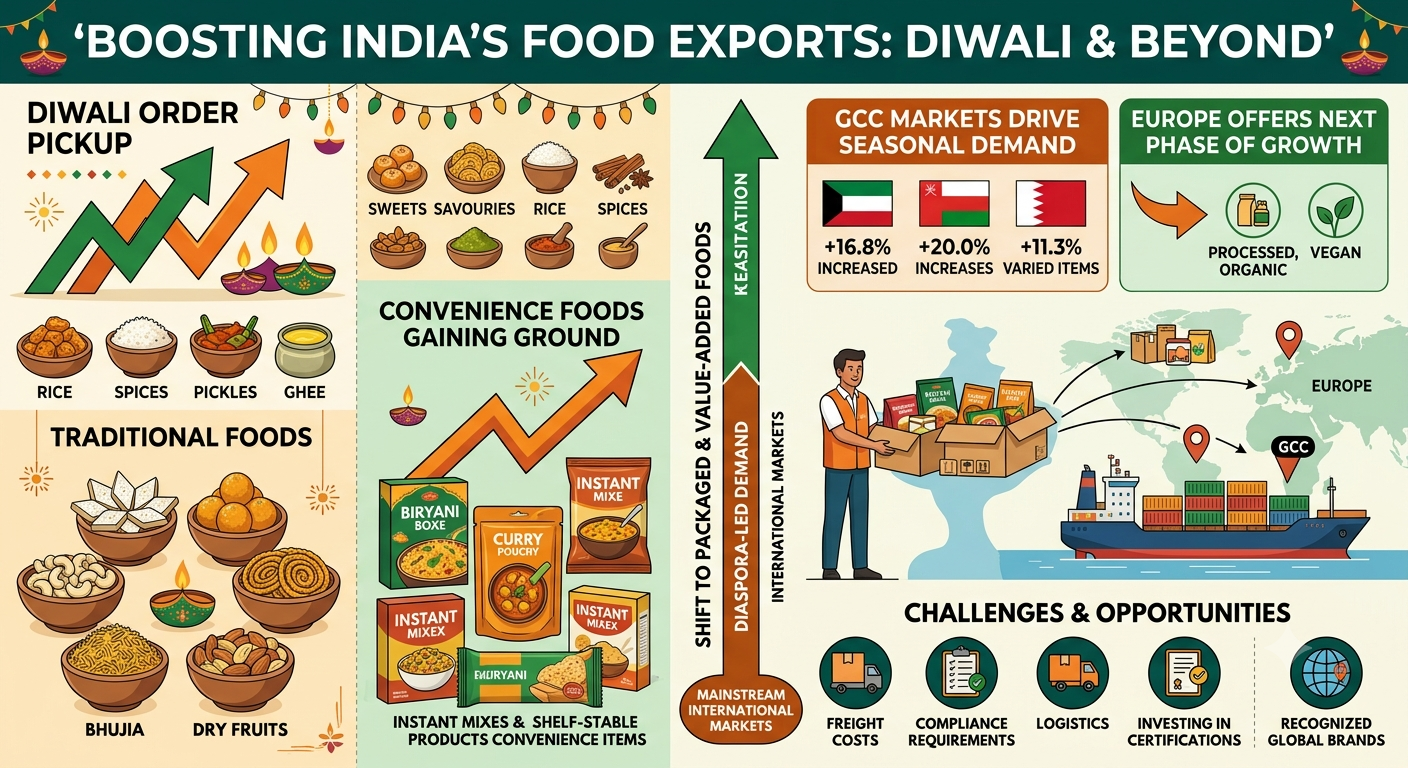
Indian food and beverage exporters are seeing a pickup in overseas orders ahead of Diwali, with international buyers reporting average demand growth of about 6 percent and some markets recording increases of more than 15 percent, according to the Trade Promotion Council of India (TPCI).
The survey of overseas buyers points to a stable-to-moderate expansion in festive demand, led by traditional products such as sweets, savories, rice, spices, pickles and ghee, while ready-to-eat and ready-to-cook foods are emerging as a faster-growing segment.
The Gulf Cooperation Council (GCC) markets, particularly Kuwait, Oman and Bahrain, are driving much of the seasonal demand, while European buyers are increasingly sourcing Indian convenience foods for mainstream retail and foodservice markets.
The shift could give Indian exporters an opportunity to move beyond diaspora-led demand and build a larger international market for packaged and value-added foods.
“Festive-season demand signals are encouraging for India’s food and beverage exporters,” TPCI Chairman Mohit Singla said. “What is particularly significant is the combination of strong demand for traditional Indian products such as sweets, savories, rice, spices and pickles with the rapid emergence of ready-to-eat and ready-to-cook foods.”
Convenience foods gain ground
Ready-to-eat and ready-to-cook products are among the strongest growth areas identified by the survey, reflecting rising demand for convenient foods that retain Indian flavors and cooking styles.
A German importer reported about 25 percent year-on-year growth in ready-to-eat food imports, while a Kuwait buyer reported growth of 28 percent, according to TPCI.
The broader export trend also points to stronger overseas demand for processed foods. India’s exports of ready-to-eat and cooked food products rose 16 percent to $2.4 billion in the financial year ended March 2026, from $2.1 billion a year earlier, the council said.
The growth is opening opportunities for frozen snacks, prepared meals, festive mixes, instant mixes, Indian breads, curries, cooked rice and other shelf-stable convenience products.
For exporters, the shift is particularly important because products with longer shelf lives, higher value addition and established brands can offer greater scope for expanding beyond traditional commodity shipments.
GCC remains key festive market
The GCC has emerged as the strongest regional demand center for Indian festive foods, with importers and distributors in Kuwait, Oman and Bahrain reporting procurement across a wide range of products.
Kuwait is seeing demand for sweets, ghee, paneer, beverages, condiments, spices, pickles, canned foods and dry fruits. Buyers in Oman are sourcing Indian rice, spices, masalas, pulses and pickles, while Bahrain continues to report demand for traditional festive foods and savories.
The region’s large Indian-origin population, growing acceptance of Indian cuisine among other consumers and expanding ethnic-food retail networks are helping Indian products move beyond their traditional diaspora customer base.
India’s wider food trade with the region reflects the opportunity. Food and beverage exports to the United Arab Emirates rose from $2.3 billion in 2021 to $3.6 billion in 2025, representing a compound annual growth rate of 11.3 percent, according to TPCI.
Europe offers next phase of growth
European markets are becoming increasingly important for Indian processed-food exporters, particularly in ready-to-eat, frozen, organic, vegan and health-oriented categories.
The survey suggests that European buyers are looking for products capable of meeting tighter food-safety, labelling and import-compliance requirements, potentially pushing Indian suppliers towards better packaging, certification and production standards.
TPCI said the pattern indicated a gradual broadening of India’s food export opportunity from predominantly diaspora-driven consumption to mainstream international demand.
“With global consumers actively seeking authentic ethnic flavors, healthier options, and convenience, India is uniquely positioned to become a reliable hub for value-added food products,” Singla said.
“The festive season provides crucial momentum for our exporters to transition from traditional commodity exports toward building strong, recognized global brands in food sector,” he said, adding that while the GCC remained an immediate growth driver, Europe offered potential for the next phase of expansion.
Traditional foods retain strong demand
Despite the rapid growth of convenience products, traditional Indian foods remain central to Diwali procurement.
Buyers continue to seek products including kaju katli, laddoo and halwa, as well as bhujia, mixture and murukku, dry fruits and nuts, rice, spices, masalas, ghee and pickles.
Exporters are increasingly combining these products with smaller consumer packs, longer shelf lives and modern packaging to make them more suitable for international retail.
The combination of traditional flavors and convenient formats could allow Indian suppliers to capture consumers who are familiar with Indian cuisine but are not part of the Indian diaspora.
Freight, compliance pose risks
The positive demand outlook comes against a backdrop of persistent logistical and regulatory constraints.
TPCI identified high freight and container costs, customs inspection delays, food-safety and import-compliance requirements, limited shelf life and geopolitical instability among the main concerns for exporters and buyers.
Disruptions affecting West Asian shipping routes could be particularly important for Indian food exporters serving Gulf markets, where timely delivery is critical for seasonal products and perishable goods.
The challenges are also increasing pressure on exporters to invest in international certifications, compliant labelling, improved shelf-life technology, cold-chain infrastructure, modern packaging and more efficient logistics.
The survey responses included international buyers and Indian exporters such as Imperial Food & Packaging Ltd., Al Reef LLC, Vepura GmbH, Arab Star Investments LLC, Bustan Egypt and Kuwait Co., Al Maya Group, AK Modern for General Trading, Megamart WLL, Haldiram Snacks Foods Pvt. Ltd., Pravin Masalewale and Taj Frozen Foods India Ltd.
For Indian exporters, the Diwali season therefore comes with a dual opportunity: capitalize on a near-term surge in festive procurement while using the demand for convenience, authenticity and value-added products to establish longer-term positions in global food markets.