India possesses the world’s largest diaspora, receives the highest annual remittance inflows, and enjoys an increasingly influential global community occupying leadership positions in business, technology, academia and politics. Yet as governments worldwide begin treating diaspora engagement as an instrument of economic strategy, technological advancement and geopolitical influence rather than simply cultural outreach, India faces a critical question: can its diaspora policy evolve fast enough to match the country’s rising global ambitions?
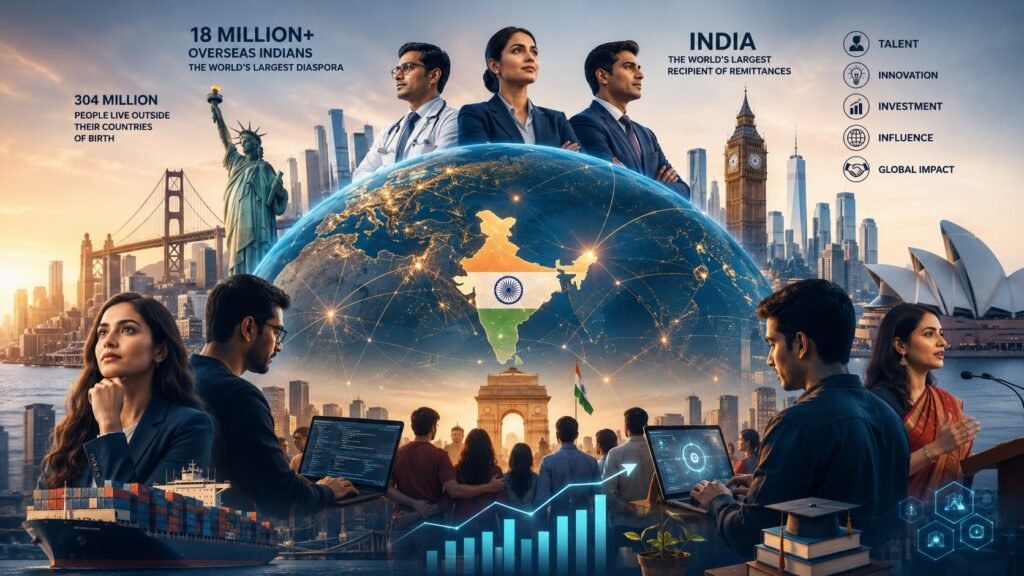
According to the United Nations Department of Economic and Social Affairs (UNDESA) International Migration Stock 2024, nearly 304 million people—about 3.7 per cent of the world’s population—live outside their countries of birth. Among them, India accounts for roughly 18 million overseas citizens and people of Indian origin, making it the largest diaspora globally, well ahead of China (11.7 million) and Mexico (11.6 million). The World Bank estimates India also remains the world’s largest recipient of remittances, underscoring the economic weight of its overseas community.
But numbers alone no longer define the strategic value of a diaspora.
Increasingly, countries are competing not only for remittances but for access to global talent, venture capital, advanced technology, research networks, political influence and international business ecosystems. Diaspora policy has consequently moved from the margins of foreign affairs into the center of national economic planning and geopolitical strategy. Governments now see expatriate communities as channels for innovation, supply-chain integration, knowledge transfer and soft power.
Advertisement
It is against this backdrop that a recent policy study by Pratyusha Dusi, Research & Policy Intern at the Pravasi Setu Foundation, argues that India has reached an inflection point. While New Delhi has built one of the world’s most visible diaspora engagement frameworks through initiatives such as the Overseas Citizenship of India (OCI) scheme, Pravasi Bharatiya Divas, the Know India Program, the e-Migrate platform and various welfare measures, the country’s next challenge is institutional rather than ceremonial. The study contends that India now needs to shift from relationship-building to capability-building by leveraging its overseas community as a driver of technology, innovation, investment and long-term development.
The paper, titled “Diaspora, Development and Statecraft: Comparative Perspectives from China and Mexico for India’s Global Engagement Strategy,” examines how the world’s three largest diaspora countries have adopted markedly different models to harness their overseas populations, and argues that India can draw important lessons from both.
Unlike India, whose diaspora engagement has largely centered on cultural identity, political outreach and remittance mobilization, China has embedded diaspora policy within its national development strategy.
Following the economic reforms of the late 1970s, Beijing built an elaborate institutional architecture connecting overseas Chinese directly with industrialization, foreign investment and technological modernization. Today, China’s diaspora engagement spans multiple government agencies through the so-called “Five Overseas Chinese Structures,” integrating policymaking, investment promotion, legislative oversight and cultural diplomacy.
Its talent recruitment programs—including the 1,000 Talents Program, 10,000 Talents Program, and various science and innovation initiatives—were designed not merely to encourage emotional attachment but to reverse brain drain through what policymakers describe as “brain circulation.” Overseas Chinese scientists, entrepreneurs and engineers became active participants in building China’s semiconductor industry, research ecosystem, manufacturing capabilities and innovation economy.
China also strategically located many of its early Special Economic Zones in traditional emigrant provinces such as Guangdong and Fujian, enabling overseas Chinese capital to become one of the principal engines of its export-led industrial expansion.
Mexico represents an almost opposite philosophy.
With most of its diaspora concentrated in the United States, successive Mexican governments prioritized migrant welfare, community development and institutional trust over technology acquisition or geopolitical influence.
The Institute for Mexicans Abroad (IME) coordinates an extensive network of financial education programs, health services, voting assistance and community outreach. Innovative schemes such as the 3×1 Program convert migrant remittances into public infrastructure by matching every dollar contributed by diaspora associations with funding from municipal, state and federal governments. Other initiatives support migrant entrepreneurship, financial inclusion and access to banking services through consular identification systems.
The result is a diaspora framework that treats migrants not simply as sources of foreign exchange but as partners in local development.
The comparison inevitably raises questions about India’s own approach.
India has unquestionably built one of the most politically visible diaspora engagement programs in the world. Successive governments have elevated overseas Indians into central actors in India’s public diplomacy, while the OCI framework, welfare schemes and increasingly digitized consular services have strengthened links with expatriate communities.
However, the comparative analysis suggests that India’s institutional architecture remains less integrated than China’s and less welfare-oriented than Mexico’s.
Although India receives record remittances annually, the report argues that it has yet to fully harness overseas expertise in frontier technologies, research collaboration, venture capital, manufacturing ecosystems and innovation networks. Bureaucratic hurdles, regulatory complexity, uneven coordination between the Centre and states and limited institutional mechanisms continue to constrain deeper diaspora participation.
The study also notes that India’s diaspora discourse remains disproportionately focused on highly skilled professionals and successful entrepreneurs, while millions of Indian migrant workers—particularly in Gulf countries—continue to require stronger legal protection, faster grievance redressal and more comprehensive welfare mechanisms.
Another significant difference lies in institutional depth.
China operates specialized agencies dedicated exclusively to overseas Chinese affairs, closely linked to its broader political and economic planning structures. Mexico has institutionalized diaspora participation through dedicated bodies, local governments and structured community partnerships. India, by contrast, largely manages diaspora engagement through the Ministry of External Affairs, with state governments displaying highly uneven levels of participation and capacity.
The report argues that India’s next-generation diaspora policy should therefore move beyond symbolic engagement towards measurable developmental outcomes.
Among its recommendations are expanding state-level diaspora institutions, building structured global knowledge networks connecting Indian researchers and entrepreneurs with domestic universities and industry, creating dedicated technology and innovation partnerships, improving digital engagement platforms, encouraging diaspora participation in local development projects and strengthening labor protections for overseas workers.
Equally important, it suggests broadening the definition of diaspora contribution itself.
For decades, remittances have dominated policy discussions. Yet in the emerging global economy, access to technology, intellectual property, research collaboration, venture financing, artificial intelligence expertise, biotechnology, advanced manufacturing and global supply chains may prove even more valuable than financial transfers alone.
For India, the strategic question is therefore no longer whether the diaspora matters—it demonstrably does. The larger challenge is whether policymakers can build institutions capable of converting the country’s unmatched global human capital into sustained economic competitiveness and geopolitical influence.
That transition—from cultural diplomacy to strategic statecraft—may well determine whether India’s largest overseas asset becomes merely a symbol of national success or a decisive driver of its next phase of development.