 Join WhatsApp Channel

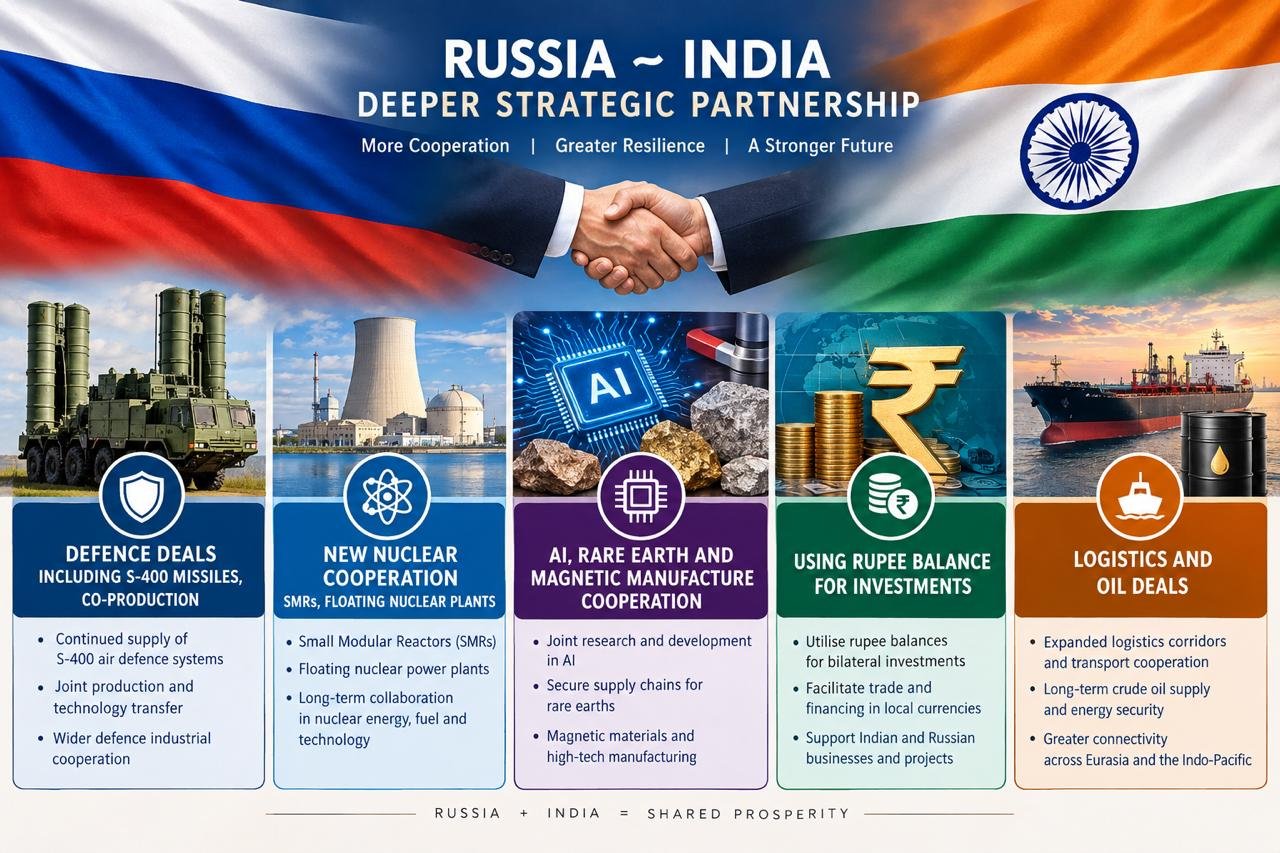
India and Russia are likely to discuss joint development of new Small Modular Reactors (SMRs) and a second Kudankulam-type nuclear power plant at another location in India, besides the status of delayed S-400 air defense system deliveries, possible joint production of the advanced Su-57 fighter aircraft, expansion of rupee-rouble settlements and the use of India’s rupee balances held in Russia for investment in India.
Top officials also told UNI that India may explore possible mining rights at Yakutia, near the Arctic Ocean, for Indian Rare Earths Limited (IREL), along with cooperation on the production of rare-earth magnets. Russia, meanwhile, wants to use part of its rupee balances accumulated from India’s purchases of Russian crude oil for joint ventures in defense, artificial intelligence and nuclear energy. Russian diplomats told UNI that with the development of the Chennai-Vladivostok maritime route, about eight Russian insurers are providing insurance and indemnity cover for vessels carrying crude oil and gas from Siberia.
They include Sogaz, Russia’s largest insurer, as well as Sber Insurance Group and AlfaStrakhovanie. The meeting between Prime Minister Narendra Modi and Russian President Vladimir Putin in New Delhi on Friday underlines the importance both countries continue to attach to their relationship. Russia remains important to India’s energy security and defense architecture and is still regarded in New Delhi as a historically “dependable and trusted friend.”
Moscow, too, needs India not simply as a major buyer of its oil but as one of the world’s largest economies and a potential gateway to the wider Asian market. While Kudankulam remains at the core of the nuclear partnership, the two countries have agreed in principle to establish a second large nuclear power plant in India, comprising six high-capacity VVER-1200 or VVER-TOI reactor units. Each reactor would generate about 1,200 megawatts, giving the plant a total capacity of 7,200 MW once completed.
“Technical studies on this are underway and may accelerate after the Modi-Putin meeting. The two nations have also started some initial work on Small Modular Reactors and floating nuclear power units,” an official said. Officials said Moscow has signaled a willingness to offer India access to some of its most advanced military technology, including possible cooperation in the joint production of the Su-57 fifth-generation fighter. “Such offers are designed not only to sustain a long-standing defense partnership but also to demonstrate that Western pressure has not eliminated Russia’s strategic relevance,” diplomats said.
India is also expected to raise the issue of delays in the delivery of S-400 air defense systems. Some deliveries may have been diverted by Russia towards the Ukrainian battlefield, officials said. Russian diplomats have assured New Delhi that India’s requirements will be prioritized, they added. On the logistics front, the two countries are committed to developing cooperation around both the Northern Sea Route and the Chennai-Vladivostok maritime corridor.
India and Russia are also believed to be broadly aligned on the exploration, processing, and technological cooperation in critical minerals, including lithium and rare-earth elements. “Russia is also considering giving India’s state-owned miner IREL access to the Tomtor rare-earth deposits in Yakutia,” officials said. Samples for preliminary analysis have already been exchanged, they added. If mining operations begin, the cooperation could subsequently extend to the joint manufacture of rare-earth magnets and the recycling of rare-earth materials.
The two sides are also considering technology transfer and deeper cooperation in developing artificial-intelligence models and toolkits. Russian companies such as Sber are positioning AI and cybersecurity as new growth areas in the bilateral relationship and are seeking joint research and development centers and sovereign IT platforms, including through the BRICS Cybersecurity Alliance. Indian diplomats said the Ukraine war would inevitably remain part of the Modi-Putin conversation, as would the conflict involving Iran and the wider Persian Gulf. For India, the security of the Strait of Hormuz is a major geopolitical concern.
Any prolonged disruption could threaten oil supplies, raise freight costs, fuel inflation, and put pressure on the rupee. Russia, although itself a major energy producer, also has a strong interest in keeping global energy markets functioning and commercial shipping through the strait free from attacks or coercion. (UNI)
Related posts:
 Putin’s Delhi Gambit: How a High-Stakes Visit Could Redraw India’s Geopolitical Map
 Ukraine-India Relations: Navigating Historical Ties and Russian Disinformation in a New Geopolitical Era
 The $500 Billion Gamble: Inside India and America’s Most Consequential Trade Fight
 Senate Advances Graham Bill Expanding Russia Sanctions and Tariff Powers
