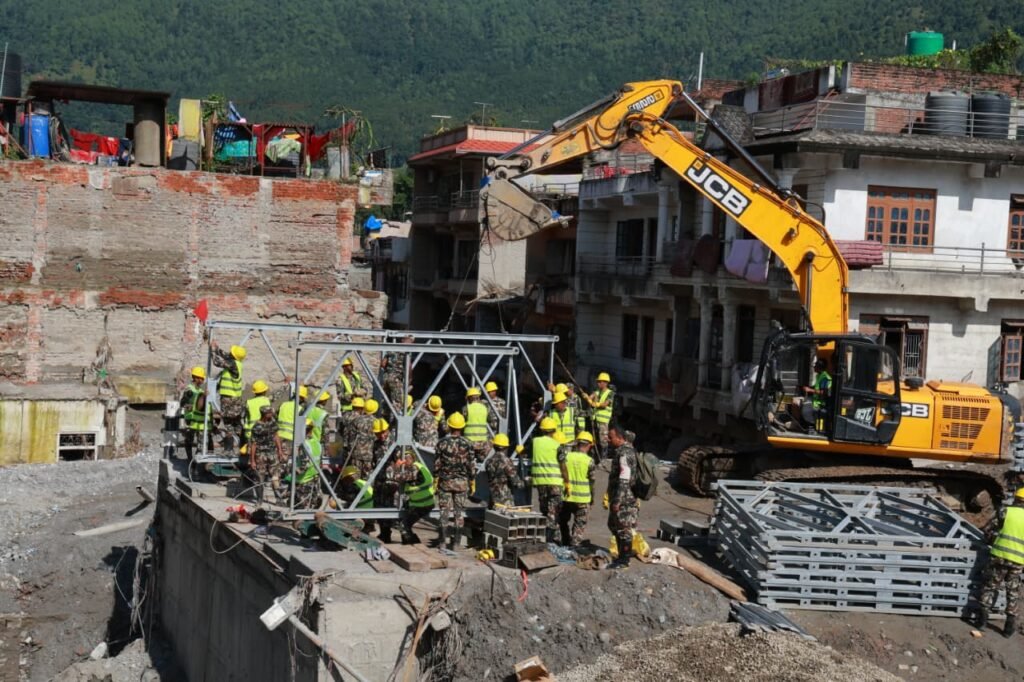
The Nepal government estimates that over NPR723.31 billion ($4.74 billion) will be needed to recover from the damages suffered in the wake of the devastating floods in the Bhotekoshi River area of Rasuwa on August 26.
The figure comes from a Rapid Damage and Needs Assessment prepared by a joint technical team from the National Planning Commission and the National Disaster Risk Reduction and Management Authority.
Of the total, NPR473.57 billion ($3.10 billion) is expected to be required to restore infrastructure, which accounts for about 75% of overall recovery needs.
Energy and transport infrastructure suffered the heaviest damage. The floods affected 13 hydropower projects with a combined capacity of 759MW and five solar plants with a total capacity of 24MW.
Advertisement
The assessment puts the cost of restoring the damaged energy infrastructure and power grid at NPR390.62 billion ($2.56 billion).
Roads and bridges were also badly hit. Around 69 km of roads were damaged, while 33 motorable bridges were washed away and another four suffered partial damage. Of the 64 suspension bridges in the affected areas, 53 were damaged.
The recovery of transport infrastructure is estimated to cost NPR73.34 billion ($480.33 million).
The floods also caused extensive damage to homes and other social infrastructure across Rasuwa, Nuwakot, Dhading, Gorkha and Chitwan.
A total of 7,570 private houses were damaged, along with 48 public buildings, 18 schools, seven health facilities and 30 cultural heritage sites. The government estimates that NPR103.55 billion ($678.19 million) will be needed to restore social infrastructure.
The productive sector, including businesses, banks and agriculture, will require a further NPR50.77 billion ($332.51 million). The floods affected 1,806 hectares of agricultural land, 17 bank branches and around 4,800 businesses.
Among the 15 affected local government units across the five districts, Bidur Municipality in Nuwakot recorded the highest number of damaged private homes, with 3,026 houses affected.
The assessment also estimates that NPR94.75 billion ($620.56 million) will be needed for disaster-risk reduction and river management, while NPR515.4 million ($3.38 million) will be required to clear and manage the mud and debris left by the floods.
The reconstruction programme has been divided into two phases.
For immediate relief and short-term reconstruction over the next six months, the government estimates that NPR8.74 billion ($57.24 million) will be needed. Long-term reconstruction is expected to cost NPR714.58 billion ($4.68 billion).
The assessment is the government’s initial estimate of the resources required to restore infrastructure, public services, economic activity and disaster-management systems in the areas affected by the August 26 floods.
The Prime Minister’s Disaster Relief Fund currently has a total balance of NPR12.433 billion ($81.43 million), according to the Office of the Prime Minister and Council of Ministers.
As of Thursday morning, NPR9.144 billion ($59.89 million) was held in nine banks, while another $21.638 million had been deposited in two other banks. The government said the combined value of the NPR and USD holdings brought the total available funds to NPR12.433 billion ($81.43 million).
The scale of the destruction has also prompted Nepal to seek international assistance, with Kathmandu framing its appeal for aid around “climate justice,” arguing that wealthier, high-emitting countries bear a historical responsibility for helping the more vulnerable nations cope with climate-related disasters.
Due to its lack of resources, Kathmandu is also seeking support from international institutions including the World Bank and Asian Development Bank, as well as donor countries and partners such as India, China, the US and the European Union.
The August 26 floods caused widespread destruction across northern and central Nepal after an ice, rock and mud surge swept downstream from the Himalayan border region. According to preliminary estimates, the total economic loss ranged between $4 billion and $7 billion.
The disaster also affected thousands of people, destroyed homes and damaged energy and transport networks. More than 5,000 people were reported missing, while hundreds of workers were believed to have been trapped inside flooded hydropower tunnels.
The Gyirong border port – a vital trade link between Nepal and China – was also severely damaged, while roads, bridges, water systems, schools and health facilities were affected across the disaster zone.