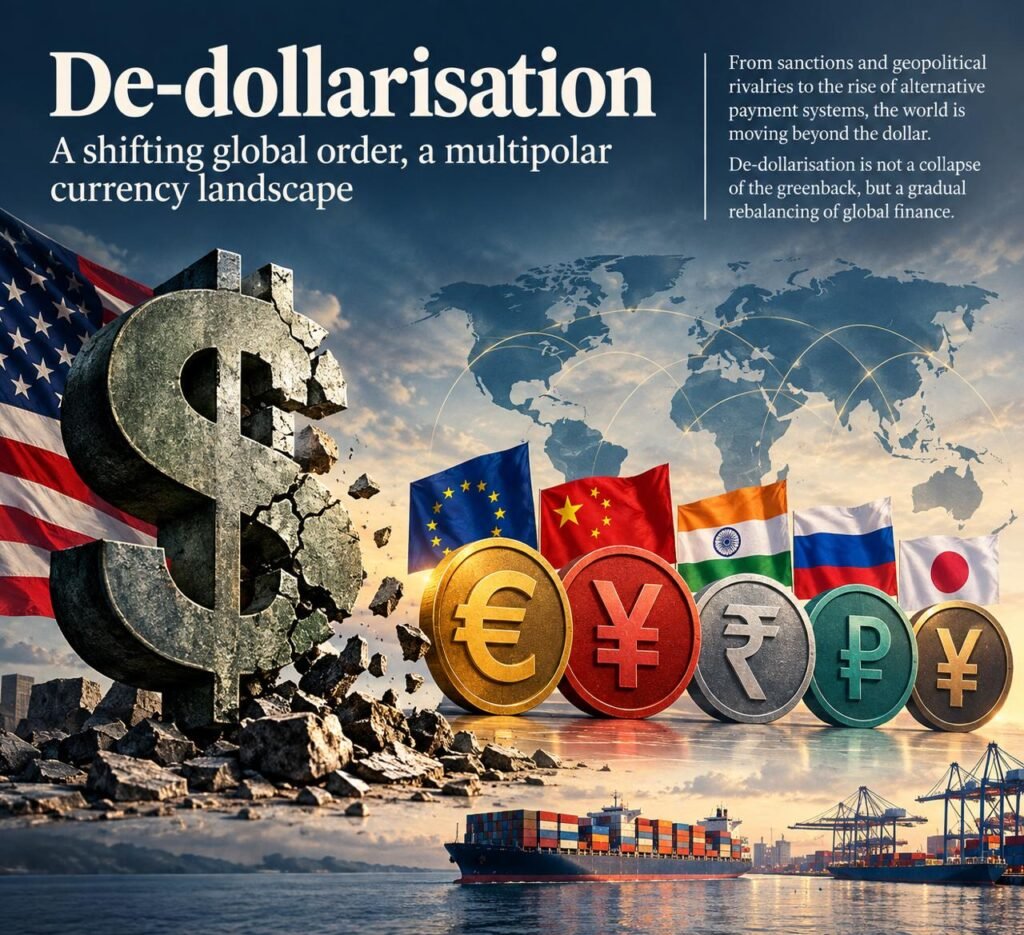
As the BRICS summit approaches, all eyes, from stock market players across the world to heads of powerful central banks, will be on any moves that may crop up during the meeting of leaders of these emerging economies, which are perceived to threaten the primacy of the US dollar in global trade and financial settlements.
De-dollarization as a process has come into focus despite its slow progress, mainly on account of statements by US President Donald Trump targeting the BRICS group of nations with a threat of being slapped with 100 per cent tariffs if they seek to replace the primacy of the dollar in global trade.
All ministers and officials concerned with managing the money and trade markets of Moscow, New Delhi, or Beijing have repeatedly insisted that none of the BRICS countries are in any way pursuing any form of ideological war against the dollar. However, the practical effect of their policies, to cushion trade from geopolitical risks, has certainly worked to chip away at the financial architecture that has underpinned the international order since the Second World War.
While de-dollarization may not be explicitly discussed at the BRICS summit slated for the end of this week, currency swaps and trade architecture are more than likely to figure in country-to-country negotiations on the sidelines of the conference. The leaders of the original members – India, Russia, China, Brazil, and South Africa – are expected to hold several significant bilateral talks among themselves and with the leaders of a number of other countries which have recently joined BRICS, such as Iran, Saudi Arabia, Egypt, Indonesia, UAE, and Ethiopia. Intra-BRICS trade was estimated to have been worth USD 1.17 trillion in 2024 and is believed to be growing at an annual average rate of 13 per cent. In terms of total exports, the share of BRICS stands at 24 per cent of the world’s.
Advertisement
The various moves by BRICS countries towards settling payments in national currencies, such as the Rupee-Rouble agreement between India and Russia, or China’s attempts to sell and buy in Yuan and not the dollar, which till recently denominated trade, have as yet failed to hasten any significant de-dollarization of international trade settlements. As of 2026, some 54 per cent of global invoicing and settlement of trade is dollar-denominated, and this has remained so for many years now. In fact, it has gone up from about 50 per cent in the year 2000.
However, while trade invoicing and settlements have held steady, the dollar’s share in foreign exchange reserves has been experiencing a gradual but definitive decline. In the year 2000, some 71 per cent of the total foreign exchange reserves of all countries were held in dollars. By 2026, this has come down to about 57 per cent, a drop of 14 per cent in a quarter of a century. “This is obviously a clear sign that central bankers in many countries are weighing in geopolitical risks with holding large stashes of dollars and spreading that risk by buying either other currencies or the ultimate safe haven, that is bullion,” said a member of the Reserve Bank of India’s monetary policy-making team, who did not wish to be named. That vote of no confidence has also now spread to keeping gold bullion by central banks in the US itself.
The Dutch central bank transferred some 86 tons of gold valued at over USD 10 billion from North America to London between March and August this year. Before this, in January 2026, France sold 129 tons of gold it had held in the US, or about 5 per cent of its reserves. With the money from the sale, France bought bullion in Europe and stored it in the vaults of its own central bank. This mirrors an action taken some 9 years back during President Trump’s first presidency when Germany’s Bundesbank transferred 300 tons of gold to its own vaults in Frankfurt. On Tuesday, Kremlin’s spokesperson Dmitry Peskov summed up what is happening, by claiming that while the BRICS was not in favor of any de-dollarization policy, member states, many of whom cannot settle in dollars because of sanctions, “are simply doing what better corresponds with our national interests,” adding that it was “American actions which have been undermining confidence in the dollar.”
Peskov pointed out that Russia’s answer to the problem of being increasingly isolated from Western financial markets because of sanctions imposed on it has been to build alternative payment channels. From India’s perspective, the problem is particularly complicated as New Delhi has simultaneously become one of the world’s largest buyers of Russian crude while seeking to preserve access to Western markets, technology and capital. This is where BRICS becomes more important. Though the grouping does not possess a single currency, a common central bank, or the institutional cohesion of the eurozone, it does allow trade between members to be settled in national currencies, as also currency swaps designated in national currencies.
These incremental changes allow national currencies to become more usable in bilateral and even some multilateral trade settlements, and with that, payment systems become more diversified. The fact that these transactions also fall outside the control of the existing Western-controlled financial settlement infrastructure is something which is deeply worrying for Washington.