Join WhatsApp Channel

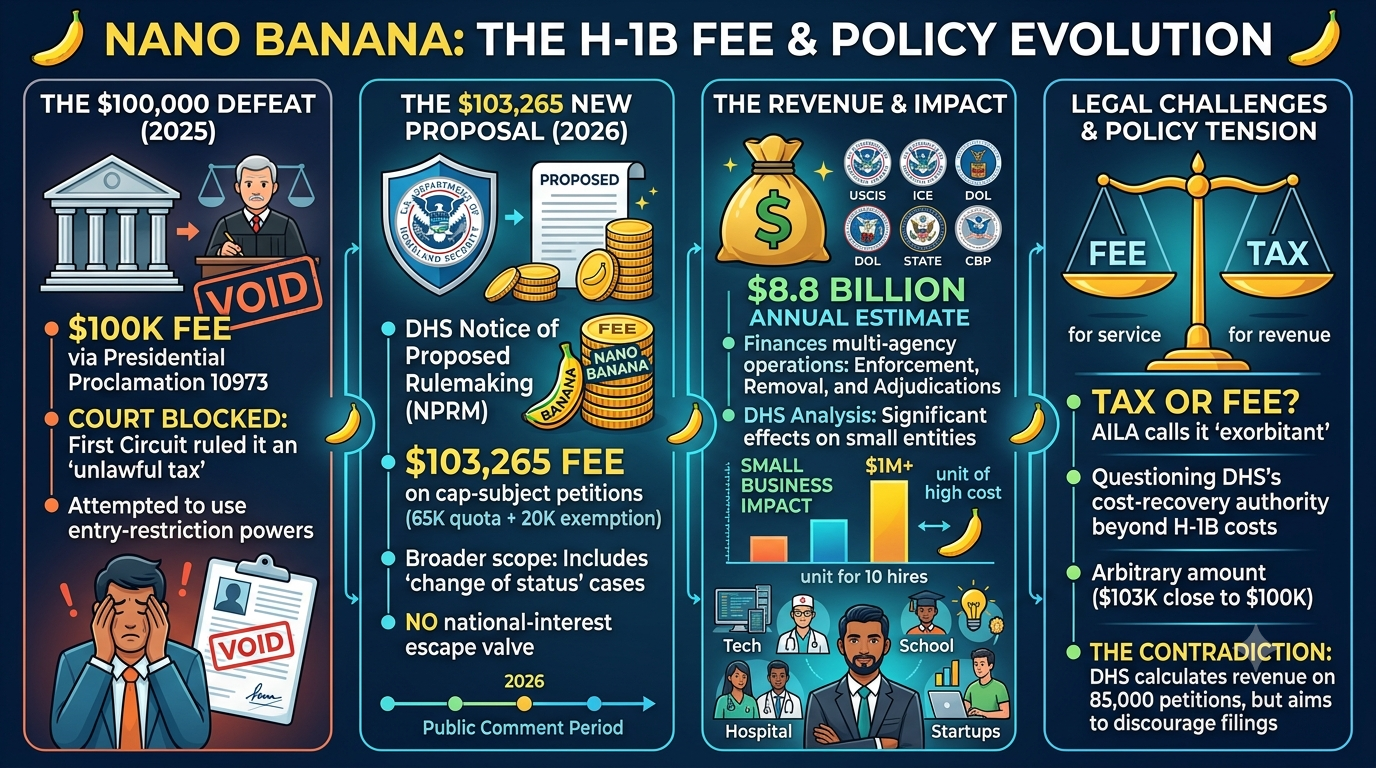
The Trump administration’s proposed $103, 265 fee on new H-1B petitions is not simply another increase in immigration costs. It is, more fundamentally, an attempt to recover through regulation what the administration was unable to impose through presidential action after a federal court struck down its earlier $100,000 H-1B charge.
On August 25, the Department of Homeland Security published a Notice of Proposed Rulemaking that would impose a $103, 265 fee on every cap-subject H-1B petition, including applications under the regular 65,000 annual quota and the 20,000 advanced-degree exemption. The proposal is not yet in force and will undergo a 30-day public comment period before DHS can issue a final rule.
But its timing is difficult to separate from the administration’s recent court defeat.
Just a month earlier, the First Circuit refused to allow the government to reinstate the approximately $100,000 fee created under President Donald Trump’s September 2025 Proclamation 10973. That measure had required a $100,000 payment for certain H-1B workers seeking entry into the United States from abroad, relying on the president’s authority under the Immigration and Nationality Act to suspend or restrict entry.
It was challenged almost immediately.
On June 8, Judge Leo T. Sorokin of the U.S. District Court in Massachusetts ruled that the $100,000 payment was, in substance, an unlawful tax rather than a permissible immigration restriction, and vacated the implementing policy. The First Circuit subsequently denied the government’s request for a stay on July 24, leaving the fee uncollectible while the appeal proceeds.
The administration’s answer has now been to try another route.
Rather than rely on presidential entry-restriction powers, DHS is seeking to impose virtually the same financial burden through formal notice-and-comment rulemaking and a far broader theory of immigration “cost recovery.” The legal architecture is materially different, and deliberately so.
The proposed $103,265 fee is based on DHS’s calculation that roughly $8.777 billion in immigration-system costs should be recovered from an estimated 85,000 annual cap-subject H-1B petitions. The result is a six-figure charge that would generate an estimated $8.8 billion annually.
That calculation, however, may also provide the blueprint for the next legal challenge.
Historically, immigration filing fees have been associated primarily with recovering the costs of administering immigration benefits and adjudications. The new proposal adopts a much broader approach, spreading the cost recovery across multiple agencies involved in the immigration system, including USCIS, immigration courts, Immigration and Customs Enforcement, the Department of Labor, the State Department and Customs and Border Protection.
Critics are likely to ask a central question: At what point does a government “fee” stop being payment for a service and become a tax or revenue-raising mechanism imposed on a narrow class of employers?
That question is particularly significant because the previous $100,000 charge failed precisely on the issue of legal authority. The federal court concluded that the administration could not use immigration entry powers as a substitute for Congress’s taxing authority. The new proposal seeks to avoid that problem by invoking statutory fee-setting and cost-recovery provisions and by following the formal regulatory process.
Yet changing the legal vehicle does not necessarily eliminate the underlying vulnerability.
Immigration attorneys and advocacy groups argue that the statute allowing DHS to recover immigration adjudication costs may not authorize the government to finance broad immigration enforcement, removal proceedings and other multi-agency operations by placing a $103,265 levy on employers filing H-1B petitions.
The American Immigration Lawyers Association has called the proposal “exorbitant.” Its president, Jeff Joseph, described it as an unprecedented attempt to fund immigration-related functions across federal agencies without specific congressional authorization. Other immigration lawyers expect litigation challenging both the scale of the fee and the government’s authority to allocate the revenue beyond the direct costs of adjudicating H-1B petitions.
The proposal is also broader than the $100,000 fee it effectively replaces.
The earlier proclamation was largely aimed at workers seeking to enter the United States from abroad and contained a discretionary national-interest exception. The new rule would apply generally to cap-subject H-1B petitions, including change-of-status cases involving workers already in the United States. It would also cover petitions under the advanced-degree exemption and, as proposed, contains no comparable national-interest escape valve.
In other words, while the administration is changing its legal strategy, it is potentially expanding the reach of the policy.
That could have far-reaching consequences for the H-1B ecosystem. Large technology companies may be able to absorb a six-figure charge for a limited number of highly specialized employees. But smaller technology firms, startups, hospitals, school systems, manufacturers and other employers may find the economics of sponsorship fundamentally altered.
DHS’s own analysis acknowledges that the proposal could have significant effects on many small entities. A company seeking to hire 10 new H-1B workers could face more than $1 million in additional government charges before salaries, legal costs and other expenses are considered.
The consequences could be particularly acute for Indian professionals, who make up the largest share of H-1B beneficiaries. The proposal could narrow the path from F-1 student status and Optional Practical Training into long-term U.S. employment, while forcing employers to reconsider whether certain positions should be filled through alternative visa categories, overseas hiring or expanded domestic recruitment.
Supporters of the administration’s approach would argue that this is precisely the point. DHS has said that making foreign hiring more expensive could discourage employers from choosing an H-1B worker over a qualified American employee unless the employer can demonstrate a genuine need for specialized foreign talent.
But the proposal also exposes a tension at the heart of the administration’s policy.
DHS is calculating its $8.8 billion annual revenue estimate on the assumption that approximately 85,000 cap-subject petitions will continue to generate the fee. At the same time, the administration is explicitly pursuing a policy intended to make employers less likely to file those petitions. Critics are likely to argue that the government cannot simultaneously justify the rule as cost recovery while acknowledging that its practical purpose is to suppress use of the program.
That contradiction may become important if, as widely expected, the proposal reaches the courts.
The legal battle is likely to shift from the question of whether a president can impose a six-figure immigration payment through an entry restriction to whether DHS can use its fee-setting authority to collect nearly $9 billion from H-1B employers and distribute much of it across the wider immigration bureaucracy.
That is a stronger procedural position than the administration had under the presidential proclamation. Formal rulemaking gives DHS an opportunity to build an evidentiary record, solicit comments and explain its methodology, making the regulation procedurally more difficult to challenge than a unilateral executive directive.
But it also opens the administration to a different level of scrutiny.
Commenters and eventual litigants are likely to challenge whether the cost allocation bears a sufficient relationship to the services provided to H-1B petitioners, whether the $103,265 amount is arbitrary and whether the agency has exceeded the authority Congress gave it. The fact that the new figure is strikingly close to the $100,000 charge already blocked by the courts will almost certainly become part of that argument.
As immigration law firm PSBP Law noted in its analysis of the proposed rule, the administration appears to be seeking “essentially the same money through a different legal door,” using a broader cost-recovery theory after the presidential proclamation route was blocked.
The proposal therefore represents more than an isolated change in the H-1B fee schedule. It signals a potentially important evolution in the Trump administration’s immigration strategy: when one mechanism is struck down, pursue the same policy objective through a different statutory and administrative framework.
For employers, however, the immediate reality has not changed. The earlier $100,000 fee remains judicially blocked, while the new $103,265 charge is only a proposed rule. Comments will be accepted for 30 days following its Federal Register publication, and the final regulation could still alter the amount, scope or exemptions.
Still, the direction of travel is clear.
The Trump administration wants a six-figure price attached to the H-1B program. Having lost its first attempt in court, it is now testing whether a more formal regulatory process and a broader definition of cost recovery can accomplish what presidential action could not. The next chapter may therefore be written not in the Federal Register, but once again in federal court.