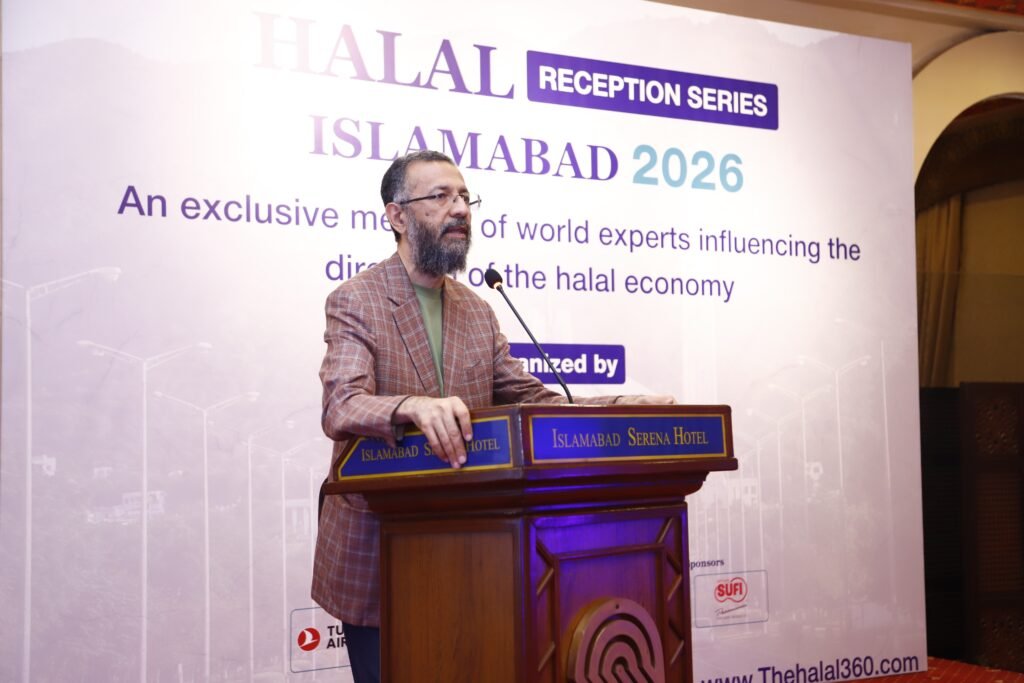
Pakistan is well positioned to strengthen its role in the global halal economy, according to Yousef Hassan Khalawi, secretary-general of the Islamic Chamber of Commerce and Development.
Speaking during a visit to Islamabad, Khalawi said the country’s “agricultural base, manufacturing capability, entrepreneurial talent, growing Islamic-finance sector and commercial links” with Gulf countries and other Organization of Islamic Cooperation markets provide a strong foundation for increased halal exports and investment.
Khalawi met with Federal Minister for Finance and Revenue Senator Muhammad Aurangzeb to discuss strengthening connections between Pakistani businesses and international markets through ICCD’s global networks. The two explored opportunities in “halal food, fashion, tourism, services and consumer markets,” as well as collaboration to expand Pakistan’s Islamic finance ecosystem and develop commercially viable partnerships, according to Menara Global.
“Pakistan has the scale, talent and productive capacity to become a more significant supplier to the global halal economy,” Khalawi said. “Pakistan has taken important steps toward a more Shariah-compliant financial system, including its post-2027 strategy and the development of new sovereign sukuk instruments. The opportunity rests in building on those foundations by helping businesses reach international buyers, meet recognized halal standards and create commercial partnerships needed to support trade and investment.”
Advertisement
His visit comes as Pakistan advances its transition toward Shariah-compliant public finance. Under the government’s post-2027 strategy, new domestic government borrowing and financial transactions would be conducted through Shariah-compliant structures beginning January 1, 2028. Existing conventional obligations would continue under their contractual terms until maturity.
Pakistan is also developing infrastructure to support a deeper Islamic capital market. In July 2026, the government introduced short-term sovereign hybrid sukuk with three- and six-month tenors. According to the Pakistan Stock Exchange, the inaugural issuance raised PKR239.3 billion, or approximately $862 million.
The broader market opportunity is substantial. According to the State of the Global Islamic Economy Report 2024/25, Muslim consumer spending across halal food, pharmaceuticals, cosmetics, modest fashion, travel and media reached PKR675 trillion, or $2.43 trillion, in 2023. That figure is projected to reach PKR933 trillion, or $3.36 trillion, by 2028. The report also ranked Pakistan among the top 10 countries in its Global Islamic Economy Indicator for the first time.
Pakistan is also making progress in Islamic banking. According to the State Bank of Pakistan’s Islamic Banking report, Islamic banking institutions held PKR14.659 trillion, or approximately $52.8 billion, in assets and PKR11.299 trillion, or about $40.7 billion, in deposits at the end of March 2026.
The country’s export potential is also evident in the livestock and halal meat sectors. In July, Pakistan’s Ministry of National Food Security and Research invited Chinese investors to establish high-tech slaughterhouses and modern meat-processing facilities equipped with cold-chain and traceability systems. Both sides agreed to expand technical collaboration and facilitate business-to-business partnerships aimed at increasing meat exports to China.
The Islamabad Halal Reception, organized by Halal 360 at Serena Hotel Islamabad on August 22, brought together representatives from the business, finance, trade, investment and development sectors. Participants considered practical measures to increase Pakistan’s involvement in halal economy value chains, with discussions covering market access, halal certification, food security, logistics, pharmaceuticals, technology, Islamic finance and investment.
Khalawi’s visit also highlighted Pakistan’s central role within ICCD’s 57-country OIC network. Headquartered in Karachi, ICCD works with chambers of commerce, business associations, governments and investors to strengthen intra-OIC trade, enterprise development, investment and cross-border commercial ties.