Join WhatsApp Channel

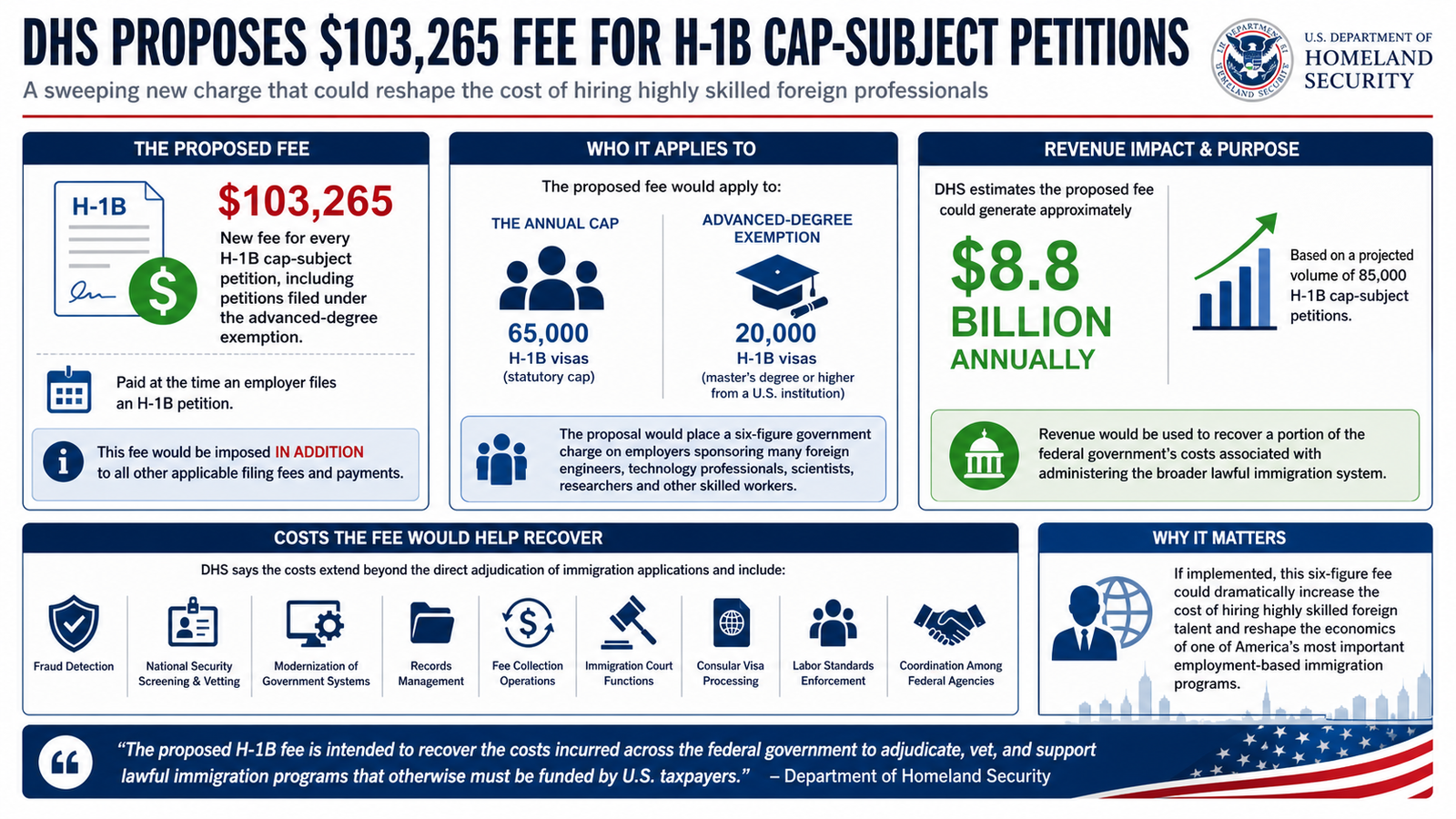
The Department of Homeland Security has proposed a sweeping new fee of $103,265 for every H-1B cap-subject petition, including petitions filed under the advanced-degree exemption, a move that could dramatically raise the cost of hiring highly skilled foreign professionals and reshape the economics of one of America’s most important employment-based immigration programs.
The proposed charge would be paid at the time an employer files an H-1B petition and would be imposed in addition to all other applicable filing fees and payments, according to details of the proposal.
If implemented, the fee would apply to the annual pool of H-1B petitions subject to the statutory cap of 65,000 visas, along with the additional 20,000 visas reserved for foreign nationals who have earned a master’s degree or higher from a U.S. institution of higher education.
The proposal would therefore place a six-figure government charge on employers seeking to sponsor many of the foreign engineers, technology professionals, scientists, researchers and other skilled workers who compete each year for a place in the H-1B system.
DHS estimates that the proposed fee could generate approximately $8.8 billion annually, based on a projected volume of 85,000 H-1B cap-subject petitions.
The department said the revenue would be used to recover a portion of the federal government’s costs associated with administering the broader lawful immigration system.
Those costs, DHS said, extend beyond the direct adjudication of immigration applications and include fraud detection, national security screening and vetting, modernization of government systems, records management, fee collection operations, immigration court functions, consular visa processing, labor standards enforcement and coordination among federal agencies.
“The proposed H-1B fee is intended to recover the costs incurred across the federal government to adjudicate, vet, and support lawful immigration programs that otherwise must be funded by taxpayers,” U.S. Citizenship and Immigration Services spokesperson Zach Kahler said.
The proposal marks a potentially significant change in the financing of the H-1B program, which has long relied on a combination of filing fees and statutory charges paid primarily by sponsoring employers. A fee of $103,265, however, would represent a dramatic escalation in the cost of participating in the cap-subject program.
For large technology companies and multinational corporations, the increase could substantially raise annual immigration costs, particularly for firms filing large numbers of petitions. For startups, smaller businesses, hospitals and other employers with limited resources, the proposed fee could prove even more consequential, potentially forcing companies to reconsider whether sponsoring an overseas professional is financially viable.
The impact could also extend beyond employers to the international workforce that has historically relied on the H-1B route to build careers in the United States.
Indian nationals, who have traditionally accounted for a substantial share of H-1B beneficiaries, could be among the groups most closely affected by any major change to the economics of the program. The H-1B visa has been a principal pathway for thousands of Indian technology professionals and other skilled workers seeking employment in the United States and, in many cases, eventual permanent residence.
A sharply higher petition cost could encourage employers to become more selective about which positions they are willing to sponsor. Companies may reserve H-1B sponsorship for workers in the highest-paid or most specialized roles, while entry-level professionals and recent graduates could face a more difficult path to securing employer backing.
The proposed charge could also have implications for international students graduating from U.S. universities. Many students use Optional Practical Training as an initial bridge into the American labor market before seeking H-1B sponsorship. A six-figure additional government fee could alter employers’ calculations when deciding whether to continue sponsoring such workers after their temporary work authorization expires.
Not all H-1B employers, however, would be subject to the proposed new fee.
DHS said the additional charge would not apply to H-1B petitions that are exempt from the annual cap. These generally include petitions filed by certain institutions of higher education, affiliated nonprofit entities, nonprofit research organizations and governmental research organizations.
The distinction could create an increasingly sharp divide between cap-subject and cap-exempt employment, potentially making universities and qualifying research institutions comparatively more attractive destinations for some foreign professionals.
The H-1B program currently operates under a numerical ceiling established by Congress. Each fiscal year, up to 65,000 new cap-subject H-1B visas or grants of status are generally available, supplemented by 20,000 additional numbers under the advanced-degree exemption for individuals who have earned qualifying master’s or higher degrees from U.S. institutions.
Demand for those visas has frequently exceeded the available supply, resulting in a registration and selection process administered by USCIS.
The proposed fee introduces a new and potentially controversial dimension to that system: the cost of access. While the statutory cap would remain unchanged, employers could face a vastly higher financial threshold before a selected worker could proceed through the petition process.
Supporters of the proposal could argue that employers benefiting from access to the skilled immigration system should bear a greater share of the government costs associated with administering, securing and supporting that system. DHS has framed the proposed charge as a cost-recovery mechanism designed to shift some of the financial burden away from taxpayers.
Critics, however, are likely to question whether a fee of more than $100,000 per petition could distort the skilled-labor market, disadvantage smaller American businesses and reduce the United States’ ability to compete globally for talent.
The proposal also raises broader questions about whether the H-1B system, originally designed as a mechanism to help employers fill specialized positions, could become increasingly accessible only to companies with the financial capacity to absorb exceptionally high immigration costs.
For the Indian and broader South Asian professional diaspora, the stakes could be particularly high. The H-1B visa is not merely a temporary work permit for many families; it is often the first stage in a longer and increasingly complicated immigration journey that can include employer-sponsored green card applications and years of waiting in employment-based visa backlogs.
Any change that makes the initial H-1B petition substantially more expensive could therefore have consequences extending far beyond a single filing cycle.
DHS’s proposal is still subject to the federal rulemaking process and would have to move through the applicable procedures before taking effect. Employers, immigration attorneys, technology companies, universities and advocacy organizations are expected to scrutinize the proposal closely and could seek to influence its final form during the public-comment process.
For now, the proposed $103,265 charge represents one of the most consequential potential changes to the cost structure of the H-1B program in years — and signals a broader effort by the federal government to require users of the legal immigration system to absorb a larger share of the costs associated with its administration.
If adopted in its current form, the proposal could fundamentally alter the calculation behind an H-1B sponsorship, transforming what has traditionally been an immigration filing expense into a major financial commitment and potentially reshaping who can afford to compete for America’s limited supply of high-skilled work visas.