Even as U.S. President Donald Trump’s administration moves to tighten immigration through stricter visa screening, expanded travel restrictions and tougher scrutiny of foreign students and skilled workers, South Asians continued to seek entry to the United States in large numbers, with India overwhelmingly dominating visa issuances across almost every major category.
Newly released U.S. State Department data for September 2025 show that India remained the region’s largest source of visitors, students, professionals and business travelers to the United States, underscoring the depth of economic, educational and family ties that continue to bind the two countries despite an increasingly restrictive immigration environment.
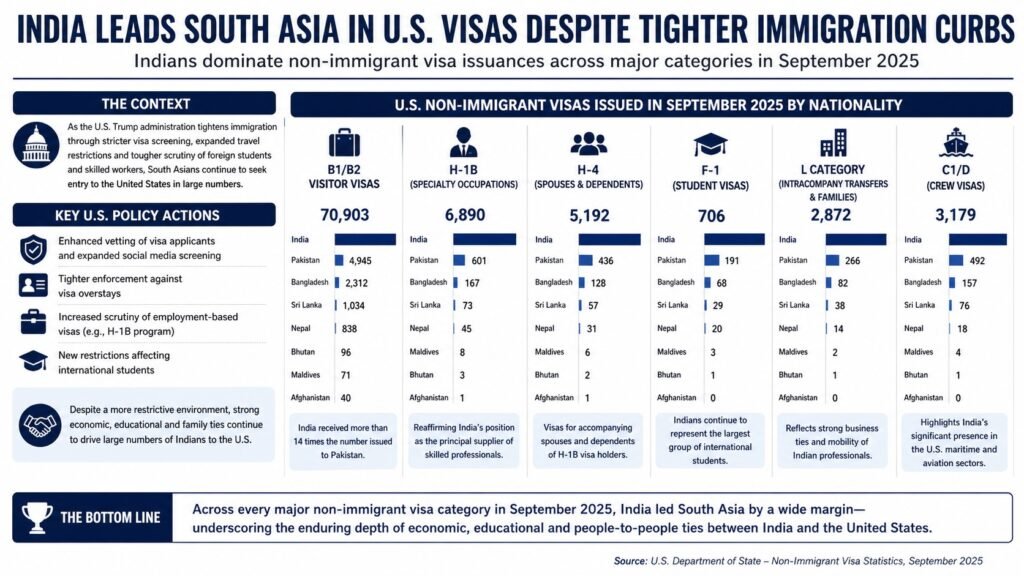
The figures come as the Trump administration has stepped up efforts to curb both legal and illegal immigration, including enhanced vetting of visa applicants, expanded social media screening, tighter enforcement against visa overstays, increased scrutiny of employment-based visas such as the H-1B program and new restrictions affecting international students. The measures have sparked concerns among universities, technology companies and immigrant communities that obtaining U.S. visas could become more difficult even for legitimate travelers and skilled professionals.
Against this backdrop, India accounted for by far the largest share of U.S. non-immigrant visas issued in South Asia.
Advertisement
Indian nationals received 70,903 B1/B2 visitor visas in September 2025, more than 14 times the number issued to Pakistan, the region’s second-largest recipient. Indians also secured 6,890 H-1B visas for specialty occupations, 5,192 H-4 visas for accompanying spouses and dependents, 706 F-1 student visas and 2,872 L-category visas for intracompany transfers and their families, reaffirming India’s position as the principal supplier of skilled professionals to the U.S. economy. The country also recorded 3,179 C1/D crew visas, reflecting its significant presence in global aviation and maritime industries.
While India dominated every major employment and travel category, other South Asian countries continued to register steady demand despite the uncertain policy climate.
Pakistan received 4,826 B1/B2 visitor visas during the month, along with 109 F-1 student visas, 93 H-1B visas and 95 H-4 dependent visas. The figures suggest that family reunification, higher education and skilled migration remain important drivers of Pakistan-U.S. mobility despite tighter immigration controls.
Bangladesh was issued 1,541 visitor visas, 78 F-1 student visas and 16 H-1B visas. A notable feature of the data was the issuance of 141 F-2 visas for dependents of international students, indicating continued family-based educational migration. Nepal received 1,020 B1/B2 visas, 31 H-1B visas and 28 F-1 student visas, while also recording 14 G4 visas for employees of international organizations.
Sri Lanka’s non-immigrant visa volumes were more modest, although the country continued to record travel across visitor and employment categories. Bhutan and the Maldives saw relatively limited movement, receiving 23 and 15 B1/B2 visitor visas respectively, reflecting their smaller populations and lower migration volumes.
The employment-based figures underscore India’s continued dominance in supplying skilled workers to the United States. Indian nationals accounted for the overwhelming majority of H-1B visas issued in South Asia, receiving nearly 74 times as many approvals as Bangladesh and more than double the combined total of Pakistan, Nepal and Bangladesh.
Corporate mobility also remained concentrated in India. Indian executives and professionals obtained 1,390 L-1 visas for intracompany transfers, while 1,482 L-2 visas were issued to accompanying family members, highlighting the extensive operations of Indian multinational companies and global technology firms.
Educational mobility, though seasonally lower than during the May-August admissions period, also remained robust. India received 706 F-1 student visas, followed by Pakistan (109), Bangladesh (78) and Nepal (28), reinforcing South Asia’s status as one of the largest source regions for international students in the United States.
On the immigrant visa side, Sri Lanka continued to record steady permanent migration, with the U.S. Embassy in Colombo issuing 102 Diversity Visas, 22 F4 family-preference visas for siblings of U.S. citizens and 22 IR5 visas for parents of American citizens during the month.
The September statistics provide only a snapshot of visas issued and do not reflect applications, refusal rates or future demand. However, they illustrate that despite increasingly restrictive U.S. immigration policies, South Asia—and India in particular—remains a critical source of visitors, international students, skilled professionals and business travelers.
Immigration experts say the coming months will determine whether the Trump administration’s tighter visa regime translates into a sustained decline in issuances. For South Asia, where remittances, higher education and technology-sector employment have long been linked to access to the United States, any prolonged tightening of legal immigration pathways could have significant economic and social consequences extending well beyond the region’s borders.