Join WhatsApp Channel


On July 18, the Combatting Hate Act (Bill C-9) will come into force, having received Royal Assent a month earlier. This law is an important step in the fight against hate, and as a testament to what the Hindu community achieved in helping shape this legislation for the better, while recognizing that its effectiveness will, ultimately, depend on how it is interpreted and enforced.
When the bill was first introduced, it aimed to strengthen Canada’s response to hate. But in one crucial respect, it risked repeating a harm that Hindu, Jain, Buddhist, Indigenous, and other communities have endured for generations: the false conflation of the sacred Swastika with the Nazi hate symbol, the Hakenkreuz.
CoHNA sounded the alarm early and helped lead a coordinated national response. Working alongside other Hindu organizations, as well as with Jewish, Buddhist, Jain, and Indigenous partners, CoHNA mobilized communities across the country, developed policy briefs and educational material, engaged lawmakers, and helped drive nearly 9,000 emails to Members of Parliament and Senators from every province and major city in the country.
That massive advocacy effort bore fruit.
On December 9, 2025, the House of Commons Justice Committee adopted MP Anthony Housefather’s amendment: it removed the word “Swastika” from Bill C-9’s reference to the Nazi emblem; and replaced it with the historically accurate term “Nazi Hakenkreuz.”
This was a major legislative victory with potential for significant downstream change. With Canada’s federal criminal law now distinguishing between one of the oldest sacred symbols in human history and the emblem of a genocidal Nazi regime that appropriated and distorted it, other governments and institutions across the country will have a template to follow.
The win also marked the coming of age of Dharmic grassroots advocacy in Canada. CoHNA helped bring together community organizations, temples, legal experts, volunteers, and interfaith allies behind a clear and consistent ask: fight hate with precision, not with language that creates new harms in the name of preventing old ones.
Beyond this correction, the Act makes several other changes worth examining on their own terms.
What does the Combatting Hate Act do?
The Act amends the Criminal Code to 1) strengthen hate crime laws and 2) protect access to places used by any identifiable community such as a Hindu temple or a Jewish school.
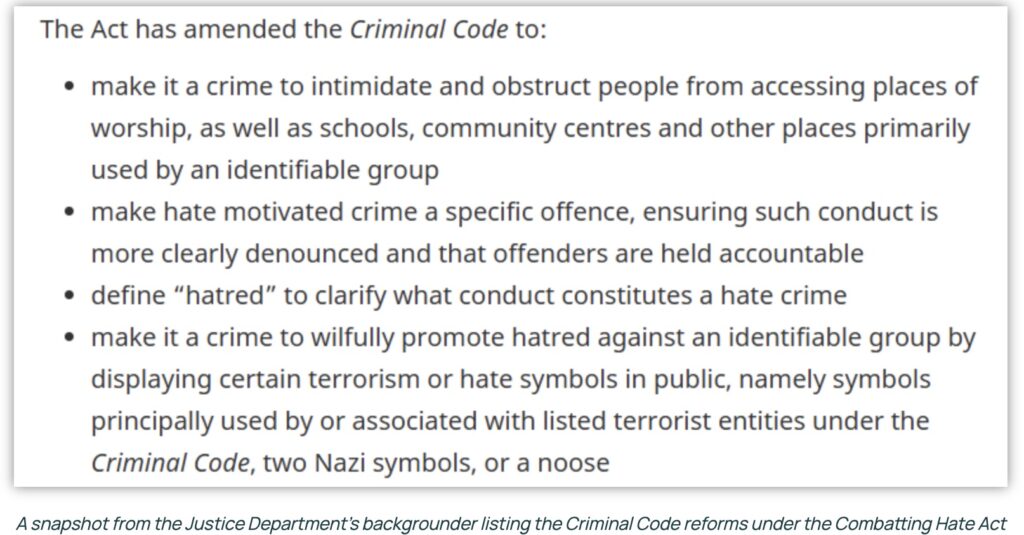
The Act also repeals the specific “good-faith religious opinion” defense for certain hate-propaganda offences, while clarifying that religious expression that does not willfully promote hatred remains protected.
What Do the New Protections Mean for Hindu Canadians?
For the Hindu community which has been contending with intimidation and violence outside its temples and community spaces, the new protections offered by C-9 could potentially be a gamechanger. Specifically, intimidating or deliberately obstructing people seeking access to a protected place, now carries standalone criminal consequences, rather than requiring the authorities to rely only on general provisions that may fail to capture the underlying motive.
This is not a small thing for a community that has often struggled to make the case that these incidents are, indeed, often motivated by anti-Hindu hate. Of course, the actual impact of this provision will depend on how narrowly or broadly its carve-outs are read. For example, Khalistani protesters who routinely demonstrate in front of Hindu temples, and sometimes violently so, may invoke the ‘communicating information’ exception to avoid liability. Notably, this exception applies only to the obstruction offence, not to the separate offence of intimidating people in order to prevent them from accessing a protected site. In effect, how and where the line is drawn between peaceful demonstration and targeted intimidation will be shaped heavily by local police, Crown prosecutors, and eventual caselaw.
The new law also defines what is hatred (“an emotion of an intense and extreme nature that is clearly associated with vilification and detestation”) and what is not hatred (“acts that solely humiliate, discredit, hurt or offend”). This definition seeks to balance free speech obligations against anti-hate crimes measures, and also offers more statutory clarity which may help law-enforcement officials assess potential hate crimes. However, major prosecutions under the new hate-crime offence are likely to generate Charter arguments about where the definition begins and ends.
Enforcement Remains the Real Variable.
It can be argued that, even before C-9, Canada already had legal tools to address hate crimes such as Sections 318 and 319. However, what can be said with greater certainty is that the institutional willingness to use those tools has been frequently questioned.
The 2023 controversy involving Montreal preacher Adil Charkaoui—whose remarks at a pro-Palestinian demonstration were denounced by then Prime Minister Justin Trudeau and then Quebec Premier François Legault but, ultimately, did not result in hate-speech charges—showed the gap that can arise between public expectations, legal thresholds, and enforcement decisions. This new law is unlikely to close that gap on its own.
Overall, it is helpful to keep in mind that while the new law is well-intentioned, it needs to be well-enforced and implemented—and this is something that the Hindu community and its advocates must monitor closely. It also reinforces the need for continued vigilance and advocacy.
Disclaimer: The opinions and views expressed in this article/column are those of the author(s) and do not necessarily reflect the views or positions of South Asian Herald.
Related posts:
 Over 70 Faith Organizations Urge Canada to Correct Misuse of “Swastika” in Hate Crime Bill
 CoHNA Capitol Hill Advocacy Draws Bipartisan Support
 CoHNA Hosts 4th Annual Hindu Day of Advocacy at U.S. Capitol, Highlights Rising Hindu American Voice
 Mississauga Becomes Second Canadian City to Condemn Anti-Hindu Hate, CoHNA Welcomes Historic Resolution