 Join WhatsApp Channel

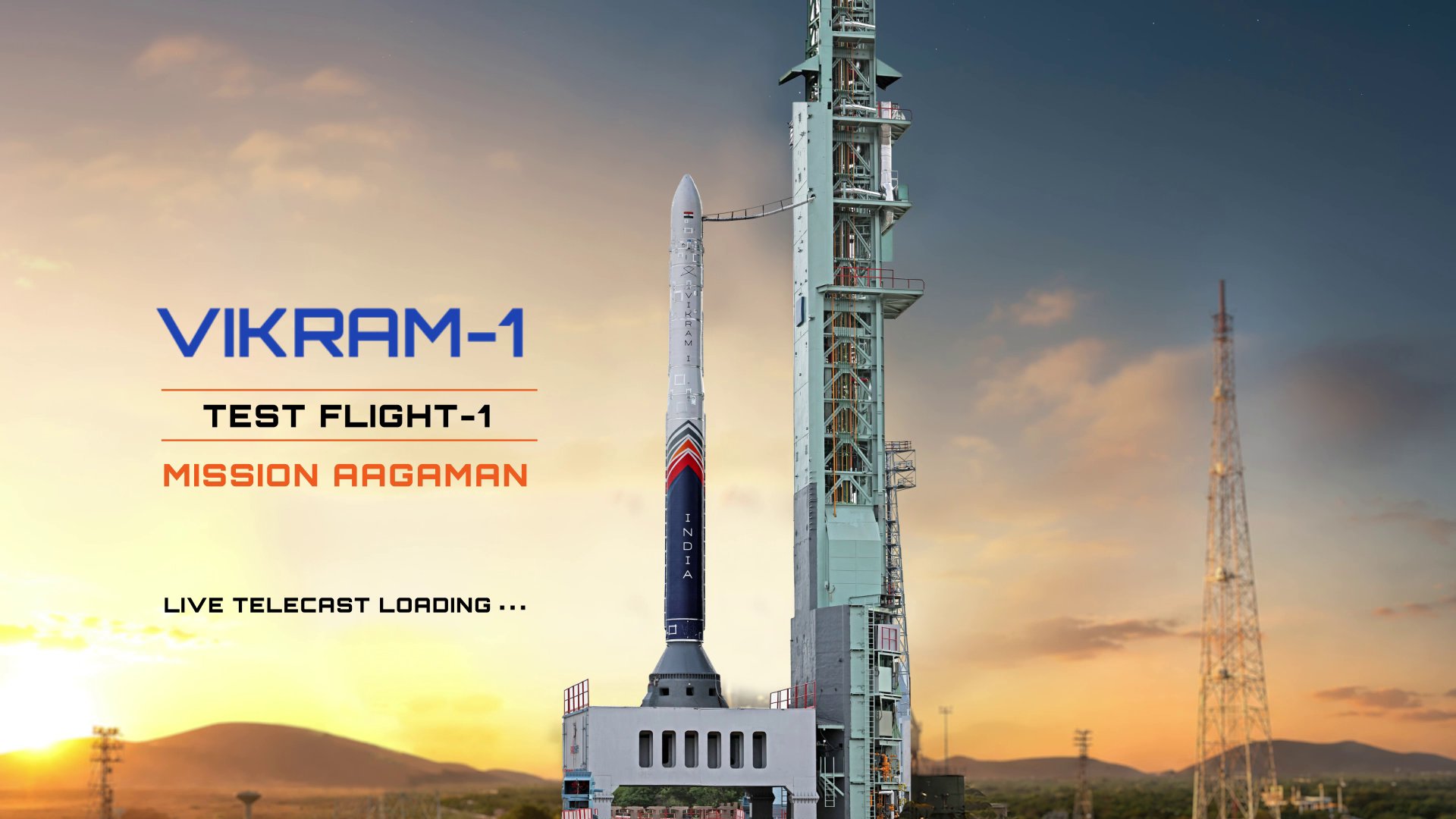
India’s commercial space ambitions reached a historic milestone on Saturday as Hyderabad-based Skyroot Aerospace successfully launched Vikram-1, the country’s first privately developed orbital rocket, marking the arrival of India’s private sector in the global launch business and opening a new chapter in the nation’s space program.
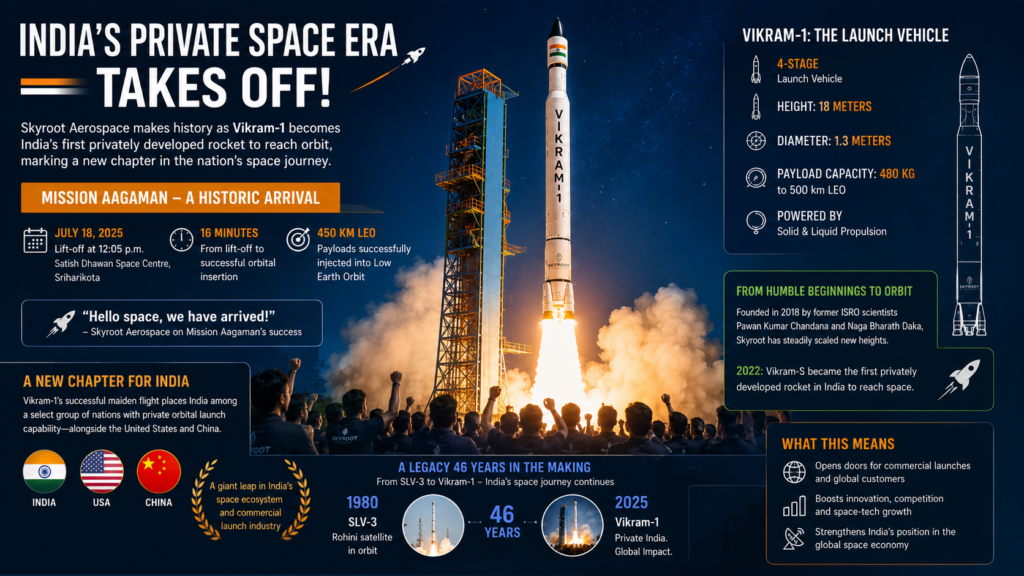
The four-stage launch vehicle lifted off from the Satish Dhawan Space Centre in Sriharikota at 12:05 p.m., following a brief planned hold in the countdown, and completed its nearly 16-minute maiden mission by successfully injecting its payloads into the targeted 450-km Low Earth Orbit. The successful mission validated the rocket’s propulsion, navigation, stage separation and orbital insertion systems, establishing Skyroot as the first Indian private company to place a rocket into orbit.
As mission controllers confirmed orbital insertion, the launch control room erupted in applause while Skyroot declared on social media: “Hello space, we have arrived!”—a message that perfectly captured the significance of Mission Aagaman, whose Sanskrit name translates to “arrival.”
The achievement places India among a select group of nations where private companies have independently demonstrated orbital launch capability, alongside the United States and China, and marks perhaps the biggest transformation in India’s space ecosystem since the government opened the sector to private participation through sweeping policy reforms.
The success also comes exactly 46 years after ISRO’s SLV-3 placed the Rohini satellite into orbit on July 18, 1980, making India the sixth nation capable of launching satellites independently. While SLV-3 established India’s sovereign access to space, Vikram-1 signals the emergence of a commercially competitive private launch industry capable of serving global customers.
Founded in 2018 by former ISRO scientists Pawan Kumar Chandana and Naga Bharath Daka, Skyroot had already made history in 2022 when its Vikram-S became the first privately built Indian rocket to reach space on a suborbital flight. Mission Aagaman now takes that achievement a decisive step further by demonstrating orbital capability.
The successful mission validates a launch vehicle that represents years of indigenous engineering. Standing about 22 meters tall and built almost entirely with lightweight carbon-composite materials, Vikram-1 incorporates several advanced technologies, including in-house developed propulsion systems, high-thrust solid-fuel stages and 3D-printed rocket engines. The restartable liquid-powered Raman upper stage enables precise orbital insertion, giving the rocket the flexibility needed for dedicated small satellite missions. Designed for the rapidly growing small-satellite market, Vikram-1 can carry payloads weighing up to 350 kilograms into Low Earth Orbit and about 260 kilograms into Sun-Synchronous Polar Orbit.
The maiden flight carried a combination of commercial, technology demonstration and symbolic payloads from Indian and international customers, including satellites and experimental technologies from Grahaa Space, Cosmoserve, Germany’s DCubed GmbH and Skyroot’s own SCOPE payload. It also transported commemorative items such as “Cosmic Bloom”, a diamond artwork by Cosmos Diamonds, and micro-sculptures honoring Indian scientific pioneers C.V. Raman, Vikram Sarabhai and A.P.J. Abdul Kalam.
Adding a symbolic touch, Prime Minister Narendra Modi sent a handwritten postcard bearing the words “Vande Mataram”, which travelled aboard the rocket along with hundreds of messages from Skyroot employees and supporters. Before the launch, Modi had described Mission Aagaman as “a historic new frontier” for India’s space journey, saying it reflected the talent, determination and entrepreneurial spirit of India’s youth and demonstrated how recent space-sector reforms were creating new opportunities for innovation and enterprise. Following the successful mission, the Prime Minister personally telephoned Skyroot’s founders to congratulate them, calling the achievement particularly significant as the nation commemorates the 150th anniversary of Vande Mataram.
Beyond its engineering success, Mission Aagaman is widely viewed as a validation of India’s policy reforms. Since 2020, the establishment of the Indian National Space Promotion and Authorization Centre (IN-SPACe) and the Indian Space Policy 2023 has fundamentally reshaped the sector by allowing private companies to build rockets, launch satellites and access ISRO’s infrastructure through a single-window regulatory framework. The reforms repositioned ISRO towards research and strategic missions while enabling startups to undertake commercial launch activities.
The launch also strengthens India’s ambitions to become a major player in the global commercial space economy. The government aims to expand the country’s space economy from an estimated $8-10 billion today to around $44 billion by 2033, with private industry expected to drive much of that growth. Dedicated launch services for small satellites are increasingly in demand worldwide as governments, universities and companies deploy constellations for communications, Earth observation, climate monitoring and defense applications. Vikram-1 is specifically designed to serve this rapidly expanding market by offering responsive, on-demand launches that complement, rather than compete directly with, larger launch vehicles such as SpaceX’s Falcon 9.
Industry observers say the mission could prove transformative for India’s private space ecosystem. Success is expected to boost investor confidence, attract international customers and accelerate the country’s emergence as a competitive launch hub for Asia, Africa, the Middle East and other regions seeking affordable alternatives for small satellite deployment. Analysts also see strategic implications, with a robust domestic launch industry enhancing India’s technological self-reliance while strengthening its position in the increasingly competitive Indo-Pacific space landscape.
For Skyroot, Mission Aagaman marks the beginning rather than the culmination of its ambitions. The company plans to begin commercial operations after further validation flights, scale production to support more frequent launches and develop larger members of the Vikram family capable of carrying heavier payloads into orbit.
For India, however, Saturday’s success will be remembered as the day the country’s private space industry crossed a historic threshold. Four decades after ISRO proved that India could independently reach orbit, Skyroot has demonstrated that Indian private enterprise can do the same—ushering in a new era in which commercial innovation stands alongside government capability in shaping the nation’s future in space.
Related posts:
 India’s First Human Spaceflight Mission Gathers Pace
 ISRO’s LVM3 Sets New Heavy-Lift Benchmark with BlueBird Block-2 Commercial Launch
 India’s Cosmic Leap: A Billion Dreams, Will See Visits to Moon, Mars, and Venus
 Shubhanshu Shukla Nears Return from Space: A Strategic Prelude to India’s Gaganyaan Mission
