Join WhatsApp Channel

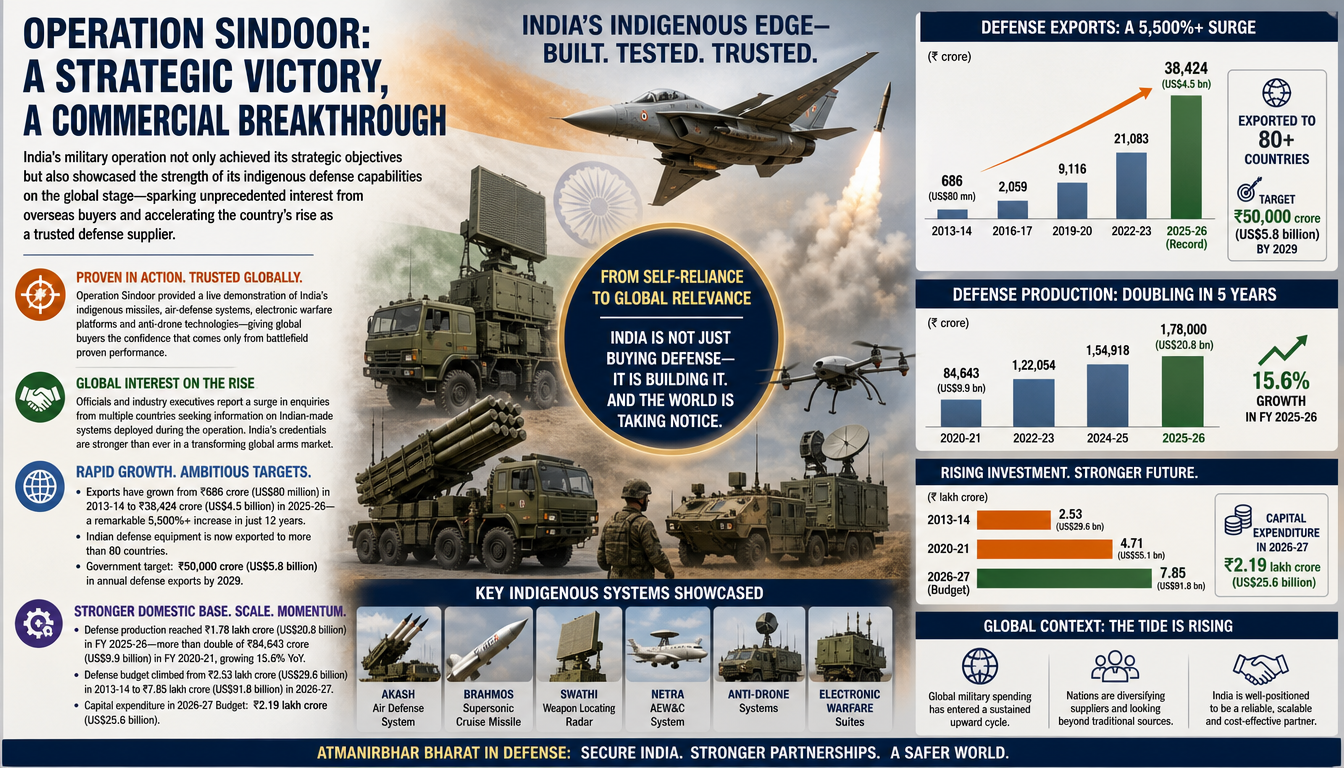
When India launched Operation Sindoor, the military operation achieved more than its immediate strategic objectives. It also provided a live demonstration of the country’s growing arsenal of indigenous missiles, air-defense systems, electronic warfare platforms and anti-drone technologies—an opportunity that defense manufacturers rarely get outside a conflict.
For New Delhi, the operation could prove to be as significant commercially as it was militarily.
Government officials and industry executives say interest from overseas buyers has picked up following the operation, with several countries seeking information on Indian-made weapon systems that were deployed during the campaign. While export contracts typically take years to negotiate, Operation Sindoor has strengthened India’s credentials at a time when the global arms market is undergoing its biggest transformation in decades.
The numbers illustrate how rapidly the sector has evolved. India’s defense exports have surged from just ₹686 crore (US$80 million) in 2013-14 to a record ₹38,424 crore (US$4.5 billion) in 2025-26, representing growth of more than 5,500% in just 12 years. Defense equipment manufactured in India is now exported to more than 80 countries, and the government has set an ambitious target of ₹50,000 crore (around US$5.8 billion) in annual defense exports by 2029.
The export momentum coincides with a dramatic expansion of domestic manufacturing. India’s defense production reached ₹1.78 lakh crore (US$20.8 billion) in fiscal 2025-26, more than doubling from ₹84,643 crore (US$9.9 billion) in 2020-21 and recording annual growth of 15.6% over the previous fiscal year. The country’s defense budget has meanwhile climbed from ₹2.53 lakh crore (US$29.6 billion) in 2013-14 to ₹7.85 lakh crore (US$91.8 billion) in the 2026-27 Budget, with capital expenditure alone touching ₹2.19 lakh crore (US$25.6 billion).
The backdrop could hardly be more favorable.
Global military spending has entered a sustained upward cycle driven by Russia’s war in Ukraine, the conflict in Gaza, tensions between Israel and Iran, instability in the Red Sea, and intensifying strategic rivalry between the United States and China. According to the Stockholm International Peace Research Institute (SIPRI), worldwide military expenditure reached a record US$2.7 trillion in 2024, marking the steepest annual increase since the Cold War, with spending expected to remain elevated through the decade.
The nature of military procurement has also changed.
The Ukraine conflict exposed serious shortages in missile, artillery and ammunition production among traditional suppliers, while the wars in West Asia highlighted the growing importance of integrated air-defense systems, drones, counter-drone technologies and electronic warfare. Governments are increasingly looking for suppliers capable of delivering equipment quickly, at competitive prices and in sufficient quantities.
Perhaps more importantly, military buyers now place greater value on systems that have been tested in combat rather than only in controlled trials.
Operation Sindoor has therefore given Indian defense manufacturers something that marketing campaigns cannot replicate—battlefield validation.
Indigenous systems including the Akash surface-to-air missile, BrahMos supersonic cruise missile, anti-drone technologies, airborne surveillance platforms and electronic warfare systems featured prominently during the operation. Defense analysts say the experience mirrors the trajectory followed by Israeli defense companies, Turkish drone manufacturers and South Korean artillery producers, whose exports accelerated after their systems demonstrated operational effectiveness during conflicts.
India hopes to follow a similar path.
Unlike many established exporters, the country is simultaneously expanding production capacity while global demand continues to rise.
Government figures show that nearly 65% of India’s defense requirements are now met through domestic production, compared with import dependence of around 65-70% a decade ago. The transformation has been underpinned by procurement reforms, higher indigenous content requirements, positive indigenization lists covering more than 5,000 defense items, liberalized foreign investment rules and greater participation by private industry.
The manufacturing ecosystem has expanded rapidly. India now has 16 Defense Public Sector Undertakings (DPSUs), around 500 licensed defense manufacturers and nearly 17,000 micro, small and medium enterprises (MSMEs) supporting the sector. The number of industrial licenses issued for defense manufacturing has more than tripled—from 258 in 2015 to 834 by March 2026—reflecting growing private-sector confidence.
Two dedicated Defense Industrial Corridors are expected to play a pivotal role in sustaining production growth. The Uttar Pradesh Defense Industrial Corridor has attracted investment commitments of ₹42,057 crore (US$4.9 billion), while the Tamil Nadu Defense Industrial Corridor has secured commitments worth ₹32,699 crore (US$3.8 billion). Together, they are developing integrated manufacturing clusters for aerospace, missiles, armored vehicles, electronics and precision engineering.
The government is also investing heavily in innovation to ensure India moves beyond licensed production into advanced defense technologies.
Funding for defense research has more than doubled from ₹13,716 crore (US$1.6 billion) in 2014-15 to ₹29,100 crore (US$3.4 billion) in 2026-27. Since 2022, 25% of the defense R&D budget has been earmarked for industry, start-ups and academia, encouraging wider private-sector participation in military innovation.
The Innovations for Defense Excellence (iDEX) program has emerged as a key driver of that ecosystem. By March 2026, it had engaged 676 start-ups, MSMEs and innovators, signing 551 design and development contracts. DRDO has also transferred more than 2,180 technologies to industry and opened advanced testing facilities to private companies, while more than 41,000 vendors supplying nearly 270,000 products have been registered on the Srijan DEEP digital platform, strengthening domestic supply chains.
The expansion in manufacturing is already translating into larger procurement programs. India signed defense contracts worth ₹2.09 lakh crore (US$24.5 billion) during fiscal 2024-25, followed by contracts worth ₹1.82 lakh crore (US$21.3 billion) in 2025-26. The long-term order pipeline provides manufacturers with greater certainty to invest in capacity expansion and technology upgrades.
India’s defense diplomacy is reinforcing those commercial ambitions. Defense partnerships with the United States, France, Russia, Japan, Australia, the European Union and Gulf countries are increasingly focused on co-development, co-production and technology transfer rather than conventional arms purchases. Simultaneously, India’s growing role in the Quad, Indo-Pacific maritime security initiatives and partnerships with Southeast Asian countries is opening new avenues for defense exports.
For many countries across Southeast Asia, Africa, Latin America and the Middle East, India offers an attractive proposition: combat-tested equipment at competitive prices, backed by a large industrial base and fewer geopolitical restrictions than some traditional suppliers.
Despite the progress, India still accounts for only a small share of the global arms trade, which continues to be dominated by the United States, France and Russia. However, analysts believe the current geopolitical environment presents an opportunity that may not have existed even five years ago. As Western manufacturers struggle with production backlogs and Russia prioritizes domestic military requirements, many governments are actively searching for alternative suppliers capable of delivering sophisticated systems on shorter timelines.
Whether India can convert growing international interest into sustained export orders will depend on maintaining quality, scaling production, meeting delivery schedules and continuing to demonstrate operational effectiveness. If those conditions are met, Operation Sindoor could be remembered not only as a defining military operation but also as the moment India’s indigenous defense industry established itself as a credible player in the global arms market.
For a country that was once among the world’s largest importers of military hardware, the shift is profound. Defense manufacturing is increasingly becoming more than a strategic necessity—it is evolving into a high-technology export industry capable of generating skilled employment, driving innovation and enhancing India’s geopolitical influence in an era of intensifying global competition.