“The Pacific and the Indian Oceans are now bringing about a dynamic coupling as seas of freedom and of prosperity,” Shinzo Abe, “Confluence of the Two Seas,” address to the Indian Parliament, 2007.
I was at Shibuya Crossing last year, standing at one of Japan’s busiest pedestrian junctions, watching what should have been mayhem unfold with astonishing order. Hundreds of people crossed at once from every direction, diagonally, sideways, and straight ahead. What stayed with me was the pin-drop discipline of that movement.
Japan seems to have cracked a civilizational code many modern societies still struggle to match. Public conduct is shaped by order, space, restraint, and duty. It can absorb density without ceding dignity. Even in a crowd, the individual seems to know where the collective begins.
Japan’s great strength may also explain its strategic hesitation.
Advertisement
Decisions in Tokyo are rarely rushed. Memories of war, postwar restraint after defeat, and limits placed on Japan’s security posture shaped a political culture that does not hurry into hard choices. India understands this more than most countries. Centuries of invasion, colonization, partition, and external pressure taught India to guard its autonomy fiercely. New Delhi does not like being hurried into another country’s design.
When India and Japan call each other trusted, special, or indispensable partners, the words are not empty. They come from real affinity. Yet they have also been used too often in place of difficult action. Therein lies the central problem.
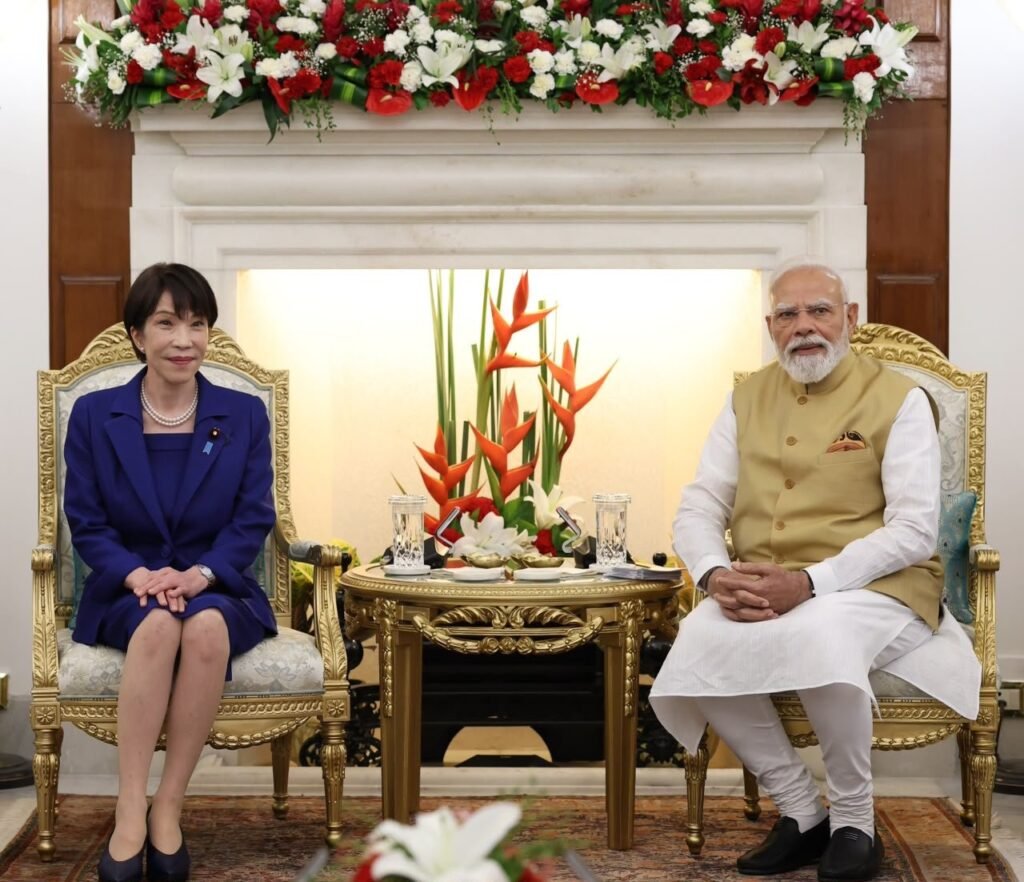
Prime Minister Sanae Takaichi’s July 1 to 3 visit to India for the 16th India-Japan Annual Summit carried the civility of a relationship that does not need much explanation. At a cultural event in Delhi, she tried her hand at the santoor and drew applause. It worked because of its spontaneity. India and Japan have always had that ease. Buddhism, Nara, food, anime, music, technology, and travel have created familiar layers over time. Warmth has never been the missing ingredient; heft is.
At the summit, both sides placed defense, economic cooperation, energy resilience, technology, innovation, and people-to-people exchanges at the center of the agenda. They adopted a joint declaration on economic security, issued a joint statement on artificial intelligence, carried forward work on energy resilience, and advanced the UNICORN naval antenna project, the first India-Japan defense co-development initiative.
Defense co-development would once have sounded too ambitious for two careful powers. Japan’s security restraint and India’s strategic autonomy made both sides move slowly, sometimes too slowly. As Asia becomes less forgiving, familiarity is no longer enough.
Prime Minister Modi captured the emotional capital of the relationship when he said, “mutual trust is our greatest strategic asset.”
Few major pairings in Asia have this degree of comfort without the complications of alliance politics. India and Japan do not threaten each other’s core interests or compete for leadership in the same way other Asian powers do.
Yet trust does not build a semiconductor plant. Nor does it train a workforce, finance a battery supply chain, or produce a naval system.
For all the goodwill, India-Japan ties still punch below their potential. Bilateral trade stood at about US$27.5 billion in FY 2025–26; respectable, but modest for two economies with this much convergence. Over the past year, nearly 120 business agreements have been signed, expected to bring more than US$10 billion in Japanese investment to India, while both governments have set a 10 trillion yen investment target over the next decade.
A fresh chapter cannot be built only on official development assistance, metro projects, high-speed rail, and well-mannered summit language. Japan’s role in India’s infrastructure helped build credibility and capacity. Now the effort has to broaden into factories, suppliers, finance, talent, and technology collaborations that do not depend on summit cycles.
Before the visit, Takaichi wrote that India is an “indispensable partner” for Japan in realizing a Free and Open Indo-Pacific. Japan does not use such language casually. For Tokyo, India is not simply a large market or a cultural friend. Without India, any durable balance in the Indo-Pacific will remain incomplete.
For India, Japan is equally important. Few Asian powers can bring together capital, technology, infrastructure experience, defense engineering, and political caution in a single package. Japan does not lecture India on strategic choices. It understands that sovereign countries do not want to be forced into choices.
Semiconductors, critical minerals, pharmaceuticals, batteries, AI, and clean energy are no longer ordinary commercial sectors. Dependence has become a vulnerability. China’s use of export controls on critical minerals and rare earths has made the point plain; supply chains are now about leverage. Export controls, disruptions, and coercive trade practices have forced governments to rethink what they buy, where they produce, and whom they rely on.
Japan also looks at India’s Northeast with a different set of eyes. Too often, New Delhi treats the northeastern region as a frontier to be administered rather than an opening to be used. Japan’s work on connectivity, healthcare, disaster resilience, forests, and skill development links India’s Act East Policy with its Indo-Pacific thinking. From there, India can connect more purposefully to Bangladesh, Myanmar, the Bay of Bengal, and Southeast Asia.
During my visit to Japan last year, one refrain kept coming up. Japan is aging and looking for solutions. Nearly three in ten Japanese citizens are already 65 or older. Life expectancy stands around 84 years. Longevity is a national achievement, but it has changed the arithmetic of family and work. Many working-age Japanese people now find themselves between children who need support and elderly parents who need care. Wages, meanwhile, have not moved quickly enough to ease that burden.
India should not look at this as Japan’s problem alone. Japan needs workers, caregivers, engineers, technicians, researchers, and students. India needs disciplined pathways for its young people to access high- and mid-skill opportunities. Japanese-language training, vocational mobility, university partnerships, and technical internships cannot remain decorative items in summit documents.
India and Japan are both large energy consumers exposed to maritime disruption, price shocks, and fragile supply chains. Cooperation on petroleum reserves, hydrogen, ammonia, batteries, solar technology, biogas, and nuclear energy should not be treated as technical housekeeping. Across the Strait of Hormuz and the wider Indian Ocean, fuel, shipping, insurance, ports, and naval stability now belong to the same register.
None of this requires an alliance. In fact, an alliance may be the wrong model. India and Japan need something more suited to their temperaments; a working compact between two cautious powers that know the cost of dependence.
Takaichi’s visit clarified the decision facing both capitals. They can keep praising the relationship, or they can make it bear greater consequence. India should not assume Japanese caution means lack of intent. Japan should not assume India’s complexity means lack of seriousness. Both countries are slow for historical reasons. History, however, cannot become a permanent alibi.
At Shibuya, the crossing works because everyone moves when the light changes. Discipline matters. So does timing.
India and Japan have tapped the stone bridge long enough. It is time to cross it.
Disclaimer: The opinions and views expressed in this article/column are those of the author(s) and do not necessarily reflect the views or positions of South Asian Herald.