 Join WhatsApp Channel

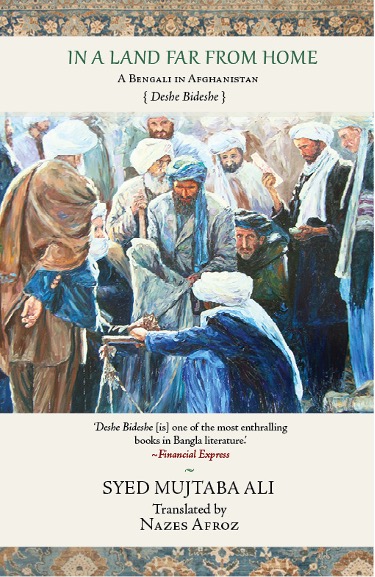
Much before Travel Blogs became popular, there were many who traveled widely and wrote extensively about their experiences. The more famous ones were: Megasthenes, Fa-Hien, Marco Polo, Al-Biruni, Ibn Batuta etc. In more modern times: Paul Theroux, Nick Danziger, Amy Gordon, Bill Bryson, Pico Iyer and even Sir V. S. Naipaul.
Well, the current generation may not know about a Bengali Traveler, linguist, journalist, scholar and academic named, Syed Mujtaba Ali Khandakar. Born in 1904, in Karimgunj, Sylet, (now in Bangladesh), he wrote primarily in Bengali. His writings were lapped up by the middle-class, travel aficionado, Bengalis ecstatically. Soiyod Mudztoba Ali (as pronounced in Bengali) was a polyglot, travelled widely and lived in India, Bangladesh, Germany, Afghanistan & Egypt. It’s surprising that like many of his generation, despite lack of modern facilities, he managed amazing accomplishments.
In 1921 Mujtaba joined the Indian freedom struggle. He studied at Visva-Bharati University in Santiniketan and graduated in 1926. Rabindranath Tagore had a great influence on him. He studied briefly in Aligarh Muslim University, later moved to Kabul to work as a professor in the Education Department (1927–1929). Ali went to Germany and studied at the Universities in Berlin and Bonn. He earned his PhD from the University of Bonn. During 1934–1935 he pursued studies at the Al-Azhar University in Cairo. He taught at a college in Baroda from 1936 to 1944 and in 1949 became principal of Government Azizul Haque College in Bogra, East Bengal. After partition, Ali went to the then East Pakistan.
He was amongst the first to call for Bangla as East Pakistan’s state language. West Pakistan on other hand was trying to impose Urdu as the state language of East Pakistan. They demanded an explanation from Ali. He resigned and slipped back to India in August 1949, tipped off by a friend, that Pakistani authorities intended to arrest him for support of the Bengali language movement. After a brief stint at University of Calcutta in 1950, Ali became Secretary of the Indian Council for Cultural Relations and editor of its Arabic journal Thaqafatul Hind. From 1952 to 1956 he worked for All India Radio at New Delhi, Cuttack and Patna. He then joined Visva-Bharati University (1956–1964) as professor of German language and later of Islamic Culture. He lived in Kolkata till early 1972. Following the liberation of Bangladesh, he moved to Dhaka to live with his family until his death in 1974.
Ali’s mother tongue was Bengali and Sylheti, but he also could speak English, Russian, French, German, Italian, Arabic, Persian, Urdu, Hindi, Sanskrit, Marathi, Gujarati, and Pashtu. Ali was one of the trailblazers of a unique category of Bengali writing. ‘Ramya Rachana’ in the Bengali language, an anecdotal story-telling – often based on real-life experiences. His writings had remarkable wit with self-deprecating humor, sharp observations on human nature and cultural ironies. On his own lifestyle, he noted that he had not even seen three Hindi films in his entire life. He joked that by virtue of this single act of “purity,” he was guaranteed a spot in heaven—though he worried heaven might trick him into watching Hindi movies anyway. He often made fun of professionals – “The greater the doctor, the worse his handwriting.” About his domestic help he said that Abdur Rahman’s turban was perpetually dirty because they lacked soap, his heart was whiter than all the snow surrounding Kabul.
His magnum opus, many say, is Deshe Bideshey, (In the Land far from Home) narrating his travel and stay in Afghanistan during late 1920s at a relatively young age of 23 years. From Kolkata he went by Train to Peshawar to Kabul to teach English & Persian in a local college. From the start itself the book is full of humor. He mentions that on the train a Sardarji told him that the cloth required for a Salvar correlates directly to the width, pleating and volume of the traditional Salwar. Growing progressively larger the further northwest, one travels from Punjab into Afghanistan. Delhi: \(3 \frac{1}{2}\) yards; Jalandhar: \(4 \frac{1}{2}\) yards; Lahore: \(5 \frac{1}{2}\) yards; Lalamusa: \(6 \frac{1}{2}\) yards; Rawalpindi: \(7 \frac{1}{2}\) yards; Peshawar (Land of the Pathans): \(10 \frac{1}{2}\) yards to an entire bolt of cloth. He goes on to describe everyday Afghan life, local hospitality, and interactions with a diverse set of people, including Pashtun locals, Russian expats, and royals.
He was fascinated by Kabul’s Bazaar, which might have been poorer than Peshawar, but was far more colorful. He said, people of at least 25 nationalities did their trading there, keeping their sartorial and linguistic distinctions. Hazara, Uzbek, Kafiristani, Qizilbash, Mongol, Kurd — the traders of Kabul could easily tell who was from where. There was a big inn at the end of the bazaar where traders would gather after the day’s work and evening prayers. The Mongols, would start dancing in a circle, whirling all the time. An Iranian could be seen in a corner with a sitar next to his ear, singing verses from Hafiz.
The main gathering was around the Tajiks, singing loudly in unison. Abdur Rahman, a Tajik from Panjshir became Mujtaba Ali’s Man Friday and took care of him. It was a time when King Amanullah wanted to modernize Afghan society. He announced reforms, including encouraging women to do away with the veil and even banned traditional dress for men in public. The mullahs resisted the king’s moves and initiated tribal rebellions, forcing King Amanullah to abdicate. “Amanullah wanted to pull the turban off the poor Afghans, and he paid the price by losing the crown.”
Mujtaba writes – Over the noise, you could hear the shout that ‘Bacha-e- Saqao is coming, Bacha-e-Saqao has arrived.’ Then we heard the bang of a rifle, and the crowd lost all sense of reason. Throwing aside everything they were carrying, people started running for their lives. Ali says, – ‘I somehow crossed the ditch and stood on the front porch of a shop. Within a minute another man appeared and stood next to me. An Italian Colonello or Colonel, aged about sixty. I said to him, I heard that the bandit leader Bacha-e-Saqao was coming to fight for Amanullah. But what is really happening? The Colonello said, ‘Seems like wrong news; he’s coming to take over the city.’ The sound of rifle shots was drawing closer. By then, the crowd was moving in waves rather than in a stream. I told the Colonello, ‘Let’s go home.’ He said he would not leave without seeing the last act.’ Military whim—there was no point in arguing.
Abdur Rahman was waiting at the door. ‘As soon as I entered the house, he closed the door and started to fortify it with heavy rocks. He had made all the arrangements for fortification. By that time the sound of the gunfire had been overpowered by the heavy sound of machine guns. Abdur Rahman brought tea. Listening to the sounds carefully, he said, the king’s soldiers have now attacked.’ I asked him, ‘The king’s soldiers are facing Bacha this late? How could he reach Kabul so easily?’ Abdur Rahman said, ‘I asked many people while waiting for you at the door, but nobody could say anything clearly. The exchange of fire continued. Abdur Rahman served me dinner early that evening and then he sat down to tend to the fire in the fireplace. From our chat I could make out that he was worried about my well-being in case Bacha won, which would be followed by anarchy and looting. Abdur Rahman told me many stories about him.
I realized that Abdur Rahman had many qualities—a jeweler of snow, a doctor of frostbite, chef-de cuisine—but he certainly was no Boswell. After filtering through all the stories carefully, I had a glimpse of the life of Bacha; he was the leader of a gang of about three hundred bandits; lived in Kohistan, north of Kabul; he looted the rich and distributed a portion of his booty to the poor. When Amanullah was away in Europe, he became so powerful that he started to collect tax from the traders of Kohistan. After coming back, Amanullah proclaimed a price on his head, ‘’Five hundred rupees reward on the head of bandit Bacha-e-Saqao.” Bacha removed all the posters and put up his own proclamation, “One thousand rupees reward on the head of Kafir Amanullah.”
Mujtaba Ali provides heartrending descriptions of a besieged city surviving only on dry bread and salt. He finally got out of Kabul with the help of the British. His travelogue is unnervingly prophetic, foretelling Afghanistan’s cycles of turmoil with its million mutinies. Ali’s young mind was curious to explore the Afghan society of the time, and, with his impressive language skills, he had access to a cross-section of Kabul’s population, whose ideas and experiences he chronicled with a keen eye and a wicked sense of humor. His account provides a fascinating first-hand insight into events at a critical point in Afghanistan’s history, when the reformist King Amanullah tried to steer his country towards modernity by encouraging education for girls and giving them the choice of removing the burqa.
Branded a ‘kafir,’ Amanullah was overthrown by the bandit leader Bacha-e-Saqao. Deshe Bideshe is the only published eyewitness account of that tumultuous period by a non-Afghan, brought to life by the contact that Ali enjoyed with a colorful cast of characters at all levels of society—from the garrulous Pathan Dost Muhammed and the gentle Russian giant Bolshov, to his servant, Abdur Rahman and his partner in tennis, the Crown Prince Enayatullah. Deshe Bideshe is the only published eyewitness account of that tumultuous period by a non-Afghan. His contact with persons of all levels of society, from the garrulous Pathan Dost Muhammed, the gentle Russian giant Bolshov, to his servant, Abdur Rahman and his partner in tennis, the Crown Prince Enayatullah; helped him immensely.
It’s sad that today, not many Bengalis, let alone other Indians, remember this brilliant travel writer who combined wit with candor. The younger Indians should realize that the Indian wanderlust is not a product of today’s social media, its inherited!
Disclaimer: The opinions and views expressed in this article/column are those of the author(s) and do not necessarily reflect the views or positions of South Asian Herald.
Related posts:
 India Reaffirms Support for Afghanistan’s Peace and Stability at UN Security Council
 India Calls for Peace, Stability, and Greater Humanitarian Support for Afghanistan at UN Security Council
 Meenakshi Lekhi Calls Science and Technology the Bridge for a Stronger US-India Partnership at FIIDS Roundtable
 India Highlights Expanding Healthcare and Humanitarian Support for Afghanistan at UN Security Council Debate
