 Join WhatsApp Channel

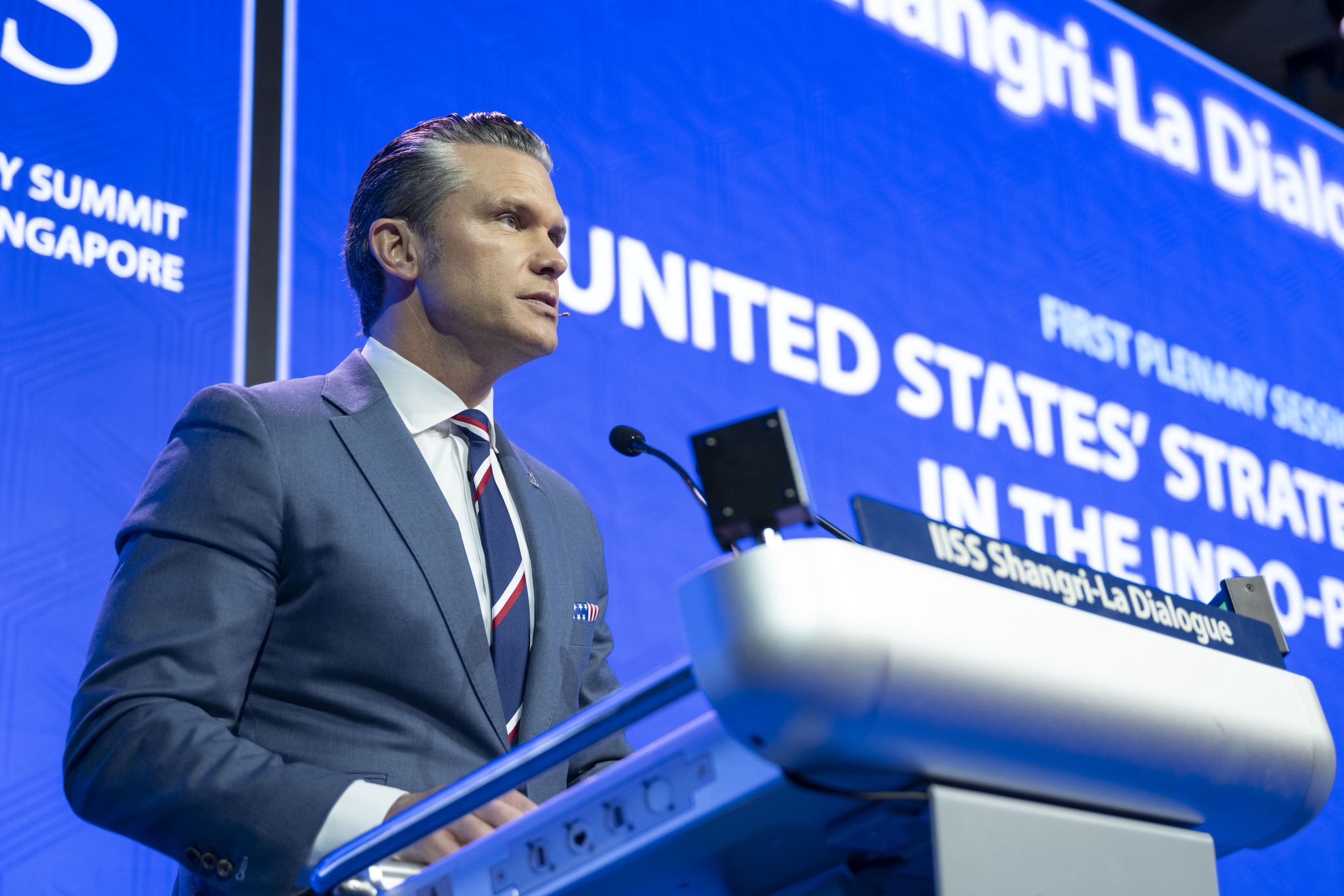
US Secretary of War Pete Hegseth on May 30 identified India as a key pillar of stability in the Indo-Pacific, as Washington sharpened its regional strategy aimed at countering China’s military expansion while pressing allies to expand defense responsibilities.
Speaking at the Shangri-La Dialogue in Singapore, Hegseth said India’s growing military capabilities and defense-industrial base made it central to maintaining a regional balance of power.
He said India plays a stabilizing role in South Asia and contributes to wider regional equilibrium.
“In South Asia, India is a critical anchor to hold the line. A powerful India acting in its own self-interest advances our shared goal of maintaining a balance of power across the region.”
He added that India’s ongoing military modernization strengthens broader regional security efforts led by the United States and its partners.
“India is modernizing its military to carry its share of the security burden, particularly in the Indian Ocean.”
Hegseth praised India’s expanding defense manufacturing and logistics capacity, highlighting its potential role in supporting both regional operations and U.S. forces.
“It’s building out the heavy industrial and logistics capacity to sustain high-end military operations, including the ability to repair and maintain our shared platforms and support U.S. Navy vessels operating forward in the theatre.”
He also pointed to growing bilateral defense cooperation, including joint production initiatives.
“We’ve also committed to pursuing co-production with India to advance capabilities like Javelin anti-tank guided munitions. Real, tangible steps to improve the collective readiness of our forces.”
He said such industrial collaboration was no longer long-term ambition but an immediate strategic requirement.
“This kind of industrial muscle isn’t just a long-term goal, it’s an immediate operational imperative.”
Hegseth’s remarks came as he reiterated concerns over China’s military expansion, which he described as a central challenge to regional stability. He warned against any single power dominating the Indo-Pacific and said the United States sought to preserve a balance of power.
“There is rightful alarm regarding China’s historic military buildup and the expansion of its military activities in the region and beyond.”
He added that Washington was not pursuing confrontation but deterrence through strength.
“We do not approach this challenge with needless confrontation, but with a posture of measured and deliberate strength.”
Reaffirming the Trump administration’s broader strategy, Hegseth said the United States was moving away from what he called “performative outrage” in diplomacy and focusing instead on capability and deterrence.
“We will prioritize lethal capabilities, strategic discipline and businesslike cooperation over empty rhetoric and peacocking,” he said adding “Any potential opponent will be forced to judge us by our hard power, collective readiness and our steadfast resolve.”
He said the U.S. military posture in the Indo-Pacific would be designed to prevent rapid military gains by adversaries.
“This is the logic of strategy… the essence of peace through strength.”
Hegseth also reinforced Washington’s demand that allies increase defense spending and operational contributions, arguing that alliances must be based on shared responsibility rather than dependency.
“We need partners, not protectorates. We seek alliances built on shared responsibility, not dependency,” he added. “You don’t have a strong alliance unless everyone has skin in the game.”
He said countries that meet these expectations would benefit from deeper U.S. defense cooperation, while others could see a shift in how Washington engages with them.
“For those nations that rise to this challenge… we are moving them to the front of the line.”
Alongside India, Hegseth cited several regional partners, including Japan, Australia, South Korea, the Philippines, Singapore, Vietnam, Thailand and Malaysia, as key contributors to strengthening collective defense capacity.
He argued that emerging defense-industrial cooperation across these countries would be essential to sustaining long-term deterrence against China.
The speech underscored Washington’s dual-track approach: strengthening military deterrence against Beijing while building a broader network of allied powers expected to assume greater responsibility for regional security.
Related posts:
 Pentagon’s “Signalgate” Review Deepens Scrutiny of Defense Secretary Hegseth Amid Broader Storm Over Covert Strikes
 Guest Column: Indo Pacific Is Our Priority Theatre… And We Are Here to Stay, Says Hegseth
 India’s Expanding Defense Ties with Europe and Bangladesh’s Strategic Balancing in South Asia
 Congress Pressures Pentagon as Hegseth Faces Scrutiny Over Deadly Boat Strike Amid Rising Tensions with Venezuela
