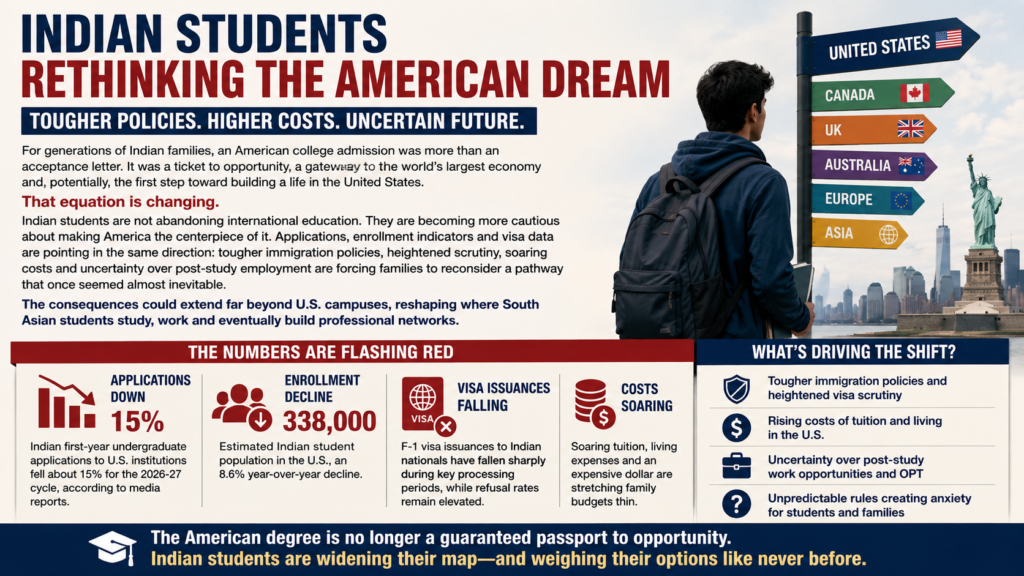
For generations of Indian families, an American college admission was more than an acceptance letter. It was a ticket to opportunity, a gateway to the world’s largest economy and, potentially, the first step toward building a life in the United States.
That equation is changing.
Indian students are not abandoning international education. They are becoming more cautious about making America the centerpiece of it.
Applications, enrollment indicators and visa data are pointing in the same direction: tougher immigration policies, heightened scrutiny, soaring costs and uncertainty over post-study employment are forcing families to reconsider a pathway that once seemed almost inevitable.
Advertisement
The consequences could extend far beyond U.S. campuses, reshaping where South Asian students study, work and eventually build professional networks.
The Numbers are Flashing Red
The clearest warning comes from the application pipeline.
Indian first-year undergraduate applications to U.S. institutions fell about 15% for the 2026-27 cycle, according to media reports. Overall international applications also weakened, marking a sharp reversal after years of strong overseas demand.
Common App senior data scientist Rodney Hughes offered a blunt explanation: “If it’s harder to get a visa, that might make it less likely that students apply.”
The decline is not confined to applications. Estimates cited in recent reporting put the Indian student population in the United States at roughly 338,000, an 8.6% year-over-year decline. Postgraduate enrollment, traditionally a major channel for Indian students entering U.S. STEM programs, has faced particularly intense pressure.
Visa data adds to the concern. F-1 issuances to Indian nationals have fallen sharply during key processing periods, while refusal rates have remained elevated.
For families committing tens of thousands of dollars to tuition and living expenses, the numbers change the calculation. The American degree is no longer being judged simply on academic quality. The question increasingly is: What happens after graduation?
The Visa Wall
For years, the U.S. higher-education proposition rested on a familiar sequence: admission, F-1 status, graduation, Optional Practical Training, a job, potentially an H-1B visa and, for some, permanent residence.
Every stage carried uncertainty. But the pathway was familiar enough for families to treat the risk as manageable. Now uncertainty itself is becoming part of the calculation.
Expanded visa scrutiny, consular delays, social-media screening and continuing changes to student-status and post-study employment rules have made the American route harder to price.
For Indian families, the financial exposure is considerable. A master’s degree can require tens of thousands of dollars in tuition and living expenses, with the total cost substantially higher at many universities.
That investment looks different when the graduate’s ability to remain and work depends on immigration decisions outside the student’s control.
Oxford higher-education scholar Simon Marginson has warned: “It takes years to correct such impressions.”
For U.S. universities, that may be the bigger danger. A bad admissions cycle can be reversed. A generation of families deciding America is too unpredictable is harder to win back.
The response is not necessarily to abandon overseas education. It is to postpone the decision. A destination survey cited in the source material found that 53% of South Asian respondents preferred completing undergraduate education at home or elsewhere in Asia before pursuing postgraduate study abroad. That points to a significant change in family strategy.
Instead of sending children abroad at 18, parents can choose a lower-cost undergraduate degree in India or elsewhere in Asia. Students can build credentials, gain internships and assess global labor markets before deciding whether a foreign master’s degree makes financial sense.
The strategy is simple: Study at home. Build skills. Go abroad later — if the numbers still work. India’s expanding technology sector, startup ecosystem and growing range of universities make that model increasingly viable.
For American universities, it creates a new risk: students who delay leaving India may eventually choose another destination altogether.
Europe is Ready
America’s competitors do not necessarily need to beat the United States at everything. They need to offer predictability. Germany is a leading example. Indian enrollment has risen sharply in recent years, with estimates putting the Indian student population at roughly 60,000 or more. Low or negligible tuition at many public universities, strong engineering programs and comparatively clear post-study employment provisions have made Germany increasingly attractive.
Ireland offers English-language education alongside major technology and pharmaceutical industries. The United Kingdom remains a major destination, while France, the Netherlands, Italy and Switzerland are gaining visibility. Singapore, Japan, Hong Kong and the UAE are also becoming credible alternatives.
The result is not a collapse in international education demand. It is a redistribution of demand. For decades, America was the default destination for ambitious South Asian students. It may increasingly become one option among several.
The Diaspora Effect
That redistribution could eventually alter the South Asian diaspora itself. International students have long been a major channel through which highly skilled Indian talent entered the United States. Indian students became deeply embedded in American graduate STEM programs and subsequently in technology, medicine, finance, research and entrepreneurship.
Today’s student can become tomorrow’s engineer, scientist, physician, founder or corporate executive. If fewer students enter that pipeline, fewer may eventually enter the U.S. workforce through it. There is also a generational consequence.
The familiar South Asian-American trajectory — student visa, graduate degree, first job, H-1B, permanent residency and eventually citizenship — has never been guaranteed. But it became common enough to shape family expectations.
If more students build careers in Germany, Ireland, Singapore, the UAE, Britain or India, professional networks will follow them. So will capital, entrepreneurship and family connections. Over time, the geography of the diaspora could change. The next generation of South Asian professionals may be more globally distributed — and less overwhelmingly anchored to the United States.
A $3.4 Billion Warning
The stakes for American higher education are substantial. NAFSA modeling cited in the source material estimates that U.S. colleges and the broader economy could lose about 111,000 international students, translating into approximately $3.4 billion in lost economic activity and nearly 40,000 jobs.
NAFSA Executive Director Fanta Aw warned: “US policy and regulations affect where international students plan to invest their future.”
The concern extends beyond tuition. International students help sustain graduate programs, laboratories and research pipelines. STEM departments are particularly exposed because of their reliance on overseas students pursuing advanced degrees. A prolonged decline could become both a university-finance problem and a national talent problem.
For decades, the question for an ambitious Indian student was: Which university can give me the best education? Increasingly, it is: Which country gives me the best future? That is a broader contest.
Students and families are comparing tuition, visa prospects, post-study work rights, salaries, residency options, currency movements and the probability of actually remaining after graduation. America still possesses enormous advantages. Its universities dominate global research, its technology ecosystem remains unmatched in many fields, and its entrepreneurial networks continue to attract talent.
The American brand is not disappearing. But prestige alone cannot overcome uncertainty. Countries are competing for students through the entire journey — from admission to graduation, employment and ultimately the possibility of building a life.
The downturn does not have to become permanent. A more predictable immigration framework, faster visa processing, clearer student rules and greater certainty around post-study employment could restore confidence. But perception is cumulative.
Once families build alternative pathways, those pathways acquire momentum. Alumni networks expand. Employers recruit locally. Universities establish partnerships. Parents recommend destinations to younger relatives. A temporary disruption can become a structural realignment.
For South Asian families, the lesson of 2026 may be that America remains an option — but no longer necessarily the option. For the United States, the lesson is more consequential.
The global race for students is becoming a race for talent. And talent has choices. If America makes its educational pathway too expensive, too uncertain or too difficult to navigate, students will not necessarily wait for Washington to change course. They can simply go somewhere else.