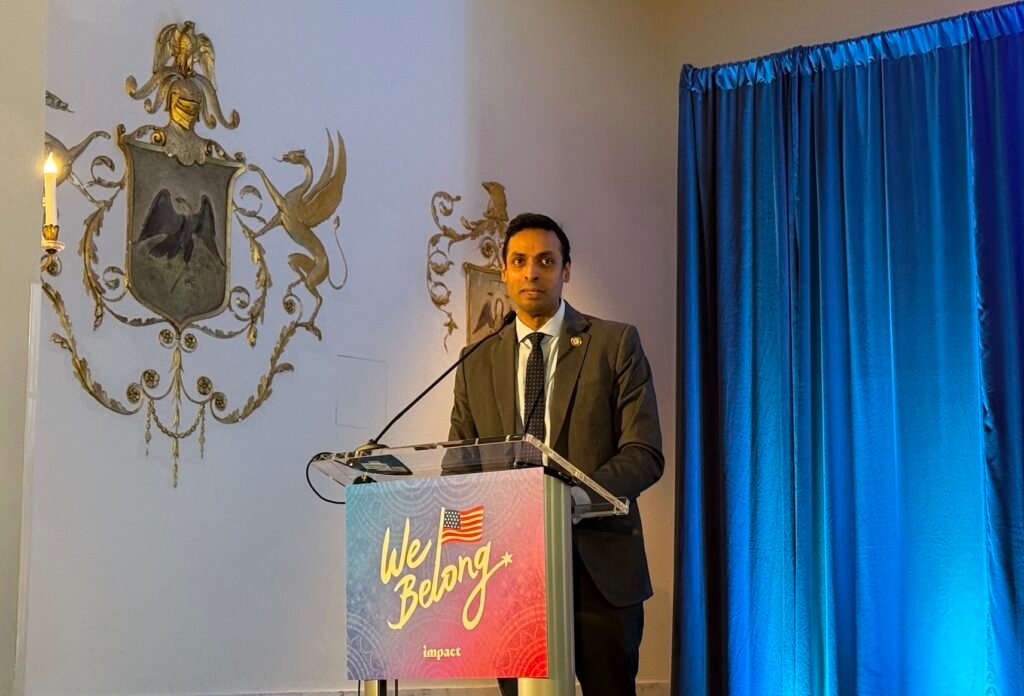
Indian American Congressman Suhas Subramanyam (VA-10) underscored the importance of authenticity, representation, and grassroots engagement in politics, urging aspiring candidates to embrace their identities and connect directly with voters.
Delivering keynote remarks on April 20, in Washington DC, at the 2026 Impact Summit titled “We Belong,” Subramanyam said “I didn’t win it by running away from being who I am, which was Indian American and South Asian and even Hindu. I ran very much as someone who was proud to be those things. One of the things that I’ve noticed being on Capitol Hill is that the general public and voters really appreciate authenticity. So, if you are planning to contest in an election be yourself.”
Subramanyam emphasized that voters are more likely to “respect” candidates who are “authentic.” Urging aspiring candidates to remain true to themselves, he stressed, “you don’t run or hide from who you are.” He cautioned that voters can quickly sense inconsistency in a candidate’s values or identity, adding that such perceptions could cost them support. “And so don’t hide who you are,” he said.
Highlighting his long association with the organization, Subramanyam noted, “Anytime there’s an IA Impact summit, I try to be there. Impact has been with me since the very beginning.” He added that he arrived early to attend a previous panel discussion and expressed admiration for the speakers, saying, “I’m just so impressed with all of them.”
Advertisement
Reflecting on the summit’s theme, “We Belong,” he said, “And I’ll tell you that a lot of people have told me many times that I don’t belong in Congress. I don’t belong in this country. I don’t belong in many places that I am.” He underscored that the theme affirms a broader message of inclusion, stating that “We absolutely belong.”
Subramanyam noted that leaders from Congress, state legislatures, and executive offices participate in such forums to engage with attendees, reinforce that they “very much belong,” and help “inspire another generation.”
Recalling his early years, he said he had not initially considered a career in politics. “I was told that talking about politics was not polite,” he said. His outlook changed during his time in New Orleans when Hurricane Katrina struck. “That’s when I decided to drop my pre-med, which my parents didn’t love, and major in philosophy, which they didn’t love either,” he added.
That decision, he said, set him on a path toward public service. He later worked on Capitol Hill and, after stepping away, found himself drawn back. “And I felt like public service,” he noted, describing the experience as a defining influence on his career.
Discussing his first electoral campaign, Subramanyam said, “The first time I ran, I didn’t know where to start.” Although he had prior campaign experience, he said he initially doubted his electoral prospects in a district with a significant Indian American population. “And we’ve never elected an Indian American or South Asian in Virginia before, certainly not the state or federal level,” he pointed out.
He added that early skepticism extended even within the community. “So when I was starting, a lot of people, the Indian Americans, thought that I was going to lose. And so many of them didn’t even vote for me, or they voted for other candidates who were South Asian when I was running,” he said. “I actually lost the South Asian vote when I ran, and I think I’ve lost it a couple of times because other South Asians want to split the vote, but I won all the other communities.”
Subramanyam highlighted the role of IA Impact in supporting candidates, noting that he drew on its resources during his campaign. He credited Aruna Miller, who was then associated with the organization, as a key mentor.
“When I was running, I worked a lot with a lot of the leadership at the time, a woman who’s now in high places, Aruna Miller, was the Director at Impact Fund, and she’s now the Lieutenant Governor of Maryland, but she helped me a lot, and she was a great mentor,” he said.
Offering practical advice to prospective candidates, Subramanyam emphasized the importance of direct voter outreach. He encouraged them to knock on as many doors as possible and to “work really hard.”
Reflecting on his own campaign efforts, he said he knocked on approximately 10,000 doors in Loudoun County, Virginia. Years later, he continues to encounter residents who remember those interactions at local grocery stores and farmers markets.
He noted that sustained community engagement played a significant role in his eventual election to Congress, pointing to extensive door-to-door outreach and participation in community events as key factors in building voter connections.