Join WhatsApp Channel

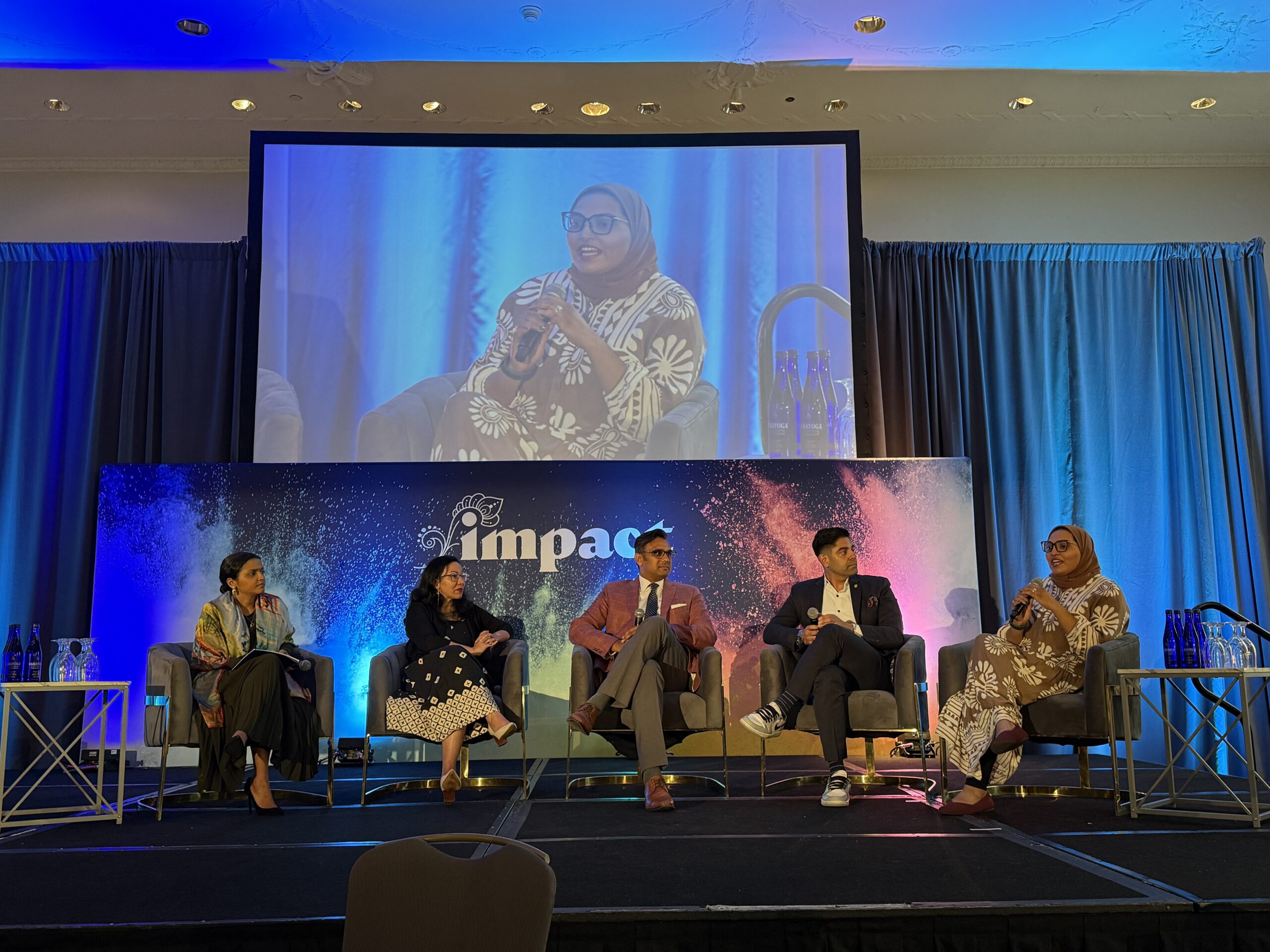
A panel discussion titled “For our Future: NextGen Leaders in Office” brought together South Asian political leaders to reflect on their journeys in public service, focusing on overcoming generational and cultural barriers while underscoring the importance of mentorship, resilience, and community engagement.
Held during the 2026 Impact Summit on April 20 in Washington, DC, the session explored the significance of local politics, the influence of personal narratives on policymaking, and the need for greater civic participation within the South Asian community. Panelists also addressed the challenges of balancing family responsibilities with political careers.
Moderated by serial entrepreneur and community builder Deepti Sharma, the panel featured Kesha Ram Hinsdale, Vermont Senate Majority Leader and State Representative for the Chittenden-Southeast District; Pavan Parikh, Hamilton County Clerk of Courts in Ohio; Ranjeev Puri, Michigan House Democratic Leader and State Representative for HD-24; and Nida Allam, Vice Chair of the Durham Board of County Commissioners in North Carolina.
Reflecting on her career, Hinsdale emphasized the evolving role of mentorship. “I kind of have no one to turn to. And now I realize that I am missing a lot of my mentors, and it’s my job to turn around and mentor others,” she said.
She recalled beginning her political journey at age 22 and the guidance she received early on, noting the lasting impact of advice from a former Speaker of the House. “It’s been the advice in the back of my head… ‘If you act like the youngest legislator, and you talk like the youngest legislator, and you set yourself apart as the youngest legislator, people are going to treat you like the youngest legislator.’” She added that the key lesson was to “figure out what you have in common and build from there.”
Parikh shared his experience of being appointed chief counsel for Ohio Senate Democrats at age 27, a role he said carried significant responsibility. As the sole attorney on staff at the time, he handled a wide range of “constitutional issue[s].”
Reflecting on his approach, he said, “Be good, but be deliberate,” emphasizing that success required intentional engagement rather than simply working hard. “It was, be very deliberate about how you interact in whatever space it is that you’re interacting in,” he added.
Puri highlighted the broader challenges faced by Asian and Indian American elected officials, describing them as a “manifestation” of systemic hurdles within institutions of power. He spoke about entering office with “a balance of conviction and also appreciation,” combining respect for institutional processes with a clear set of non-negotiables.
Recalling pressure to modify his name during his campaign, Puri said, “I came in very authentically as Ranjeev,” noting that he chose not to shorten his name despite suggestions that it might offer electoral advantages. “I had said that there’s enough people that have done that. There’s no criticism. But that’s not what I’m trying to do,” he said.
Allam reflected on the absence of a clear path when she first entered politics at age 26 in North Carolina. Drawing from her experience as an organizer for the Bernie campaign and her role in the state Democratic Party, she described the personal motivations that shaped her political journey.
“What had driven me in politics was losing my three friends to an anti-Muslim hate crime and seeing how our elected leaders weren’t showing up for our communities because they didn’t look like us, they didn’t understand the lived experiences of our community and what we were dealing with,” Allam added.
She also recounted facing bias during her campaign, including comments that “no one will vote for her because of that thing on her head.”
Reflecting on her narrow loss in the Democratic House Primary recently, Allam said, “I don’t see this race overall as a loss,” pointing to the competitiveness of the contest and the level of opposition she faced. “That’s a win. It’s huge. That shows that not only is a brown Muslim immigrant woman with Indian and Pakistani parents electable, but electable in the South,” she said.
Addressing broader perceptions of the region, she added that common concerns such as economic stability and access to childcare resonate across communities. “The issues that our communities are facing… are the same issues that working families across this country are facing,” she said.
Emphasizing the importance of representation, she added, “It’s important for us to run for office and share that we have that lived experience as well. Because if we don’t run, then the same folks are going to keep leading, and our voices will never be there.”
Related posts:
 Nida Allam Launches Congressional Bid in North Carolina’s 4th District with Major Progressive Endorsements
 In Conversation with Rajesh Mehta: Ambassador Lakshmi Puri
 Hardeep Singh Puri Seeks Central Intervention for Safekeeping of Guru Gobind Singh’s ‘Holy Jore Sahib’
 Anant Nambiar Sworn In to Westchester County Board, Makes History as First South Asian and Hindu Legislator