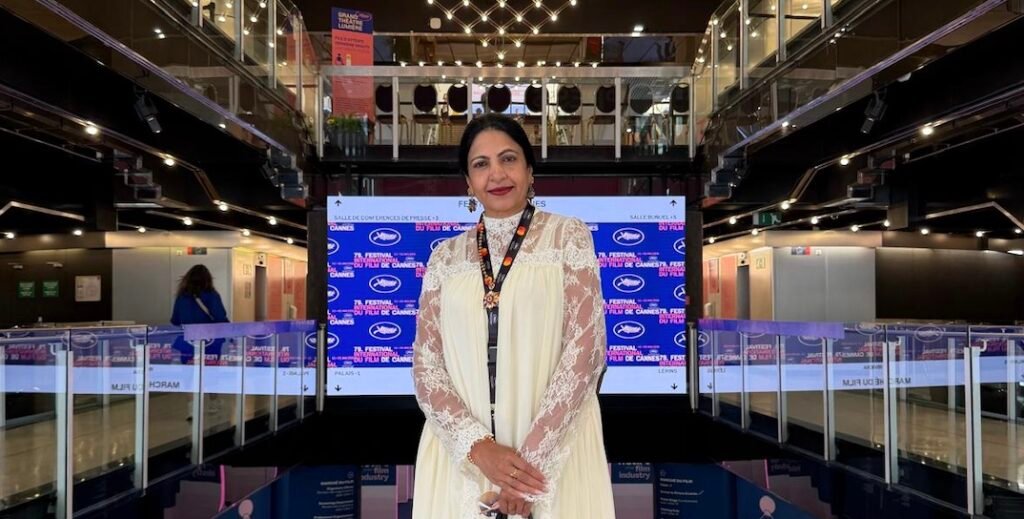
Arriving at the 79th Cannes Film Festival and Marché du Film, I was reminded once again why this extraordinary gathering captivates artists, dreamers, and visionaries from around the world. Set along the sunlit shores of the French Riviera, Cannes is far more than a film festival—it is a meeting place of cultures, ideas, and creative possibilities, shaping business trends, generating new economies, where narratives cross borders and resonate deeply with audiences.
As an Indian-origin American filmmaker, poet, lyricist, creative director, producer, and entrepreneur, my first journey to Cannes was filled with a sense of discovery and inspiration. Walking through the corridors of the Palais des Festivals, attending screenings, meeting filmmakers and industry leaders from across the globe, and experiencing the vibrant energy of the Marché du Film, I was reminded that cinema remains one of humanity’s most powerful languages.
For me, the experience was also deeply personal. As the writer-director of my debut feature *Vishwa Thulasi* I found myself reflecting on the extraordinary journey of storytelling—how stories travel across cultures, generations, and borders. Amid the celebrations of global cinema in Cannes, I was once again reminded that films are far more than entertainment; they are enduring expressions of our shared hopes, memories, identities, and humanity.
India’s connection with Cannes has always filled me with pride. From Neecha Nagar winning the festival’s highest honor in 1946 to Satyajit Ray’s Pather Panchali earning worldwide acclaim, Indian cinema has left an indelible imprint on world cinema. More recently, Payal Kapadia’s All We Imagine as Light received the Grand Prix, while Anasuya Sengupta made history as the first Indian performer to receive a major acting honor at Cannes. This year, seeing Payal Kapadia return as Chair of the Critics’ Week Jury president felt like another meaningful milestone in India’s growing international presence.
Advertisement
Through twelve inspiring days, I was immersed in conversations that extended far beyond film financing and distribution. I met studio executives, producers, directors, writers, journalists, film critics, trans-media consultants, ambassadors, artists, and cultural leaders from around the world. Each exchange reinforced my belief that cinema is more than entertainment—it is a bridge connecting people, communities, and nations while generating new economic opportunities through creativity and innovation.
One of the most rewarding aspects of this year’s Cannes journey was presenting my international projects and creative partnerships. At the center was LAJJAWATI, an ambitious trans-media universe spanning a feature film, limited series, literature, music, and immersive live performance. Rooted in resilience, transformation, and the strength of the human spirit, the project weaves Indian artistic traditions into a universal narrative that resonates across cultures. Inspired by the emotional grandeur of classic Bollywood and Hollywood musicals, it reimagines that legacy for contemporary audiences.
Alongside LAJJAWATI, I was honored to represent several international projects, including a Romanian historical biographical drama exploring identity and artistic legacy, a Tamil-language survival drama centered on resilience and human solidarity, a Japanese humanitarian documentary about recovery and hope, and a heartwarming children’s film celebrating friendship and the bond between humans and animals.
Many of these initiatives have evolved through my collaborations with three-time GRAMMY® Award-winning composer Ricky Kej. Together, we explore how cinema, music, humanitarian narratives, and live performance can advance conversations on peace, environmental stewardship, compassion, and global unity. Several projects are now expanding into orchestral and international concert presentations, allowing audiences to experience these works through both visual and musical expression.
Beyond project meetings and presentations, some of my most memorable moments occurred in unexpected places—over coffee, during quiet walks along the Croisette, and in gatherings where artists shared hopes for a more compassionate world. I attended screenings that challenged perceptions, joined industry discussions that sparked new ideas, and met inspiring women filmmakers, composers, critics, and changemakers.
I was also grateful to connect with members of the Indian delegation and representatives from the Ministry of Information and Broadcasting, whose presence reflected India’s growing influence in the global creative landscape. Throughout the festival, I often reflected on media visionary Biren Ghose’s observation I read on the news that nations lead not only through economics but through culture, innovation, and imagination. His words resonated deeply as I witnessed creators from diverse backgrounds shaping meaningful global conversations.
My own creative journey has intersected with Biren’s work through humanitarian media initiatives. In the UNICEF-associated project Life Song, I had the privilege of serving as music producer alongside Ricky Kej and Salim-Sulaiman, while Biren Ghose contributed as video producer with R. K. Chand. The project reflected a shared commitment to using music and visual media to inspire meaningful social change.
As Cannes unfolded, a recurring theme emerged across discussions, films, and personal interactions: the urgent need for empathy, tolerance, freedom of thought, and genuine human connection. In a world often divided by differences, the works celebrated at Cannes reminded us of our shared humanity.
As I reflect on my time at Cannes 2026, I return home with renewed inspiration and gratitude. I am grateful for the artists who paved the way before us, for the emerging voices who will shape the future, and for the opportunities to build meaningful connections across cultures and disciplines.
Most importantly, I leave with an enduring belief that art remains one of our greatest instruments of peace. Through cinema, music, poetry, and creative expression, we continue to discover one another—not as strangers separated by borders, but as human beings connected by dreams, compassion, and hope.
As the Mediterranean evening light faded over the Croisette on my final day in Cannes, I carried home more than meetings, screenings, and projects. I carried home a renewed conviction that art, at its best, reminds us not only who we are, but what we can become together. Cannes and the Marché du Film reaffirmed my belief that creativity is not merely a cultural force—it is also an economic one. Here, stories become intellectual property, ideas evolve into partnerships, and artistic vision fuels creative economies.
In an era defined by creativity and ingenuity, the future is ours to claim if we can bring together various perspectives under a common goal and turn our imaginative powers into meaningful change, leading to financial liberation.
Disclaimer: The opinions and views expressed in this article/column are those of the author(s) and do not necessarily reflect the views or positions of South Asian Herald.