Join WhatsApp Channel

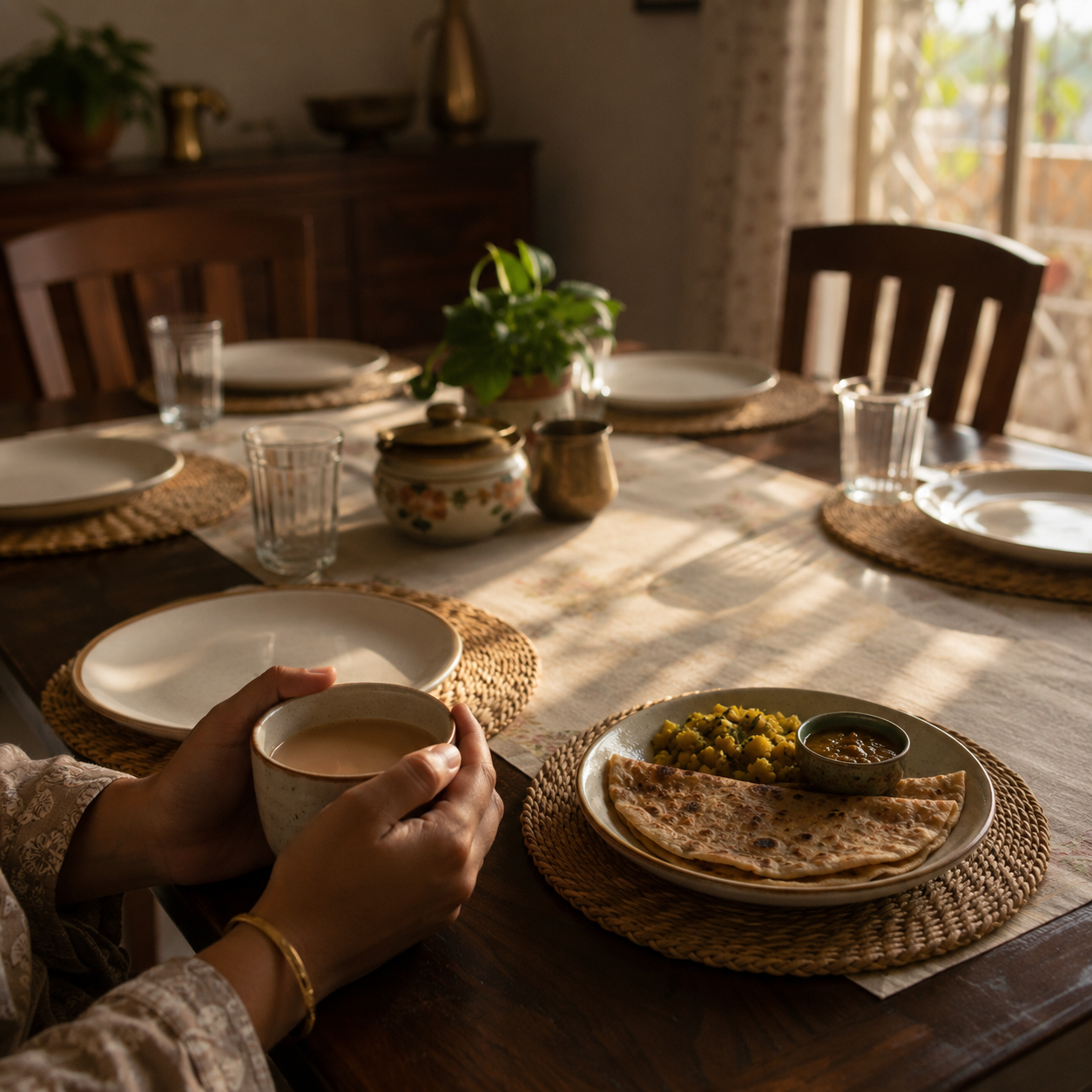
She woke up before the rest of the house, the way she always did. Made tea, rolled out parathas, set the table, packed the lunchboxes. But on this particular morning, before anyone came to the kitchen, she did something different. She put a paratha on a plate, poured herself a cup of tea at the temperature she liked, and sat down to eat. Quietly. Unhurriedly. Before anyone else had been served.
It was, by any measure, an ordinary act. A woman is eating breakfast in her own home.
And yet, if you have grown up in a household where the woman of the house eats last — after the children, the husband, the in-laws, the guests — you will understand that this small moment was anything but ordinary. She ate first. And in many homes, that sentence alone would be enough to shift the air in the room.
Nobody would say it directly, perhaps. But the word would hover, unspoken, in a glance or a joke made later to a relative. Selfish. Not as an accusation. Just as a quiet verdict, delivered so softly that even she might start to believe it.
When did we start using “selfish” to describe a woman who keeps something for herself? Not someone who takes from others or withholds love. Simply a woman who, before pouring into everyone else, pauses long enough to pour into herself first.
Somewhere across generations, a quiet definition of goodness took shape: a good woman gives first, eats last, needs least. Her value is measured not by what she keeps but by what she gives away. The mother who never sat down at the table. The grandmother who never bought anything for herself. That standard was passed down, quietly, plate by plate. And so, when a woman breaks it — even in the smallest way — something in the room tightens. Not because she has done anything wrong. But because her small act of self-preservation disrupts a pattern everyone around her has come to depend on.
Here is the distinction I believe is worth making, because the language around it has become muddled.
Self-care has become a fashionable word, but it is often reduced to indulgences — a spa day, a holiday, a face mask. These are pleasant. They are not the point. Self-respect is something far quieter and far more foundational. It is the steady belief that your needs are not an afterthought. That your hunger matters as much as anyone else’s at the table. That rest is not a reward you earn through exhaustion but something you deserve simply because you are a person in the house, not just a function of it.
Because the woman who always eats last does not just lose a meal. Over the years, she loses something harder to name — her preferences, her desires, sometimes her own voice. The selflessness that was supposed to make her admirable slowly makes her invisible, first to the people around her, then to herself.
The woman who ate first did not love her family any less that morning. She simply loved herself enough to stop being last.
That is not selfishness. It is the smallest, bravest act of self-respect — choosing to believe that she, too, deserves a warm plate.
Disclaimer: The opinions and views expressed in this article/column are those of the author(s) and do not necessarily reflect the views or positions of South Asian Herald.