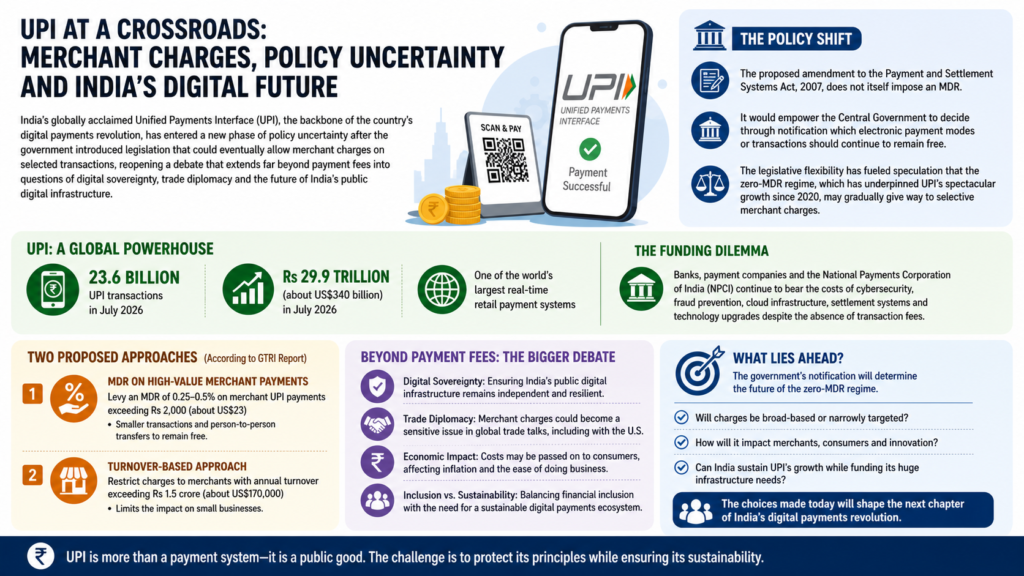
India’s globally acclaimed Unified Payments Interface (UPI), the backbone of the country’s digital payments revolution, has entered a new phase of policy uncertainty after the government introduced legislation that could eventually allow merchant charges on selected transactions, reopening a debate that extends far beyond payment fees into questions of digital sovereignty, trade diplomacy and the future of India’s public digital infrastructure.
While the proposed amendment to the Payment and Settlement Systems Act, 2007, does not itself impose a Merchant Discount Rate (MDR), it would empower the Central Government to decide through notification which electronic payment modes or transactions should continue to remain free. The legislative flexibility has fueled speculation that the zero-MDR regime, which has underpinned UPI’s spectacular growth since 2020, may gradually give way to selective merchant charges.
The debate comes at a pivotal moment. India processed 23.6 billion UPI transactions worth Rs 29.9 trillion (about US$340 billion) in July 2026 alone, making UPI one of the world’s largest real-time retail payment systems. Yet the very success of the platform has created a funding dilemma. Banks, payment companies and the National Payments Corporation of India (NPCI) continue to bear the costs of cybersecurity, fraud prevention, cloud infrastructure, settlement systems and technology upgrades despite the absence of transaction fees.
According to a report by the Global Trade Research Initiative (GTRI), policymakers are evaluating two possible approaches. One proposal would levy an MDR of 0.25-0.5 per cent on merchant UPI payments exceeding Rs 2,000 (about US$23) while keeping smaller transactions and person-to-person transfers free. Another option would restrict charges to merchants with annual turnover exceeding Rs 1.5 crore (about US$170,000), limiting the impact on small businesses.
Advertisement
Although merchants would formally pay the charges, economists say businesses are likely to recover the additional cost through higher prices, convenience fees or incentives for cash payments, ultimately affecting consumers.
Sustainability versus Strategy
The question confronting policymakers is not simply who pays for UPI, but how India finances a digital public infrastructure that has become indispensable to the economy without undermining financial inclusion or its strategic autonomy.
Reserve Bank of India Governor Sanjay Malhotra this week acknowledged the economic reality, saying that “someone will have to pay the cost” of maintaining the payments infrastructure, although he stressed that it was premature to conclude how the government would eventually recover those costs.
The GTRI report argues that introducing merchant charges is only one of several financing options. It suggests alternatives including targeted government support, cross-subsidization from other financial services, incentives for banks, or limited fees applicable only to large commercial transactions rather than a broad-based MDR.
Trade Policy Enters the Equation
What makes the debate unusually significant is its intersection with India’s increasingly complex trade relationship with the United States.
The Office of the U.S. Trade Representative’s 2026 National Trade Estimate Report criticized India’s digital payment policies, particularly the zero-MDR regime, government support for RuPay, payment-data localization requirements and proposed market-share limits for third-party payment applications.
The report grouped India’s policies with Brazil’s Pix instant-payment system, arguing that government-backed payment platforms disadvantage foreign payment companies such as Visa and Mastercard.
GTRI says the timing of the proposed legislative amendment has inevitably raised questions about whether New Delhi is attempting to create greater policy flexibility as trade negotiations with Washington continue.
Lessons from Brazil
The think tank points to Brazil as a cautionary example.
Despite facing a Section 301 investigation and an additional 25 per cent U.S. tariff on most Brazilian imports, Brazil refused to dilute its Pix payment system or abandon its policy framework. Brazilian authorities argued that the dispute was less about market access than about protecting the fee-based business models of international card companies.
GTRI argues that India’s response should be similarly guided by domestic economic interests rather than external commercial pressure.
Who Really Controls UPI?
Ironically, even as Washington argues that India discriminates against American payment firms, U.S.-linked companies already dominate the consumer-facing UPI market.
Google Pay and Walmart-owned PhonePe together process more than 80 per cent of all UPI transactions. NPCI’s proposal to cap the market share of individual payment applications at 30 per cent—intended to reduce concentration risk and encourage competition—has already been deferred until December 2026.
According to GTRI, the disagreement therefore centers less on market access and more on issues including market concentration, payment-data localization, RuPay’s preferential position and the limited fee income available to international payment networks under India’s public digital payments model.
Balancing Competition and Sovereignty
The report argues that India should retain payment-data localization rules because financial transaction data have significant regulatory, cybersecurity and national security implications. It also supports continued government backing for RuPay as a domestic card network capable of competing with Visa and Mastercard while reducing India’s dependence on foreign payment infrastructure.
For policymakers, the challenge extends well beyond deciding whether merchants should pay a fraction of a percentage point on digital transactions. The broader question is whether India can build a financially sustainable payments ecosystem while preserving the principles that made UPI a global model—low-cost access, interoperability, competition and public ownership.
As trade negotiations with Washington gather momentum, analysts say any future decision on merchant charges will be watched not only by banks and payment companies but also by governments seeking to replicate India’s Digital Public Infrastructure model.
For now, the proposed legislation merely creates the legal framework for future policy choices. But by opening the door to selective UPI charges, it has also reopened a much larger debate over who should pay for India’s digital economy—and who should shape its future.