
It is not easy to fight two different wars at the same time even if the two converge into a single canvas called economics. And it is certainly a challenge when an administration takes on a hugely unpopular task barely two months from a mid-term election where conventional wisdom speaks of a sitting President losing in an off-year political show.
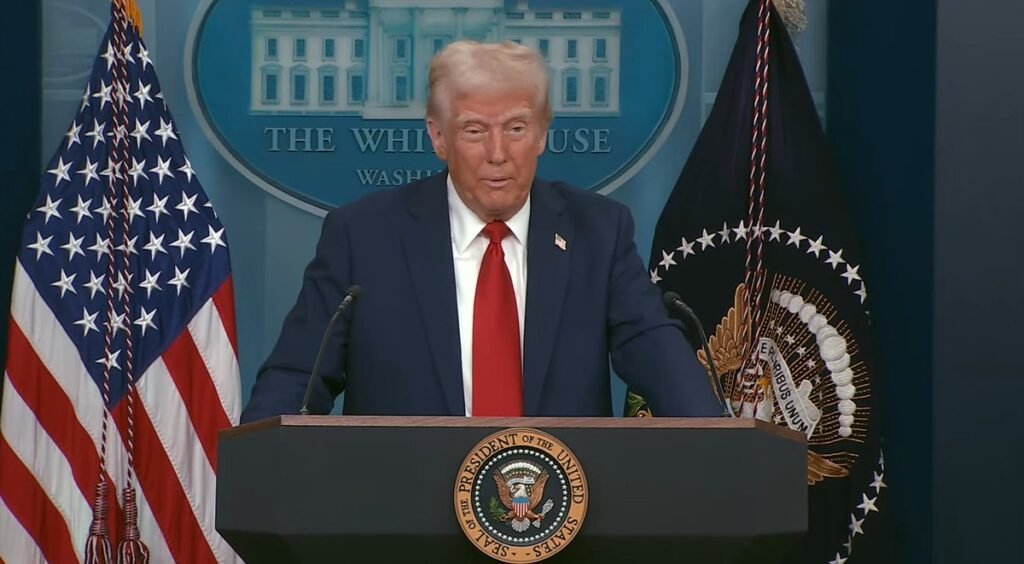
But that is where President Donald Trump finds himself in: struggling to end a war that is entering the seventh month, he has started looking for an economic way out of the mess by tightening the economic noose on Iran by threatening third countries doing business with it. The Economic Fury which is intended to make Iran an Outcast will bring the regime to its hands and knees looking for a deal. This is what Washington anticipates.
The second front that President Trump has opened is with Canada where in the absence of a trade accord, the United States has slapped a 50 percent tariffs on select goods with Ottawa responding on a rate between 15 to 50 percent, or what is put out as “dollar for dollar.” For all the occasional bickering and pot shots, few imagined that these “cousins” will actually end up in a trade war that, irrespective of who says what, will hurt both nations.
The United States and Canada have the biggest bilateral trade in the world of about US$ 900 billions annually. The only rhetoric that has not started flying around is an idea to start fencing the unguarded 9000-odd mile border. And in between, there was even an accusation that Washington had offended the sensitivities of the French culture and language of the province of Quebec.
Advertisement
The United States and Canada have been at this tariffs war or game since March 2025 on a variety of products. This time around American tariffs kicked on August 22, and Canada has announced retaliation on some 700 items for the tune of about US$ 28 billions that will go into effect on September 8. Still the hope that the two sides could and would walk back, provided neither side give in to the temptation of throwing words.
“You’re at war when you get attacked. We got attacked,” said Canadian Prime Minister Mark Carney who seems to be riding politically high in his standoff with President Trump. And Ontario’s Prime Minister Doug Ford has told a news agency that he is ready to escalate even further by cutting off his province’s shipments of electricity and critical minerals. President Trump called Ontario’s Ford “less intelligent” than his late brother Rob and a flunky of Prime Minister Carney. President Trump in turn was called a loser. So much for now.
The Republican Party and its law makers facing the mid terms of November 3 are watching anxiously as to how the latest war of tariffs and sanctions unfold. Both events in Canada and Iran would be on top of concerns of a voter in terms of high prices at grocery stores and gas pumps. Just at a time when everyone is looking for some relief. The top leadership of the Party says that President Trump will make it with flying colors even if ground realities do not point in that direction. One poll shows President Trump at an all time low in approval ratings at 33 percent. Still there is belief that the war in the Middle East will end soon enough to see political and electoral benefits. But the latest set of sanctions and punitive measures against third countries would seem to point in a different direction with no early end in sight to a war that no one is sure of why it began, its objectives and exit plans.
The latest set of measures announced against Iran are the most comprehensive set drawn up by Washington intended to fill the uncovered gaps of the last fifty years. Significantly Treasury Secretary Scott Bessant did not name China when he spoke of Operation Economic Outcast to punish countries doing any sort of business with Iran. Washington and the rest of the world know that Iran’s biggest source of economic and diplomatic support comes from China that buys billions of dollars’ worth of Iranian oil directly and from shadowy refineries called “Teapots.” Now the scale of sanctions is such that dollar payments of these so-called Teapots will also be in the radar as also the banks processing the transactions. And for all those who have found it fashionable to talk to alternatives to the dollar payment will now find it impossible to switch at short notices.
The initial response from Beijing has been along expected lines: that it will not be a passive spectator to sanctions and that it will safeguard its “legitimate” rights and interests. “Economic warfare and maximum pressure will not help resolve the issue; they will only further intensify tensions and conflicts, create spillover risks, disrupt the global economic and financial order,” China’s foreign ministry has said.
For all the unofficial connections between the Teapots and the mainland refineries and the ability of Washington to turn the screws on the subsidiaries with a view to pressuring the parent companies, Official China is unlikely to give the impression that it is running away from Iran because of the threat of secondary sanctions.
Beijing is unlikely to hold out a threat of cancelling the proposed visit of President X Jinping to the United States in September; but will surely hold out the prospect of retaliatory tariffs—as it has done before—and a threat to put a squeeze on the export of rare minerals so vital to America’s technology and defence. The outcome of President Xi’s visit is essentially in the hands of Washington: a summit on the future of bilateral economic and political relations with implications to the global order; or arguing about tariffs, sanctions and China’s role in the Iran war.
Disclaimer: The opinions and views expressed in this article/column are those of the author(s) and do not necessarily reflect the views or positions of South Asian Herald.