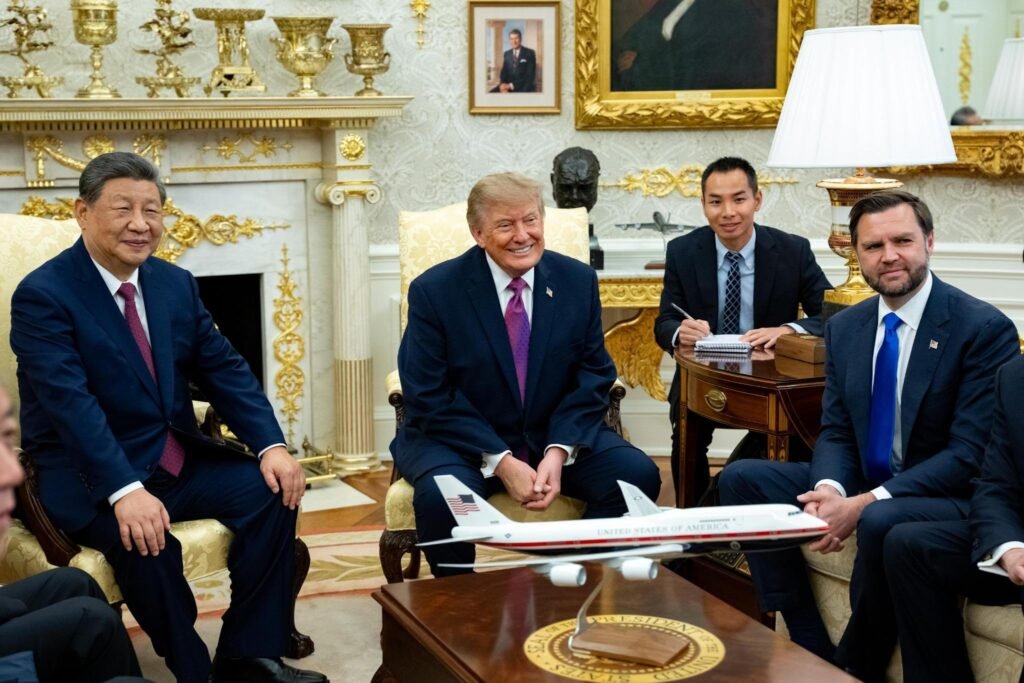
Memories are in short supply, especially in politics. In 2012 and before he had formally entered politics President Donald Trump slammed the then President Barack Obama for hosting then Chinese Vice President Xi Jinping. “So wrong! @Barack Obama is hosting China’s VP Xi Jinping at the Pentagon with full honor ceremony with music and cannons” President Trump wrote fourteen years ago that little knowing he will be trolled today for what he had done. He not only went to the Andrews Air Force Base, a rare protocol gesture and welcomed his guest with a fighter jet providing a noisy backdrop as the national anthem was being played.
It certainly was not reminiscent of President Richard Nixon meeting Chairman Mao Zedong or of President Ronald Reagan meeting the President of the then Soviet Union Mikhail Gorbachev. Both were hailed as history making events: the first for the United States opening out to China in 1972; and the second in 1988 marking the beginning of the end of the Cold War and the eventual break-up of a once dreaded empire.
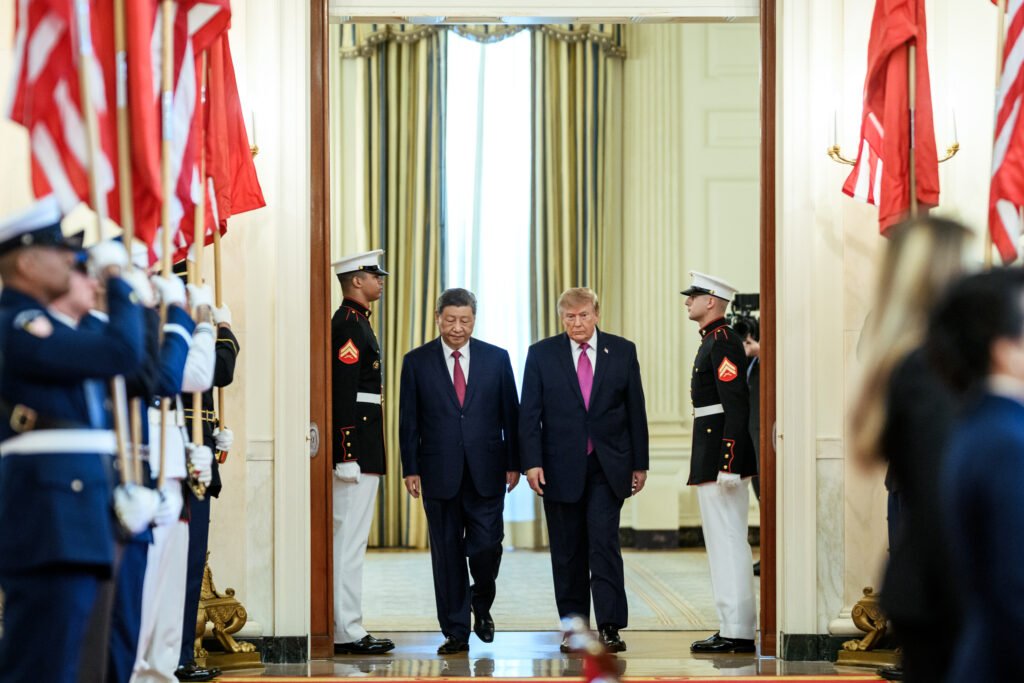
But today’s setting for the United States-China meeting is quite different. If the two summits in a span of four months are anything to go by, it has only reinforced an image of a confident China willing to stand up to anything that is thrown at it by way of tariffs or the threat of primary and secondary sanctions. And President Trump has shown to his visitor of doing much better than President Obama’s “music and cannons.”
The optics at the Air Force Base or the White House cannot mask the atmospherics which is one of a genuine apprehension of where this relationship is heading, bilaterally and to the world at large. For all the tough language, rants and posturing during and after the passage of the Lindsey Graham Sanctioning Russia and Iran Act of 2026, Washington finds itself in a really awkward situation of being unable tell President Xi that he is slammed with a 100 percent tariffs for buying 50 percent of his crude oil needs from Russia.
Advertisement
In fact, for all the noise on the Graham Bill, there is the quiet takeaway that Washington and Beijing had agreed to extend the trade truce until January 2027. The real difficulty for Washington is in a painful realization that even with a US$ 200 billion surplus, China had the capacity to squeeze the United States in not only the export of rare earths but also in a potential of going back on the promise of buying some US$ 15 billions worth of agricultural products.
Trade is not the only item on the agenda even if the White House did not fashion it that way. With about six weeks left for a crucial mid-term elections, one of the slim chances has been pinned on an end to the war with Iran with no one in America really happy the price of petrol and diesel at the pumps, the latter now showing signs of coming near the US$ 8 per gallon. And it does not take a rocket scientist to figure out that a spike in transportation charges will be ultimately passed on to the consumer.
China has been relatively quiet in the Middle East war except for occasionally putting out statements for the conflict to end. But hawks in the foreign policy establishment have been saying that Beijing has been quietly helping Tehran, especially in providing critical satellite images enabling more accurate targeting by Iran. And if the statements in New York at the United Nations General Assembly is anything to go by, the United States and Iran are quite far apart.
It remains to be seen in the next few days how President Trump and his allies spin the positives of President Xi’s trip going beyond looking at the two countries in a cooperative framework as opposed to rivals. This is especially so when it comes to how Washington and Beijing are going to manage the future trajectory of Artificial Intelligence other than merely saying that it should be in the hands of humans. “We have both the capability and responsibility to develop and manage AI for good and ensure that the development of AI is always under human control and serves the well-being of the people,” President Xi said at the White House.
There is perceptible unease in the Asia Pacific on what China and the United States might have said on Taiwan, Beijing continually asserting that the issue of re-unification is on the top foreign policy agenda, even by force if necessary. Little has come by this summit as the previous one came up with a shocker by way of silence followed by the Trump administration putting on hold a US$ 14 arms package to Taipei saying that it could be used as a “bargaining chip” with China, seen as giving a veto in a process that has legal and legislative stipulations to American administrations.
To Republican law makers, all this pageantry will have to translate into votes this Fall failing which the legislative agenda of the President is finished. There is already a feeling that the United States’ position in the global scheme of things has been considerably weakened politically, not just by the conflict in the Middle East but by allies and alliances feeling ruffled and hence going about on their own with China. Canada is an example.
And senior Republicans like Senator Roger Wicker, Chairman of the Armed Services Committee question whether President Trump should have even met President Xi. “Our commander in chief should keep in mind that his guest is a brutal, unelected and oppressive dictator who seeks to dominate his neighbors and whose massive military arsenal is aimed directly at the United States of America.”
Disclaimer: The opinions and views expressed in this article/column are those of the author(s) and do not necessarily reflect the views or positions of South Asian Herald.