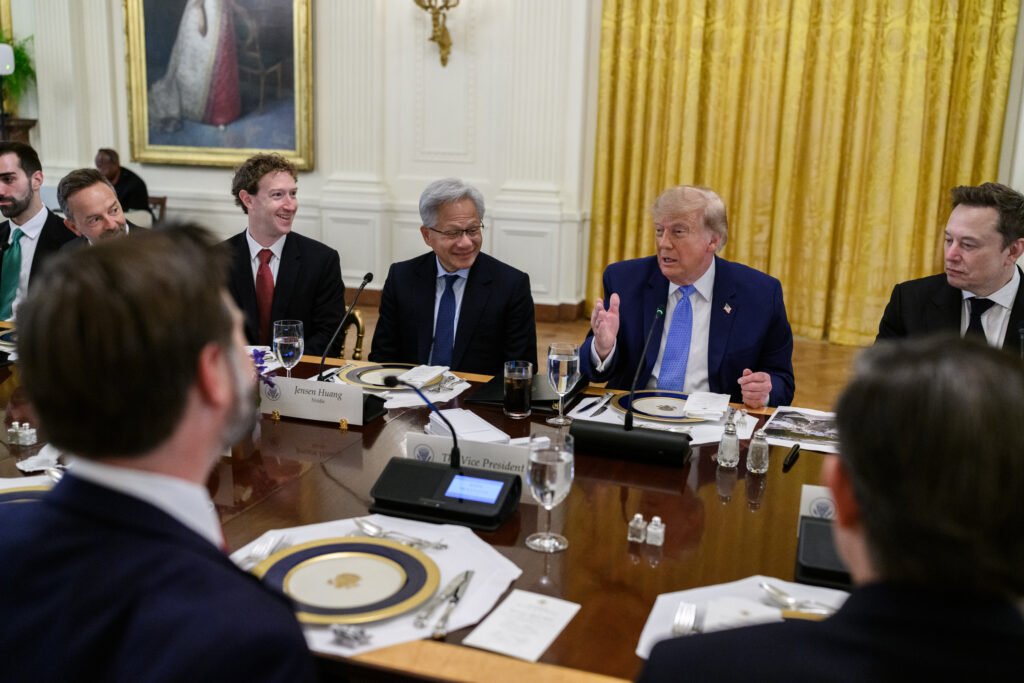
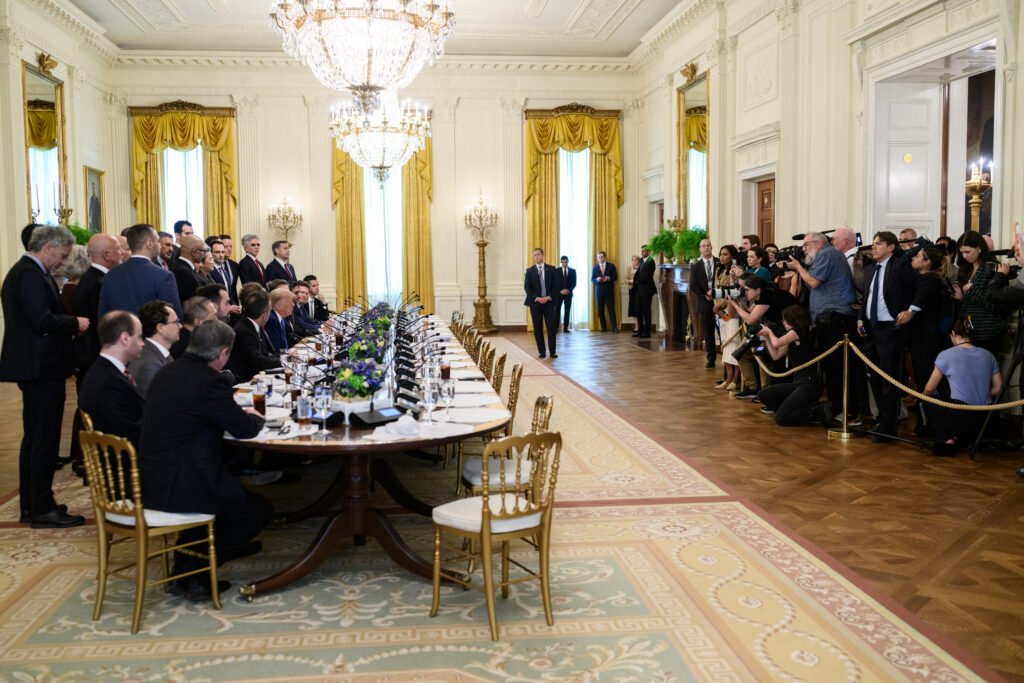
President Donald Trump announced that the executive branch would replace the term “Artificial Intelligence” with “Super Intelligence,” while joining technology executives to discuss an industry accord addressing the development and safety of the technology.
A White House fact sheet released September 29 said Trump signed an executive order directing the terminology change across the executive branch. The administration described the decision as recognition of the advancing technological frontier and the opportunities it could offer Americans.
The order directs departments and agencies to use “Super Intelligence” and “SI” in official correspondence, public communications, policy documents, and non-statutory documents, replacing references to “Artificial Intelligence” and “AI.” It also instructs the Assistant to the President for Science and Technology (APST) to propose a federal definition of the new terms reflecting the technology’s development. The APST is additionally tasked with identifying further executive actions needed to implement that proposed definition throughout the executive branch.
“It’s not AI. It’s SI. We’ve changed the name officially today… The name has been officially changed by the biggest, the smartest, the greatest people anywhere in the world,” Trump told White House reporters alongside technology executives.
Advertisement
Asked whether the White House Accord on SI would hold, Trump described it as “morally binding,” citing the participation of prominent industry leaders.
“I don’t know if that’s ever going to be assembled again. But that was a who’s who of that world. And I think it’s a very special day. They almost viewed it as a separate kind of a constitution,” he said.
Responding to a question about his position that SI did not need guardrails, Trump said, “I’m seeing tremendous self-policing.” He described the models as complex and said he expected them to be used for beneficial purposes. He also said he was considering establishing a committee of approximately 10 people to oversee the broader enterprise. The proposed committee, as Trump described it, would watch over the industry’s activities. He linked that idea to his expectation that companies would monitor themselves as the technology continued to develop.
Asked about the technology’s use by good and bad actors, Trump pointed to potential medical advances. He said researchers were already finding solutions to problems previously considered beyond reach, alongside other applications he viewed positively. He maintained that those who misused the technology would be caught, citing the roles of the Justice Department, FBI, and CIA.
“Remember this: whoever wins SI, because now we’re calling it again super. We’re using the word super, because the other word is a fake word. It’s not an appropriate word. Whoever wins SI is going to win,” he said.
Addressing public resistance to expanding data centers, Trump said he expected companies to support host communities financially and through other contributions. He suggested that assistance could include support for schools, teachers, and teacher pay, describing such arrangements as potential partnerships between companies and communities.
Trump also claimed that communities with data centers had generally benefited from increased investment, lower taxes, higher incomes, and rising housing values. He said companies opening facilities would be generous toward residents and that partnerships could provide financial and other benefits. His comments framed community investment as central to gaining support for the facilities. He said the companies would help the people who welcomed them, including through contributions to education. Trump described the potential relationship as one in which businesses and residents would benefit from facilities opening in their communities.
Asked whether his backing of data centers could hurt Republicans in the midterm elections, Trump reiterated that companies would form partnerships with communities. He said those arrangements would benefit local residents and help address concerns surrounding the infrastructure expansion.
House Speaker Mike Johnson said Republican congressional candidates and incumbents were discussing the issue with constituents.
“Our candidates for Congress right now, the Republicans in the House, our candidates and our incumbents are out in their communities right now, as we speak, communicating on this. They’re saying we cannot lose the race to China. We cannot lose America’s edge because it’s important for every American worker, every American family, for their safety, security, the future, the economy,” he said.
Johnson said technological development must be balanced with community concerns. He noted that industry leaders agreed on the need to address those concerns and make commitments to local communities, a responsibility Trump emphasized during the meeting.
As an example, Johnson cited the House’s passage of the Ratepayer Protection Act approximately three weeks earlier, with almost no opposition. He said the legislation codified Trump’s ratepayer protection pledge, under which companies would generate the energy needed for their Super Intelligence infrastructure and, in most cases, supply power back to the grid. Johnson emphasized that companies must earn residents’ trust and address local concerns while advancing innovation, supporting national security, and maintaining America’s position as a global superpower.
NVIDIA President and CEO Jensen Huang described the expansion as a major source of employment.
“Well, this is the largest industrial revolution in history, and we’re going through the single largest infrastructure buildout in human history, and so it’s creating a million jobs here in the United States,” he said.
“We have chip plants coming up, computer plants coming up, AI factories coming up, and so it’s creating just an enormous amount of jobs,” Huang added.
Beyond infrastructure construction, Huang said several hundred billion dollars in venture capital had supported new businesses. He said tens of thousands of those companies were also generating employment. Huang presented the construction of plants and computing facilities, together with the formation of new businesses, as connected sources of job creation. His remarks covered both the infrastructure supporting the technology and companies using it.
“There’s no conflict between innovation, technology, and safety. We are going to have to create new technologies to advance the capabilities of AI, but we’re also creating new technologies to advance the safety of AI,” he said.
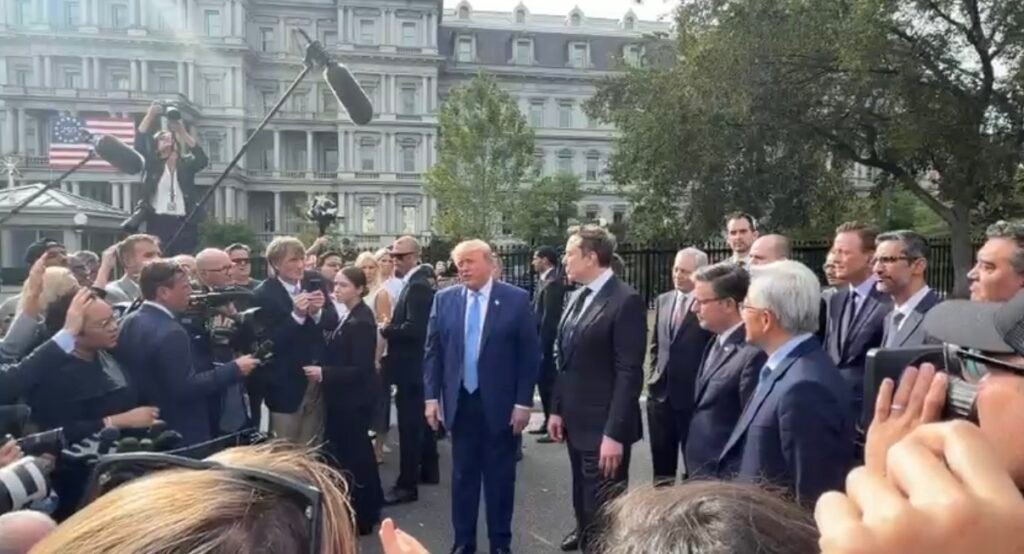
“All of this technology is being developed by the industry today, and you see behind me just an incredible number of leaders in our industry moving together as one,” Huang added. He said industry leaders intended to develop the technology responsibly and safely, describing it as consequential for humanity and America’s future prosperity.
OpenAI President Greg Brockman pointed to opportunities for small businesses, scientific research, and drug development.
“We build artificial intelligence to benefit everyone. We think it can lift everyone up. We see a whole renaissance of small businesses, scientific discoveries really starting to happen,” he said.
Brockman said drug development could improve people’s lives and expressed confidence that the accords agreed upon under Trump’s leadership would help the industry move forward safely.
“I think that’s just so important because we’re doing this in order to benefit people in the world,” he added.
Anthropic CEO Dario Amodei discussed both the technology’s potential benefits and its risks.
“I will say what I’ve always said, which is that AI has incredible benefits. I’ve talked about the medical benefits of the technology. I think that’s very important,” he said.
Amodei acknowledged that the technology carried real risks and said the mechanism for addressing them remained under discussion.
“But we all need to work. We all need to work together to make sure that we win and we can win safely. If we do this right, if we work with the president and everyone here, we can win safely,” he said.
Meta CEO Mark Zuckerberg said the participating leaders had signed the White House Accord on developing the technology safely.
“The basic idea is that we want to give the American people and our customers confidence that the technology works in the way that we intend,” he said, noting that each company was developing somewhat different products.
Zuckerberg said the accord outlined principles and commitments for robust internal controls and identifying problems with the technology. He described multiple layers of review, including internal risk assessments, external auditors and evaluators, and independent reviews by company boards of reports submitted by auditors. He said these reviews would accompany efforts to detect issues and strengthen internal oversight, with company boards independently examining the findings presented to them.
“I think that these are good steps forward. The idea isn’t that this is the only thing that we will ever do; it is that this is a start and an accord that the whole industry could come to,” he said.
“And I was very proud to have that discussion with a number of our colleagues who I think are running great companies. It was sort of a historic conversation. I don’t think anything like this has come before, and I think this is a meaningful step forward,” Zuckerberg added.
Inviting Sundar Pichai to address reporters, Trump jokingly said “This guy is a monster and nobody knows him.” Pichai smiled and replied, “Hopefully, a better tagline than I’m a monster.”
“I think this moment is historic and consequential, and I think there are extraordinary benefits to this technology. You can see it in the GDP growth. We have to make sure we are addressing the risks, and the president has asked us in industry to step up, and we want to make sure we’re putting our products out safely,” Pichai said.
“And as Mark said, we are signing up to a set of processes and controls, like we do in other areas like financial controls in a company, and we are bringing those well-known best practices through the development of this accord,” he added.
Asked about the possibility of China overtaking the United States in SI, Trump said he did not expect that outcome unless American policies pushed companies to operate elsewhere.
“We want them built in this country. It’s massive income. People’s taxes are going to go down. It’s going to pay off debt. It’s growth. This is growth like nobody’s ever seen before,” he said.
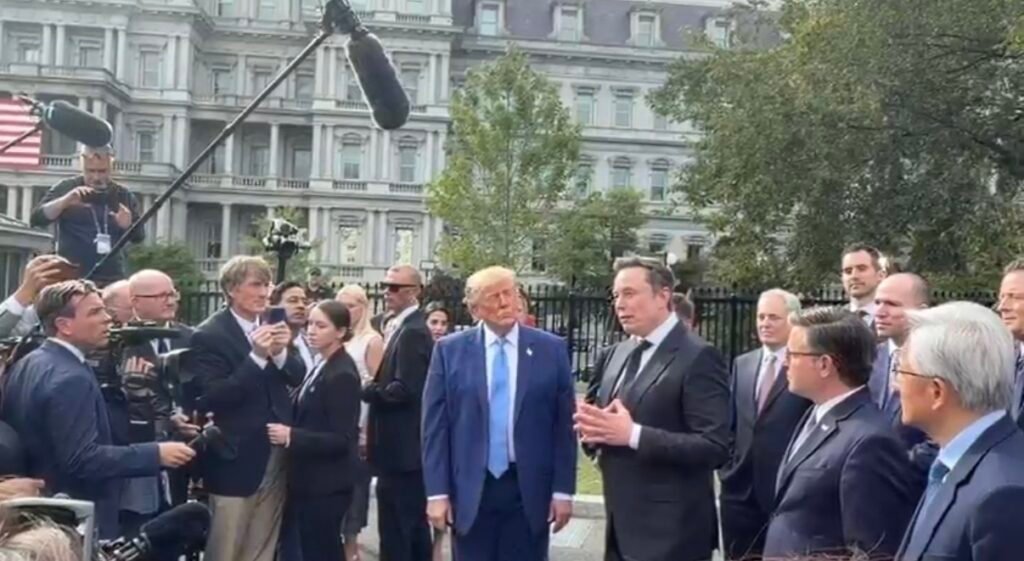
Trump said he and Elon Musk, whose companies include Tesla, SpaceX, and X, had recently met with Chinese President Xi Jinping. According to Trump, Xi said China would take any data centers the United States did not want.
“He would love to have every single one because, you know why? They’re smart. They want every data center. They want it because that’s great for China,” Trump said.
Musk described an optimistic outlook for SI, particularly its potential effects on incomes and access to medical treatment.
“I think by far the most likely outcome is an age of abundance, where we don’t have just universal basic income; we have universal high income,” he said.
Musk said the medical benefits deserved further discussion, suggesting that robotics and superintelligence could expand access to care around the world.
“When you have robots and you have superintelligence, it means that everyone in the world can get better medical care than anyone here, including me, and wouldn’t that be wonderful?” he said, while acknowledging that jobs would change.
“So I think we’ll see an evolution of robots,” Musk said.
He also referred to Trump’s comments about employment and demand for workers, expressing his view that the most likely outcome would be beneficial. His remarks acknowledged changes in the workplace while emphasizing the opportunities he expected the technology to create.
Asked about appointing an SI czar, Trump said a decision was approaching. He outlined plans to seek input before announcing his selection.
“I’m very close to making a decision. I’ll be naming. I’d say over the next three or four days,” he said.
Trump added that he wanted to consult the participating companies, Johnson, John Thune, and others before making the appointment.