The episode of Yaksha-prashna is one of the more interesting portions of the Indian epic Mahabharata, where a Yaksha, a demigod or celestial being, asks a series of questions (prashna in Hindi/Sanskrit) to the eldest of the Pandava brothers – the heroes of the epic.
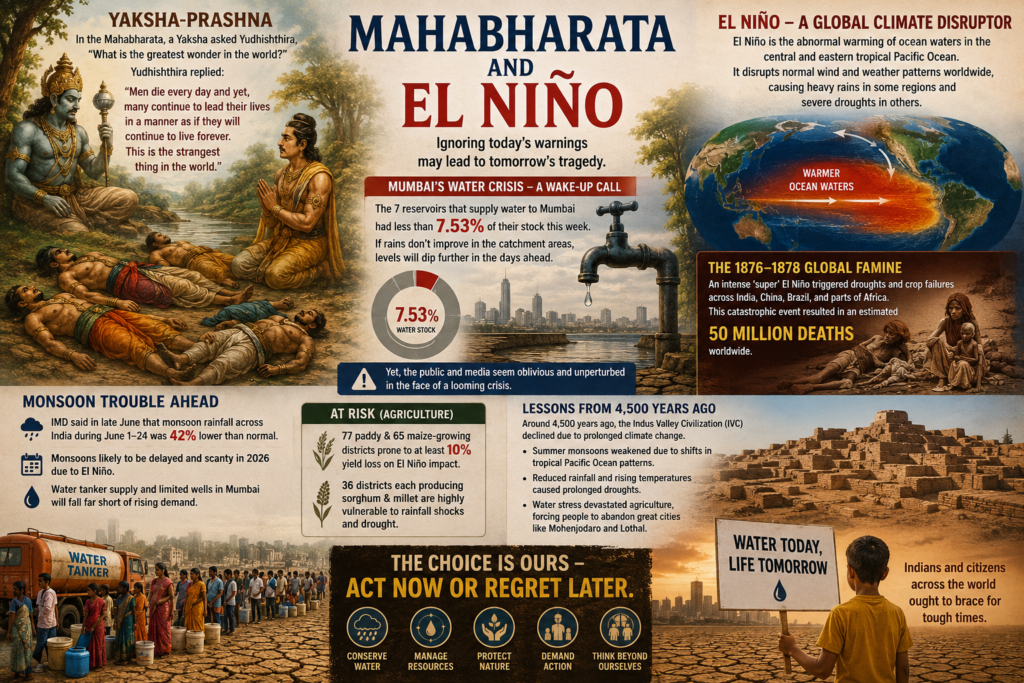
Among many questions, the Yaksha asks Yudhishthira, what is greatest wonder (strange thing) in the world? To that Yudhishthira, the eldest of the Pandava-s replies, “Men die every day and yet, many continue to lead their lives in a manner as if they will continue to live forever. This is the strangest thing in the world.”
I find a strange correlation between this story and what’s unfolding in Mumbai, my hometown, now.
The seven reservoirs that supply water to Mumbai had less than 7.53% of their stock this week. The water levels would surely dip further during the next few days if there is insufficient rains in the catchment areas.
Advertisement
Going by the predictions of the weather bureau, there is going to be a serious water deficit across India and especially in Western, Central and Northern India. The India Meteorological Department said in late June that monsoon rainfall across the country during June 1-24 was 42 per cent lower than normal with only 21 per cent of the geographical areas received average rainfall.
Yet, the general public and media seem to be oblivious and unperturbed in the face of a looming crisis. I am all the more anxious and worried as unlike previous years, the monsoons are likely to be delayed and remain scanty in 2026 due to the El Niño. If indeed, my apprehensions come true, how will Mumbaikars and fellow Indians in affected areas quench their thirst?
El Niño is a climate phenomenon characterized by the abnormal warming of surface ocean waters in the central and eastern tropical Pacific Ocean. It disrupts normal wind and weather patterns worldwide, often causing heavy rainfall in some regions and severe droughts in others.
The Global Famine of 1876-1878 was arguably the most lethal El Niño event as an intense ‘super’ El Niño caused cascading droughts and crop failures across India, China, Brazil, and parts of Africa. This triggered famines that resulted in an estimated 50 million deaths worldwide.
Reverting to Mahabharata’s Yaksha-prashna, that episode started with a ‘water crisis’, where four Pandava brothers died one by one after disregarding the warnings of the Yaksha. While another water crisis is looming before the citizens of Mumbai and India, what is the government doing? Mumbai’s case is particularly severe as the few freshwater wells that supply water through tankers to parched areas in Mumbai will certainly fall way short to meet the rising demand.
Around 4,500 years ago, civilization in the Indus Valley region began to decline as people migrated eastward to the Gangetic plains. Here, they shifted from a civilization – highlighted by large cities such as Mohenjodaro and Lothal – to one mostly comprising small farming villages. By 1800 BCE, most Harappan cities were almost completely abandoned.
Historians and archaeologists attribute the decline of the Indus Valley Civilization (IVC) to prolonged climate change among other reasons. Extensive paleoclimatic studies and stalagmite analyses indicate that summer monsoons gradually weakened in IVC due to shifts in tropical Pacific Ocean patterns. This caused reduced rainfall and rising temperatures over several centuries, which in turn led to prolonged droughts. This resulting landscape dehydration and long-term water stress severely impacted agricultural output, forcing communities to evacuate from the cities.
Some 4,500 years later, the country’s 77 paddy and 65 maize-growing districts are prone to at least 10% yield loss on El Niño impact, says the Union agriculture ministry. Worse, 36 districts each producing sorghum and millet are supposedly particularly susceptible to rainfall shocks associated with drought-bearing weather conditions.
Indians as well as citizens from across the world ought to brace for tough times.
Disclaimer: The opinions and views expressed in this article/column are those of the author(s) and do not necessarily reflect the views or positions of South Asian Herald.