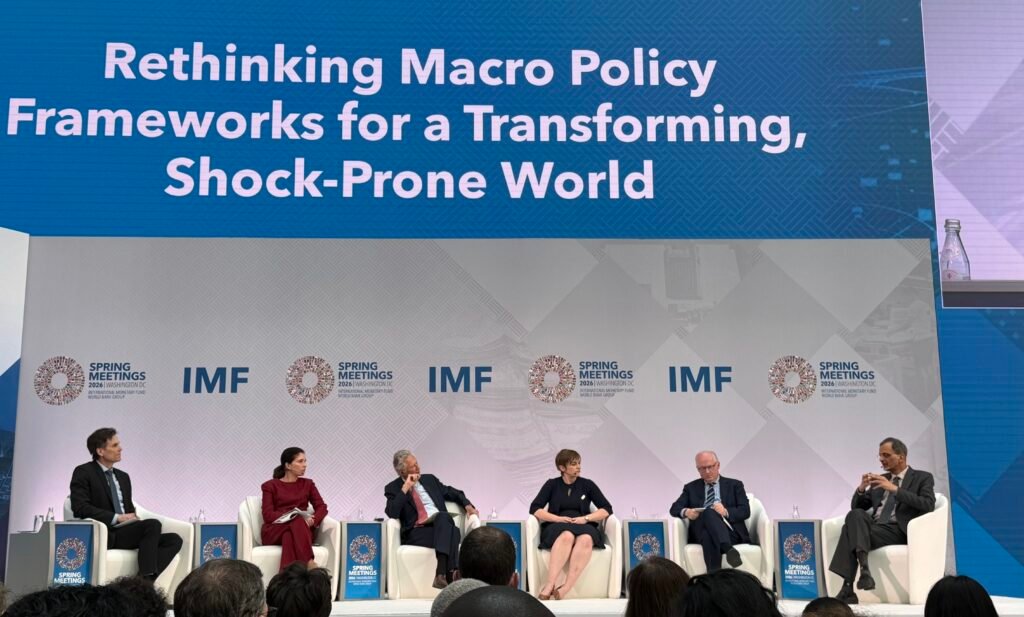
India’s Chief Economic Advisor Anantha Nageswaran emphasized the need for flexible and forward-looking policymaking as global economies navigate overlapping structural shifts, during a panel discussion at the IMF and World Bank Spring Meetings 2026 in Washington, DC.
Speaking on April 16 at a session titled “Rethinking Macro Policy Frameworks for a Transforming, Shock Prone World,” Nageswaran joined global economic leaders to examine whether traditional macroeconomic policy frameworks remain effective amid rapid and overlapping structural changes.
The discussion explored how fiscal, monetary, and external sector policies are being tested by shifting global dynamics, including demographic transitions, climate change, geoeconomic fragmentation, and the rise of artificial intelligence.
Highlighting India’s economic outlook, Nageswaran noted that demographics continue to provide a structural advantage. He described the country’s demographic profile as a “tailwind” that supports fiscal revenue growth, particularly when combined with ongoing formalization of the economy.
Advertisement
Addressing the growing attention around artificial intelligence, he cautioned against overestimating its immediate impact on labor markets. Referring to recent market developments, he said, “I think we probably are justified in thinking that much of the hype and the fears about AI could be overstated, and the impact on the labor market might take a long time to play out, which is in a way good thing giving more time for emerging economies like India, which has a huge job creation responsibility for it to play out.”
On climate change and the global energy transition, Nageswaran pointed to the fiscal challenges associated with shifting away from fossil fuels. He noted that significant upfront investments will be required for renewable energy infrastructure, while traditional revenue streams from fuel taxation may decline over time. As a result, he suggested that the transition could act as a fiscal burden in the near term, although it may eventually become beneficial in the long run.
Turning to geopolitics, Nageswaran said rising global tensions are likely to increase government spending on security and strategic reserves. He highlighted the need for countries to build buffers in essential commodities such as crude oil, metals, and food staples, noting that such measures will add to fiscal pressures.
In this context, he underscored the importance of a more dynamic approach to policymaking. “Policy making has to become entrepreneurial in nature,” he said, adding that “We should be prepared to make mistakes and not make the best, the enemy of the good in decision making. And we should be prepared to reverse them if they are reversible.”
Nageswaran also outlined how India has sought to balance economic support with fiscal discipline in the post-pandemic period. He noted that India’s public debt-to-GDP ratio has declined by seven percentage points since the COVID-19 pandemic, in contrast to a global increase of about ten percentage points.
“We have therefore managed to consolidate public finances by reorienting the quality of expenditure. The ratio between revenue and capital expenditure used to be between 88 and 12,” he said. “Now 22% of it is capital expenditure, which naturally has a higher multiplier, and only 78% is revenue expenditure.”
He highlighted the use of technology-driven welfare delivery systems, particularly direct benefit transfers, as a key reform that has improved efficiency and reduced leakages in government spending. Additionally, he pointed to fiscal prudence as a factor in lowering India’s risk premium, noting that the spread between India’s 10-year borrowing cost and U.S. Treasury yields has narrowed significantly over the past decade.
Looking ahead, Nageswaran identified the effective utilization of the demographic dividend as a central priority for emerging economies. He stressed that investments in education and skill development, especially in areas less vulnerable to automation, will be critical to sustaining growth.
He also highlighted a less discussed but increasingly important concern. “The moment we speak of demographic dividend, our minds turn to education and skilling, but we don’t pay attention to the mental and emotional health dimensions which these technologies are now extracting a heavy toll out of,” he said.
He added that addressing these broader social challenges will be essential to maintaining long-term productivity and fiscal stability. “Therefore, when we talk of fiscal policy and demographic dividend, it is about all these dimensions, and if we take care of them it will ensure growth is sustained, fiscal buffers are maintained, and enabling us to handle the tradeoffs,” he added.
The panel also featured Laura Alfaro, Chief Economist of the Inter-American Development Bank; Olivier Blanchard, Professor Emeritus at the Massachusetts Institute of Technology; Philip Lane, Chief Economist of the European Central Bank; and Sarah Hunter, Chief Economist at the Reserve Bank of Australia. The session was moderated by Christian Mumssen, Director of the IMF’s Strategy, Policy, and Review Department.