
A single cyber fraud complaint did not lead investigators to the masterminds. The money did.
That digital money trail—spanning more than 5,000 mule bank accounts, cryptocurrency wallets and multiple foreign jurisdictions—eventually exposed one of India’s largest cyber-enabled money laundering networks, involving nearly Rs 868 crore (about US$101 million) in illicit proceeds.
The investigation has now earned India’s Financial Intelligence Unit (FIU-IND) international recognition, with the agency being named runner-up for the Best Egmont Case Award (BECA) 2026 at the Egmont Group Plenary in Baku, Azerbaijan, one of the highest honors for financial intelligence agencies worldwide.
The case illustrates how financial crime investigations are increasingly won not through confessions or undercover operations, but by reconstructing the movement of money across banking systems, payment platforms and digital assets.
Advertisement
The investigation began after the Indian Cyber Crime Coordination Centre (I4C) alerted FIU-IND to suspicious transactions linked to an organized cyber fraud. Rather than pursuing individual fraud complaints, FIU analysts started building a financial map of where the stolen money had travelled.
Their first discovery was the scale of the laundering operation.
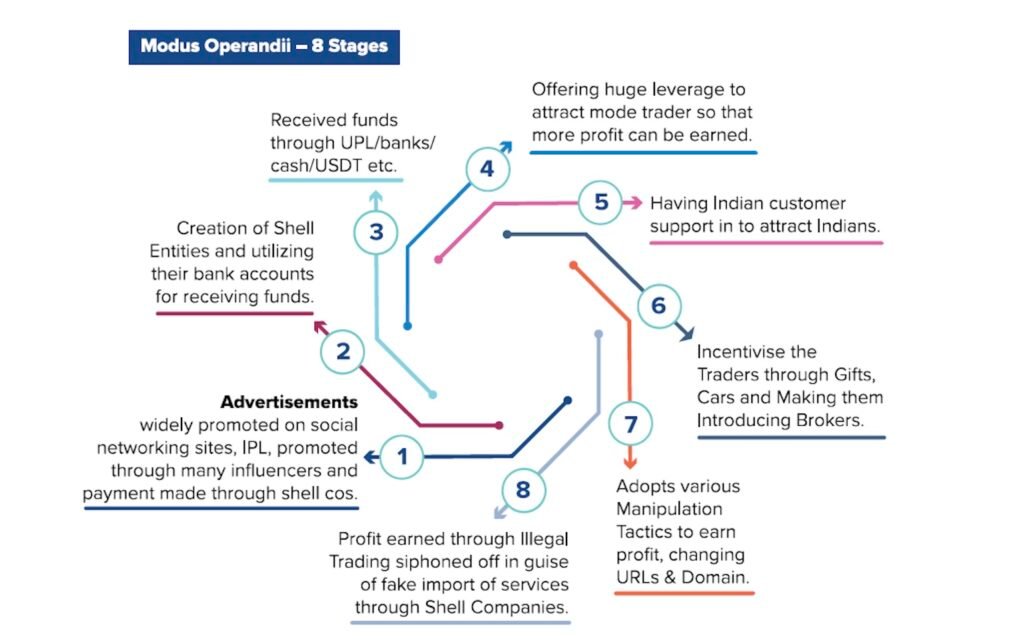
Instead of moving money directly to the criminals, the proceeds were broken into thousands of transactions and routed through more than 5,000 mule accounts—bank accounts opened or controlled by individuals acting on behalf of criminal networks. The accounts received stolen funds, transferred them within minutes to other accounts and ultimately channeled them into cryptocurrency, creating multiple layers designed to frustrate investigators.
Using advanced financial intelligence tools, FIU-IND analysts reconstructed these transaction chains account by account. They examined suspicious transaction reports filed by banks, analyzed cash deposits, payment patterns and fund transfers, and overlaid them with cyber-fraud intelligence received from I4C. The analysis revealed clusters of accounts moving money in identical patterns, exposing a coordinated laundering network rather than isolated fraud incidents.
The next challenge lay beyond India’s borders.
Investigators found that significant portions of the proceeds had been converted into virtual digital assets and transferred through cryptocurrency wallets across multiple jurisdictions. Every conversion added another layer of anonymity, making traditional law enforcement techniques less effective.
To pierce that veil, FIU-IND turned to the Egmont Secure Web, the encrypted intelligence-sharing platform connecting Financial Intelligence Units in 182 countries.
Through the platform, Indian investigators exchanged financial intelligence with counterpart FIUs overseas, requesting information on wallet ownership, transaction histories, exchange platforms and beneficiary accounts. The international cooperation enabled investigators to follow cryptocurrency transfers across borders, identify linked entities and reconstruct the global laundering trail.
Rather than chasing criminals’ country by country, investigators followed the money wherever it moved.
FIU-IND’s analytical work culminated in a detailed Operational Analysis Report that transformed raw financial data into actionable intelligence. The report identified the key entities involved, mapped the relationships between mule accounts, cryptocurrency wallets and beneficiaries, and highlighted the methods used to disguise the proceeds of crime.
That intelligence became the blueprint for enforcement action.
Acting on FIU-IND’s findings, the Directorate of Enforcement carried out coordinated searches at 13 locations. Authorities seized Rs 47 lakh (about US$55,000) in cash, froze cryptocurrency holdings valued at approximately Rs 13.6 crore (US$1.58 million), attached assets worth Rs 8.67 crore (about US$1 million) and filed two prosecution complaints under the Prevention of Money Laundering Act.
According to the Egmont case summary, investigators also identified overseas beneficiaries, uncovered previously unknown financial linkages, and generated intelligence that helped authorities freeze accounts, prevent further losses and strengthen future investigations into cyber-enabled financial crime.
Beyond the seizures, the case marks a shift in how India combats organized financial crime. As cyber fraud increasingly exploits digital payments, cryptocurrencies and cross-border transfers, financial intelligence has become the first line of defense. Instead of treating banks as passive victims, investigators now use banking data, suspicious transaction reports, digital payment records and blockchain analytics to identify criminal networks before they disappear behind layers of technology.
The international recognition is also significant for India’s financial sector. FIU-IND was one of only two finalists selected from submissions by 182 member jurisdictions of the Egmont Group, reflecting the growing sophistication of India’s anti-money laundering capabilities and its expanding role in global efforts to combat cyber-enabled financial crime.
For banks, fintech firms and cryptocurrency service providers, the investigation underscores a new reality: the next breakthrough in financial crime is increasingly likely to come not from a crime scene, but from an analyst who can connect thousands of seemingly unrelated transactions into a single, global money trail.