Join WhatsApp Channel

The United States is witnessing an unexpected contraction in its labor force as tighter immigration policies under President Donald Trump’s second administration reduce the number of foreign-born workers without producing the anticipated gains in employment for U.S.-born workers, according to a new analysis by the National Foundation for American Policy (NFAP).
Drawing on June 2026 data from the U.S. Bureau of Labor Statistics (BLS), the report concludes that the country’s labor market is entering a period of structural adjustment in which declining immigration is weighing on workforce growth, labor supply and, potentially, long-term economic expansion.
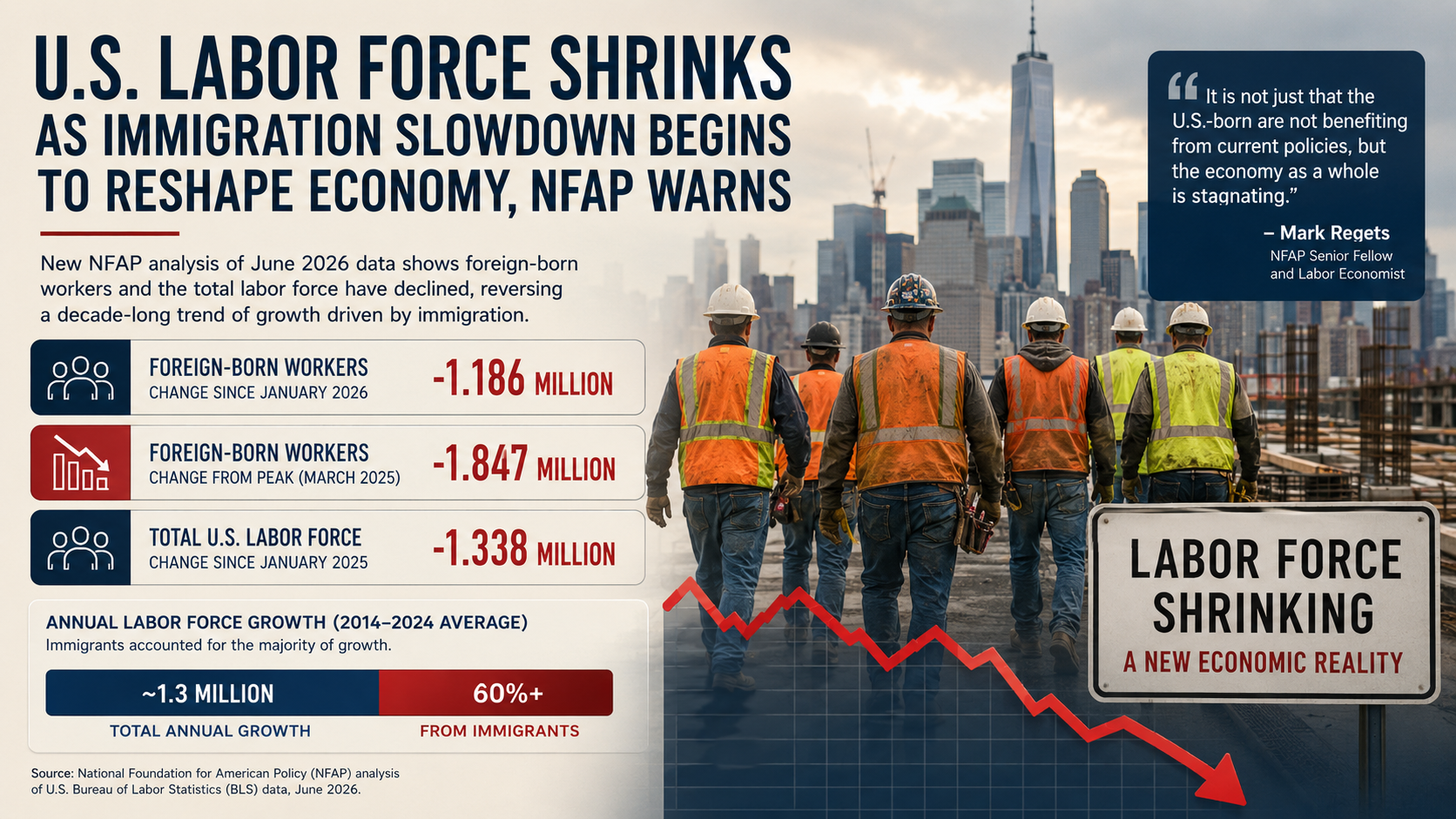
The analysis finds that the number of foreign-born workers has fallen by 1.186 million since January 2026 and by 1.847 million from its peak in March 2025. Even more striking, the total U.S. labor force has contracted by 1.338 million workers since January 2025, reversing a decade-long trend in which immigration accounted for more than half of annual labor force growth.
“The U.S. economy has long depended on immigrants for labor force growth,” the report notes, emphasizing that from 2014 to 2024 the country added an average of more than 1.3 million workers annually, with immigrants contributing the majority of that increase. Instead of continuing that trajectory, the labor force is now shrinking.
NFAP Senior Fellow and labor economist Mark Regets argues that the latest figures challenge one of the central economic arguments behind immigration restrictions.
“It is not just that the U.S.-born are not benefiting from current policies, but the economy as a whole is stagnating,” Regets said, pointing to slowing employment growth and a declining labor force.
No Evidence of Labor Market Replacement
One of the report’s most significant conclusions is that American-born workers have not filled jobs vacated by departing immigrants.
The unemployment rate for U.S.-born workers rose to 4.6 percent in June 2026 from 4.4 percent a year earlier, while labor force participation among U.S.-born adults declined from 61.8 percent to 61.0 percent during the same period. Even among prime-age workers aged 25 to 54—typically the strongest segment of the workforce—participation slipped from 83.5 percent in January 2025 to 83.3 percent in June 2026.
“Most economic research shows that immigration increases employment opportunities for the U.S.-born, so it would not be surprising if reducing immigration harms American workers,” Regets said.
The findings contradict the assumption that restricting immigration would automatically translate into higher employment among native-born Americans. Instead, the report suggests that businesses may simply hire fewer workers, reduce production or postpone expansion when labor becomes scarce.
Immigration Policy Driving Workforce Decline
NFAP attributes much of the decline to a series of immigration restrictions implemented during Trump’s second term.
Among the major policy changes are reductions in refugee admissions, tighter legal immigration pathways, expanded visa restrictions affecting nationals from dozens of countries, and court-backed efforts to terminate Temporary Protected Status (TPS) for several immigrant groups. The report argues that these measures, combined with a perception of a less welcoming immigration environment, are likely encouraging both reduced inflows and higher emigration among existing immigrants, including legal visa holders.
Although the report cautions that monthly household survey estimates contain statistical uncertainties, it argues that multiple data sources point toward the same overall trend of declining immigrant participation in the labor market.
Long-Term Economic Costs
Beyond the immediate labor market, NFAP projects substantial macroeconomic consequences if current immigration policies remain in place.
Its estimates suggest that immigration restrictions could reduce the U.S. workforce by 6.8 million workers by 2028 and by 15.7 million by 2035. That would translate into a cumulative loss of approximately 102 million worker-years over the next decade and reduce U.S. economic output by an estimated $12.1 trillion between 2025 and 2035. The organization also forecasts that annual economic growth could decline by nearly one-third compared with previous projections.
The report argues that slower workforce growth comes at a particularly challenging time for the United States, where an aging population, rising public debt and persistent labor shortages in healthcare, technology, agriculture and manufacturing have increased reliance on immigrant workers.
Implications for Skilled Immigration
While the report examines overall immigration trends, its findings also carry significant implications for employment-based immigration, including the H-1B visa program and employment-based green cards that are heavily utilized by Indian professionals.
Reduced legal immigration, longer processing times and broader restrictions could further tighten labor availability in sectors already facing skill shortages. Technology companies, universities, hospitals and research institutions have repeatedly argued that international talent remains essential to maintaining U.S. competitiveness.
NFAP estimates that legal immigration alone could fall by more than 600,000 people during Trump’s second term. The organization attributes much of the projected decline to sharply reduced refugee admissions and expanded visa restrictions affecting nationals from 39 countries, alongside measures that limit family-sponsored immigration.
For employers, the report suggests the challenge may increasingly shift from managing immigration compliance to finding enough workers. For policymakers, it revives a longstanding debate over whether immigration restrictions protect domestic employment or instead constrain economic growth by reducing the size of the workforce itself.