 Join WhatsApp Channel

With a reported total investment of around $75 million, including $28 million said to have gone directly into the First Lady’s coffers and a further $35 million spent on promotion, her latest film project looks less like a documentary and more like the ultimate personal branding campaign. But does it also make her an unlikely feminist icon?
The First Lady has walked into Hollywood and commanded an eye watering fee usually reserved for male stars, negotiated by male executives, while female talent continue to sigh and wish for parity. Has Melania closed the gender pay gap? Is she the new face of feminism?
Women have reached the highest levels of business, politics and media. Yet more often than not, behind every high-profile woman is a man. History is littered with firsts, the first woman prime minister, the first female president, the first woman CEO of a multinational. Scratch the surface and many of these women are also the wife of, daughter of, sister of, or mother of someone powerful. Women in elite families navigate gender disparity differently because the usual rules do not apply.
That is why leaders like Margaret Thatcher remain so striking. A shopkeeper’s daughter navigated her way to Downing Street, overcoming both gender bias and rigid class structures, the latter arguably the greater obstacle in Britain.
Melania’s fee is, in large part, because she is the wife of the President of the United States. Still, with other family members reportedly finding ways to monetize their proximity to power, why should she be banished to the White House drudgery of choosing decorations when she could be filmed doing it and making big money at the same time?
Money aside, it is an impressive feat. She has put out her story on her own terms. As both subject and executive producer she was in complete control, much to the howls of the media decrying the blatant lack of editorial independence. But do audiences really care about creative integrity, or are they simply consuming the version of reality that feels most entertaining or politically comforting?
The rich and powerful once had an Achilles heel, the free press. Surrounded by courtiers and yes men, they were often buffered from the reality of the emperor’s new clothes. Over time, power becomes an illusion, with gatekeepers controlling the ecosystem around the principal, replacing genuine relationships with transactional loyalty. Disconnection from reality is often what triggers eventual demise.
Journalism, at its best, provided a reality check. It could feel like a slap in the face, but it was also a public service, forcing the powerful to confront blind spots and course correct. Fragile egos rarely welcome it, but independent scrutiny is a kind of medicine.
That era is fading. Eyeballs have moved from newspapers to user generated content on social media, and ears have moved to podcasters. Traditional media has tried to adapt, but how can it compete with anonymous accounts spewing misinformation and disinformation with little or no guardrails?
Media houses can be sued for inaccuracies. They can be held accountable by watchdogs. They train journalists in rigor and ethics. Social media platforms, whose incentive is engagement, offer no equivalent discipline. We are now swimming in a dirty information ecosystem, entering a low trust era where societies fracture along algorithmic fault lines.
Liberals and conservatives who once argued over a drink now retreat into separate digital bubbles. The algorithm pushes the same worldview repeatedly, regardless of truth or fairness. In such an environment, why would the powerful subject themselves to a BBC documentary when they can create their own production company, control every element of their image, and profit handsomely at the same time?
Melania has followed a well-trodden path. The powerful no longer need journalism. They can manufacture their own narratives. Controlled documentaries have sometimes backfired when they leaned too heavily into marketing rather than storytelling. But Victoria Beckham delivered a masterclass in owned media by blending polish with vulnerability and humor. Michelle Obama’s Becoming attracted less criticism, perhaps because it came after her White House years and she was not the executive producer. Still, both exerted significant controls.
Perhaps Melania had no other route to express herself. Vilified by the press for years, in an age where polarization runs so deep that opinions are shaped more by political allegiance than critical thinking, she may have wanted to tell her own story. The money is a byproduct, though admittedly a very large one.
The Melania film raises uncomfortable questions about our new media order. Trust in journalism is collapsing while trust in peer generated content rises, even when the peer is sponsored by a dozen brands. Journalism always relied on advertising, but there was traditionally a separation between newsroom and revenue. Today, the distinction is blurred beyond recognition.
Even the corporate context matters. Bezos’s Amazon deal may not be purely commercial. Yes, the film reportedly grossed $7.2 million domestically in its first weekend, but a $35 million marketing spend is not simply promoting demand, it is manufacturing it. The wider political benefits Amazon can accrue through regulatory and taxation dynamics make the project look less like entertainment and more like strategic public affairs.
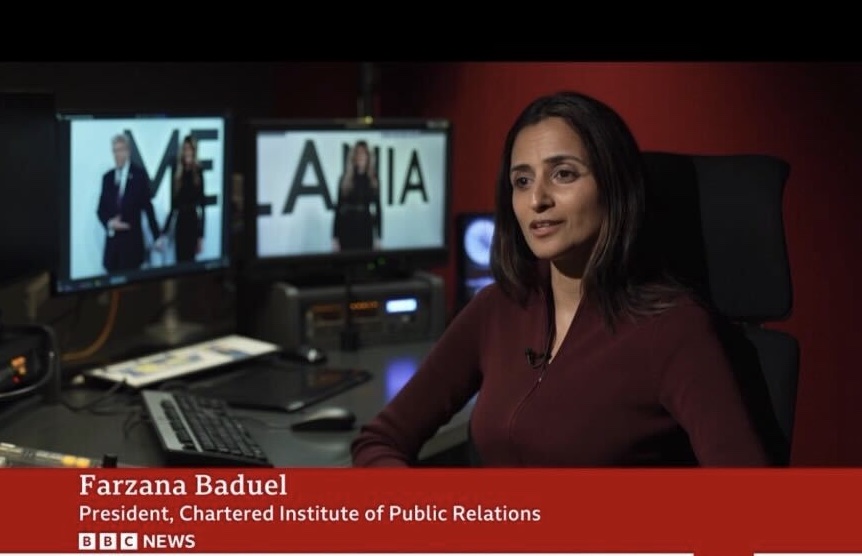
Critics have been unsparing. Variety called it a “cheeseball infomercial of staggering inertia.” The Guardian likened it to a medieval tribute, a lavish offering designed to placate a greedy king. Others have been blunter still, calling it propaganda, or Melaniaganda. I went on BBC News and called it propaganda.
The controversy has only grown. The director Brett Ratner’s Me-Too infamy makes many wince. Radiohead’s Jonny Greenwood has asked for his music to be removed. Advertising buses have been vandalized. Yet the film has still drawn an audience, with red state supporters turning up enthusiastically while blue state critics delight in stories of empty cinema halls.
The difference between marketing and PR is that marketing pays for attention, while PR earns the right to attention. Melania’s project is not feminism, nor is it journalism. It is something else entirely.
The powerful no longer need gatekeepers to the public because they can become the gatekeepers themselves through their own production companies and social media channels.
So, has Melania closed the gender pay gap in Hollywood? Not quite. She has simply reminded us that for some women, the gap was never about gender at all.
It was always about power.
Disclaimer: The opinions and views expressed in this article/column are those of the author(s) and do not necessarily reflect the views or positions of South Asian Herald.
Related posts:
 Women Don’t Lack Ambition, They Lack a Level Playing Field
 Global Study Finds Women Still Largely Absent in News Media Representation
 International Women’s Day 2025: Leading Experts on Maximizing Women’s Health and Rights
 A Force More Powerful: A New Book on The Rise of the Global Women’s Funding Movement
