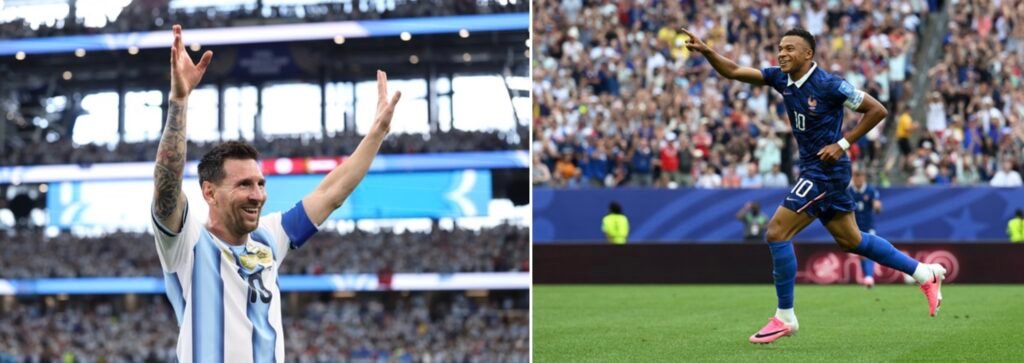
In sports, the number 10 jersey is often reserved for a team’s most creative, influential, and talented player. In soccer, the shirt traditionally symbolizes attacking responsibility, leadership, and playmaking ability. As a result, the players wearing the iconic No. 10 jersey at the 2026 FIFA World Cup have attracted significant attention.
Each of the 48 participating teams has a player wearing the No. 10 shirt, making the jersey one of the tournament’s most closely watched symbols of individual talent and leadership.
Among them is New Zealand’s Sarpreet Singh, the only player of Indian descent competing at the 2026 FIFA World Cup. Singh wears the No. 10 jersey for his national team and is among the tournament’s notable playmakers.
The most prominent No. 10 at this year’s World Cup is Argentina captain Lionel Messi. The defending champions’ leader has continued to add to his remarkable legacy, becoming the all-time leading scorer in FIFA World Cup history with 18 goals. Messi opened the tournament with a hat-trick against Algeria and followed it with a two-goal performance against Austria, helping Argentina advance to the Round of 32. All five of Argentina’s goals in its first two matches were scored by Messi, a rare achievement at the World Cup.
Advertisement
While many No. 10s are established international stars, the tournament has also showcased emerging talents who are beginning to make their mark on the global stage. From seasoned veterans to rising prospects, the players wearing the coveted jersey represent some of the biggest names in world soccer.
Among them is France’s Kylian Mbappé, the Real Madrid forward widely regarded as one of the sport’s premier talents. France has already secured qualification for the Round of 32, joining Mexico, the United States, Germany, Argentina, and Norway. Mbappé, who had scored 13 World Cup goals entering the tournament, remains a contender to challenge scoring records at future editions of the competition.
Messi, meanwhile, continues to redefine longevity and excellence. Playing what is expected to be his final World Cup, the Argentine captain is seeking to defend the title won in Qatar in 2022 while continuing to set records that may stand for years to come.
Germany’s Jamal Musiala has emerged as a central figure in his country’s new generation of talent. The Bayern Munich attacking midfielder is known for his creativity, dribbling ability, and capacity to break through defensive lines. At 23, he is viewed as a key player in Germany’s bid to return to the top of world soccer after disappointing campaigns in Russia and Qatar.
Spain’s Dani Olmo is another influential No. 10. His technical ability, vision, and movement make him one of the most important players in Spain’s attack and a potential difference-maker in crucial matches.
Portugal’s Bernardo Silva brings extensive international experience to another World Cup campaign. After years competing at the highest levels of European soccer, Silva remains one of Portugal’s leaders alongside Cristiano Ronaldo.
Brazil’s Neymar Jr. also continues to command attention. Widely regarded as his country’s most dangerous attacking player, Neymar is aiming to capture the one major title that has eluded him during an accomplished career. Under coach Carlo Ancelotti, he is expected to play a pivotal role in Brazil’s pursuit of World Cup glory.
Among the three host nations, Mexico’s Alexis Vega, United States captain Christian Pulisic, and Canada’s Jonathan David carry the responsibility of leading their respective teams. David has already made headlines with a hat-trick against Qatar, helping Canada secure its first-ever World Cup victory. Pulisic and Vega will be expected to guide their teams through the knockout rounds as the co-hosts seek deep tournament runs.
The 48 players wearing the iconic No. 10 jersey at the 2026 FIFA World Cup represent a blend of established stars, emerging talents, and national leaders, each carrying the expectations associated with one of soccer’s most celebrated shirt numbers.
Group A
- Jaesung Lee – South Korea
- Alexis Vega – Mexico
- Patrik Schick – Czech Republic
- Relebohile Mofokeng – South Africa
Group B
- Jonathan David – Canada
- Ermedin Demirovic – Bosnia and Herzegovina
- Hassan Alhaydos – Qatar
- Granit Xhaka – Switzerland
Group C
- Neymar Jr. – Brazil
- Che Adams – Scotland
- Jean-Ricner Bellegarde – Haiti
- Brahim Díaz – Morocco
Group D
- Christian Pulisic – United States
- Ajdin Hrustic – Australia
- Miguel Almirón – Paraguay
- Hakan Calhanoglu – Turkey
Group E
- Jamal Musiala – Germany
- Simon Adingra – Ivory Coast
- Leandro Bacuna – Curaçao
- Kendry Páez – Ecuador
Group F
- Memphis Depay – Netherlands
- Ritsu Doan – Japan
- Benjamin Nygren – Sweden
- Hannibal Mejbri – Tunisia
Group G
- Leandro Trossard – Belgium
- Mohamed Salah – Egypt
- Mehdi Ghayedi – Iran
- Sarpreet Singh – New Zealand
Group H
- Dani Olmo – Spain
- Giorgian De Arrascaeta – Uruguay
- Salem Aldawsari – Saudi Arabia
- Jamiro Monteiro – Cape Verde
Group I
- Kylian Mbappe – France
- Ali Mohanad – Iraq
- Martin Odegaard – Norway
- Sadio Mané – Senegal
Group J
- Lionel Messi – Argentina
- Farès Chaïbi – Algeria
- Florian Grilltsch – Austria
- Mousa Altamari – Jordan
Group K
- Bernardo Silva – Portugal
- James Rodríguez – Colombia
- Theo Bongonda – DR Congo
- Jaloliddin Masharipov – Uzbekistan
Group L
- Jude Bellingham – England
- Luka Modrić – Croatia
- Brandon Thomas – Ghana
- Ismael Díaz – Panama