For more than a decade, Ramesh’s life followed a familiar rhythm. He worked at a petrochemical plant in Oman, sent money home every month to Andhra Pradesh, and dreamed of returning to India after securing his family’s future.
That routine ended abruptly in March.
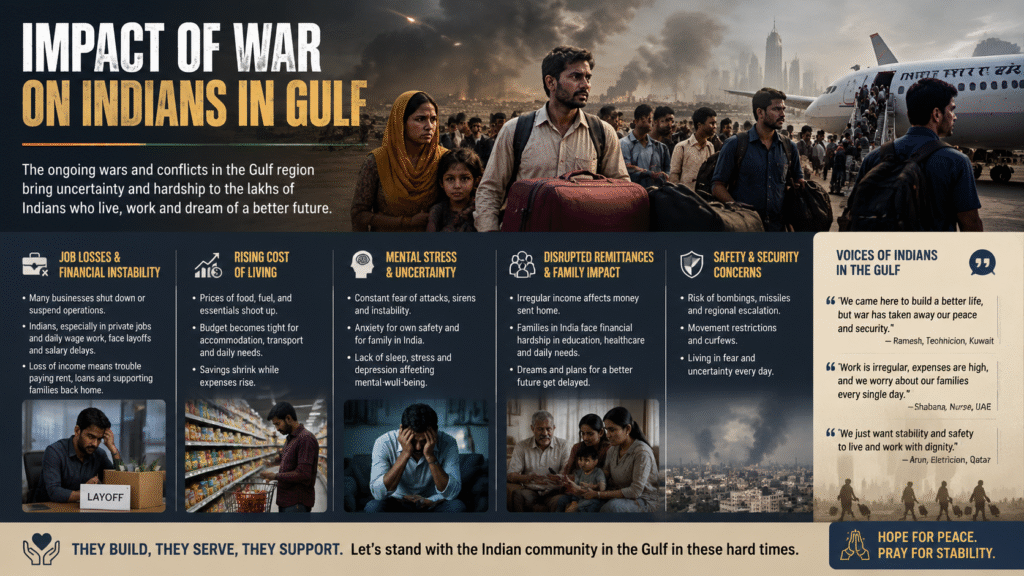
As the conflict involving the United States, Israel and Iran escalated, his employer cut operations and asked him to proceed on unpaid leave. Overnight, the future he had carefully planned became uncertain.
“I never imagined I would have to leave like this,” he says. “Back home, there are very few opportunities that match my experience or salary.”
Advertisement
Ramesh is among millions of Indian expatriates across the Gulf Cooperation Council (GCC) countries whose lives have been disrupted by a conflict unfolding far from their workplaces but increasingly close to their daily realities.
While global attention has focused on military developments and oil prices, the human cost is being felt in homes and workplaces from Muscat to Manama, Doha to Dubai.
For decades, the Gulf represented hope for Indian workers. Better salaries and stable employment enabled millions to support families, build homes and educate their children. Today, that promise is under strain.
In Bahrain’s capital, Manama, Ashok (name changed), a marketing professional from Chennai, says uncertainty has become a constant companion.
“Everything has become more expensive,” he says. “People worry about their jobs, their future and whether the situation will get worse.”
Rising costs have forced many expatriates to cut spending. For workers supporting families in India, every increase in rent, food or transport expenses means less money sent home.
The emotional toll is equally severe.
In Muscat, some Indian families have already sent spouses and children back to India to reduce expenses and prepare for an uncertain future. Family apartments have once again become bachelor accommodations.
“The atmosphere has changed,” says a long-time resident. “People are trying to save money wherever they can because nobody knows how long this situation will continue.”
The logistics sector has been among the hardest hit.
Shiv Kumar (name changed), a Chennai native employed in Dubai, rushed back from India after hearing that conditions were deteriorating. By the time he returned, his job no longer existed.
Shipping and transportation companies have struggled with disruptions to regional trade routes. Some firms have downsized while others have shut down altogether.
For workers who spent years building careers in the Gulf, the sudden loss of employment can be devastating. Many return home only to discover that equivalent jobs are unavailable or offer significantly lower salaries.
For Renjit George, a resident of Abu Dhabi originally from Kerala, the crisis has become a family setback spanning two generations.
This month he is preparing to leave after losing his job. His 60-year-old father, who worked at Ras Al Khaimah port, also lost his position as operations slowed.
“Two generations of our family depended on Gulf employment,” he says. “Now both of us are looking at starting over.”
The consequences extend far beyond the Gulf. Millions of Indian households depend on remittances from family members working overseas. States such as Kerala, where migration has shaped communities for generations, are particularly vulnerable to any decline in overseas earnings.
Yet despite the uncertainty, many Indians remain determined to stay. Years of hard work have created careers, businesses and communities that cannot easily be abandoned.
Across the Gulf, expatriates continue to hold on to a simple hope—that stability will return and the dreams that brought them there will survive.
For them, the war is not merely a geopolitical crisis. It is a story of interrupted ambitions, anxious phone calls home, children waiting for fathers to return, and families wondering whether the future they worked so hard to build is beginning to slip away.