
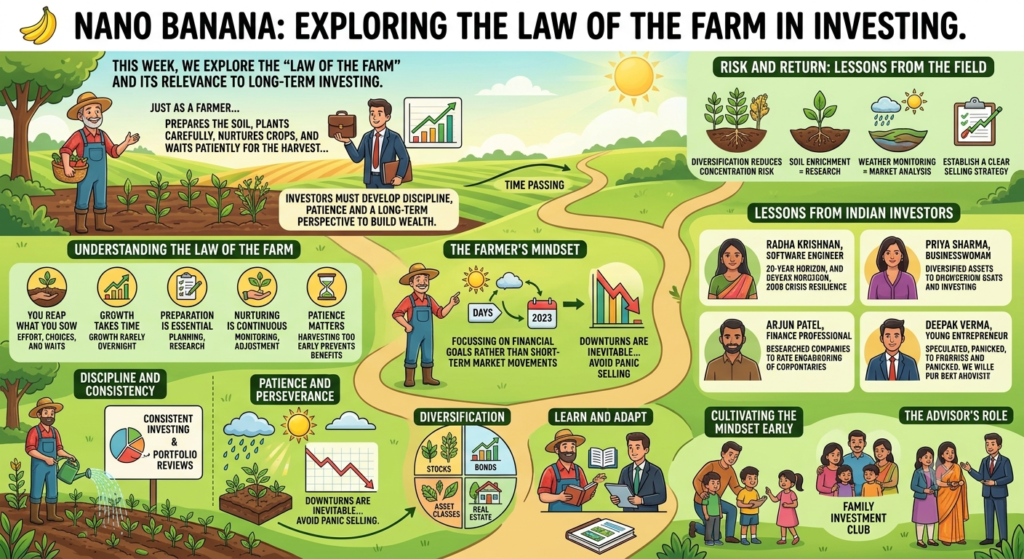
This week, we explore the “Law of the Farm” and its relevance to long-term investing. The analogy is simple: just as a farmer prepares the soil, plants carefully, nurtures crop and waits patiently for the harvest, investors must develop discipline, patience and a long-term perspective to build wealth.
The farmer understands that growth cannot be rushed. Nature follows its own timetable, and successful investing is no different. Investors who accept this reality are better equipped to manage risk, withstand market volatility and allow compounding to work over time.
Understanding the Law of the Farm
The Law of the Farm rests on several timeless principles. You reap what you sow: effort, preparation and sound decisions influence results. Growth takes time: wealth creation rarely happens overnight. Preparation is essential: careful planning and research improve the prospects of success. Nurturing is continuous: investments require monitoring and periodic adjustment. And patience matters: harvesting too early can prevent investors from realizing the full benefits of long-term growth.
Advertisement
The Farmer’s Mindset
Farmers think in seasons and years, not days or weeks. Investors should adopt the same long-term vision, focusing on financial goals rather than reacting to short-term market movements.
Discipline and consistency are equally important. A farmer follows a regular routine of planting, watering and protecting crops. Investors should similarly invest consistently, review portfolios and rebalance when necessary.
Patience and perseverance are critical during difficult markets. Farmers know that bad weather or poor harvests can occur despite careful preparation. Investors must accept that downturns are inevitable and avoid turning temporary declines into permanent losses through panic selling.
Farmers also understand risk management. Diversifying crops can protect against weather, pests or disease affecting one harvest. Investors can apply the same principle by diversifying across asset classes, sectors and geographies.
Finally, farmers continuously learn and adapt. Investors should do the same by researching companies, industries and changing economic conditions.
Risk and Return: Lessons from the Field
Agriculture provides useful lessons for managing investment risk and return.
Diversification reduces dependence on a single crop or outcome. A diversified portfolio can similarly reduce concentration risk.
Soil enrichment represents research. Just as healthy soil supports better crops, understanding a company’s fundamentals, competitive advantages and management can improve investment decisions.
Weather monitoring resembles market analysis. Investors should remain aware of interest rates, inflation, economic cycles and other factors that could influence their investments.
And just as farmers know when conditions are right to harvest, investors should establish a clear selling strategy based on their financial goals, time horizon and risk tolerance rather than fear or excitement.
Lessons from Indian Investors
Consider four hypothetical Indian investors.
Radha Krishnan, a software engineer, invested with a 20-year horizon. During the 2008 financial crisis, her portfolio suffered significant losses, but she remained invested and continued contributing regularly. Over time, patience and compounding worked in her favor.
Priya Sharma, a businesswoman, diversified across Indian and international equities, bonds, real estate and gold, helping her navigate market volatility.
Arjun Patel, a finance professional, researched companies with strong fundamentals and sustainable competitive advantages. His approach demonstrates the importance of preparation before investing.
By contrast, Deepak Verma, a young entrepreneur, invested heavily in a popular stock hoping for quick gains. When the price plunged, he panicked and sold at a loss. His experience illustrates the dangers of impatience and concentration.
Cultivating the Mindset Early
The farmer’s mindset can be developed from a young age. Parents can teach children saving, delayed gratification, hard work and the connection between effort and reward. Involving children in family financial discussions or creating a small family investment club can make investing practical and educational.
The Advisor’s Role
An investment advisor can help families apply these principles through financial education, goal setting, diversified portfolio construction and behavioral coaching. Advisors can also assist with succession planning, helping transfer both wealth and financial knowledge to future generations.
Conclusion
The Law of the Farm offers a timeless framework for successful investing. Wealth creation, like farming, requires preparation, discipline, continuous care and patience.
Investors cannot control every season of the market. They can control how they prepare, diversify, invest consistently and respond to uncertainty.
The lesson is simple: plant wisely, nurture consistently and give compounding the time it needs to grow.
Disclaimer: The opinions and views expressed in this article/column are those of the author(s) and do not necessarily reflect the views or positions of South Asian Herald.