 Join WhatsApp Channel

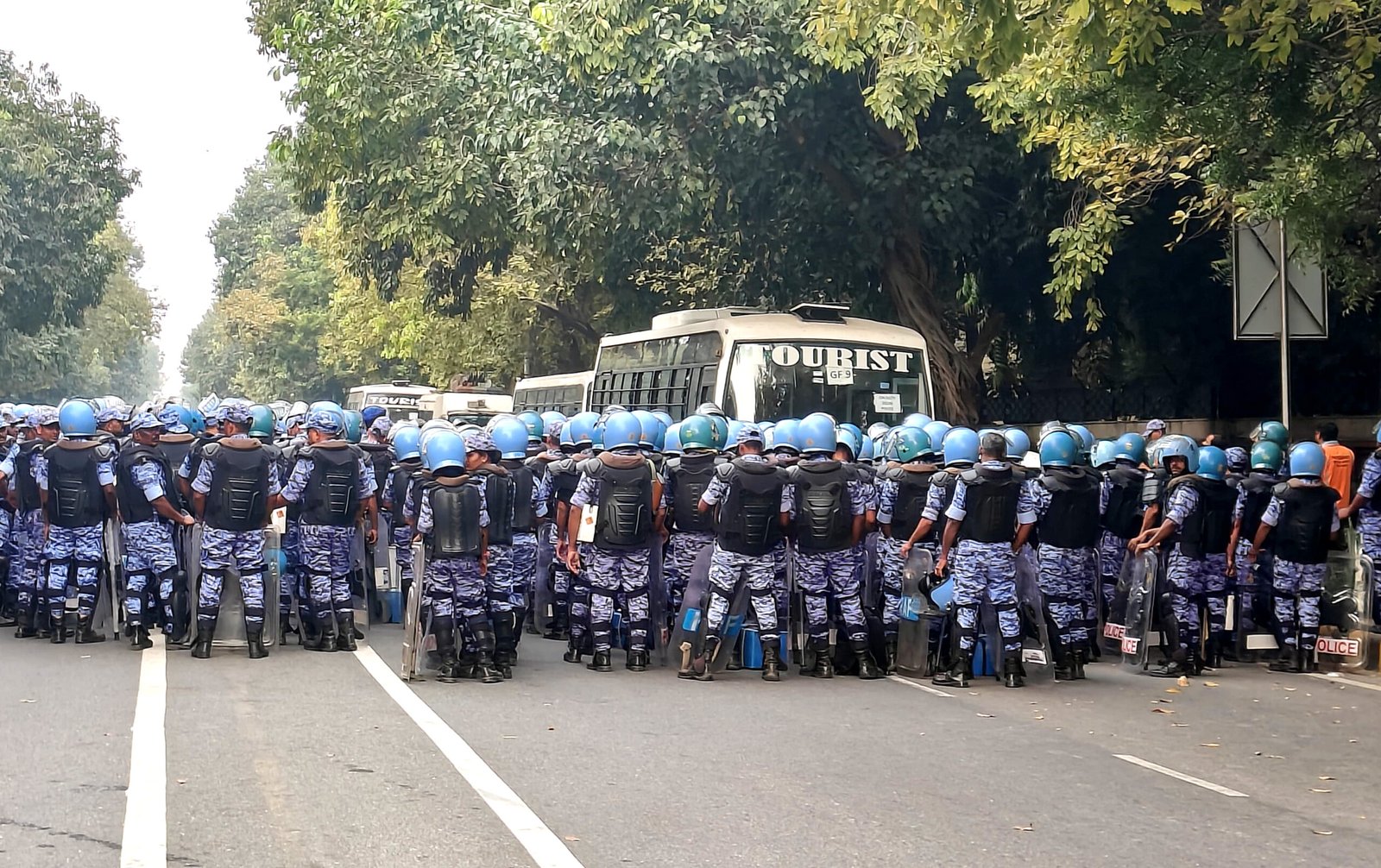
In waves they came, threading their way through barricades, dodging police cordons and playing a game of cat and mouse with officers who advanced to block them. Some ran, others doubled back and regrouped, trying again to reach their destination. Many never got close. Waiting police buses swallowed up protesters, carrying them away for detention almost as soon as they emerged on the streets.
By Saturday afternoon, Delhi’s planned mass protest had been stopped in its tracks, but the operation to prevent it had become a spectacle of its own. More than 2,000 people had been detained, according to local media reports, as thousands of police and paramilitary personnel sealed off parts of central Delhi, restricted metro access and intercepted demonstrators far from Jantar Mantar, the intended rally site.
The crowds that organizers had hoped would fill the streets never materialized. Yet the repeated attempts by young protesters to get past the barricades, the detention of rally organizers aboard an aircraft and the sweep involving opposition leaders, lawyers and journalists ensured that the confrontation spread well beyond the capital’s streets.
The scale of the response, rather than the size of the gathering that ultimately reached the streets, became the defining image of the day.
The Cockroach Janta Party (CJP), a youth-led group, had called the rally to demand the resignation of Chief Election Commissioner Gyanesh Kumar over alleged irregularities in the Special Intensive Revision (SIR) of electoral rolls. The Election Commission says the exercise is intended to remove ineligible entries and improve the accuracy of voter lists. The ruling Bharatiya Janata Party (BJP) has rejected allegations that the process is designed to favor it.
Delhi Police denied permission for the demonstration, citing the late submission of the application, previous law-and-order problems and concerns about crowd management. Authorities argued that a gathering of the anticipated size could not proceed without approval.
But the effort to stop the rally reached far beyond Jantar Mantar.
CJP founder Abhijeet Dipke and fellow organizers Saurav Das and Ashutosh Ranka were detained aboard an aircraft after it landed at Delhi airport, according to media reports. YouTuber Dhruv Rathee was reportedly detained at his home in neighboring Gurugram. Opposition leaders, student activists, lawyers and journalists were also caught up in the operation.
The sight of police entering an aircraft to detain the organizers became one of the day’s most striking episodes. Dipke was reported as telling officers: “I have come to be arrested. I am not afraid of you guys.”
The detentions did not end the protest call. CJP named Ajinkya Shinde as its interim protest leader and urged supporters to continue demonstrating, arguing that wherever police stopped them could become a site of protest.
“Not few. A storm is coming,” Das wrote on X, conveying the organizers’ determination to portray the movement as larger than the numbers able to assemble.
On the streets, the mood was more immediate and uncertain. One protester described the efforts to evade police as a “game of cat and mouse”, with demonstrators advancing when officers moved away and retreating when they closed in. Another protester, Jasmine, questioned why citizens should need permission to demonstrate against the authorities they wanted to challenge.
For those caught in the sweep, the day was less about speeches and slogans than the prospect of being bundled into a bus before they could reach the rally site. For families and friends, the concern was more personal: where had their relatives been taken, were they safe, and when would they return?
Outrage moves online
As the streets were sealed, X became a second arena of protest. Politicians, journalists and public figures questioned why such an extensive security deployment was needed to prevent a demonstration.
Former Indian cricketer Sanjay Manjrekar posted: “Peaceful protests is a democratic activity. Last time I heard India was a democratic country.” Actor Prakash Raj criticized the police action, while filmmaker Anurag Kashyap expressed solidarity with the protesters, according to media reports.
Congress leader Shashi Tharoor criticized what he described as a “war-like deployment”, arguing that a government confident in the fairness of elections should be willing to face scrutiny rather than seal off its capital. He called for those detained to be released.
Former Delhi chief minister Arvind Kejriwal described the action as worse than the Emergency, when civil liberties were suspended and opposition leaders jailed. Former Kerala chief minister Pinarayi Vijayan, reportedly detained during the day’s events, described Delhi as an “open prison” in a Facebook post.
The BJP offered a sharply different interpretation. Party president Nitin Nabin accused opposition leaders of attempting to create tension, while BJP MP Sambit Patra argued that democracy had prevailed over “mob rule”. The party maintained that restrictions were intended to prevent disorder, not suppress criticism.
The competing accounts left a central question unanswered: whether the restrictions and detentions were proportionate to the risks anticipated by the authorities.
Journalists and lawyers caught in the sweep
Concern grew after reports that journalists covering the demonstrations had been detained, some despite identifying themselves as members of the media. Reports also alleged that equipment was seized and some journalists physically mistreated. The Committee to Protect Journalists called for detained media workers to be released, their equipment returned and allegations of abuse investigated.
The reported detention of lawyers prompted the Supreme Court Bar Association to seek the intervention of Chief Justice of India Surya Kant over the safety and whereabouts of advocates, including women lawyers.
The disruption extended to commuters and residents. Barricaded roads, metro restrictions and transport interruptions made movement through parts of the capital difficult. The Supreme Court also stressed that restrictions on metro and train services should not amount to a complete shutdown.
Behind the confrontation lies a dispute over who gets to vote. The Election Commission says the revision seeks to identify deceased, duplicate, relocated and otherwise ineligible entries. Opposition parties and activists fear that eligible voters could be wrongly removed and question whether the process offers adequate safeguards. Allegations of deliberate political manipulation remain contested.
Those concerns require transparent procedures, evidence and accessible remedies. Errors in voter lists must be open to challenge and correction, while allegations of systematic wrongdoing must be tested against records rather than assumed to be true.
On Saturday, however, the debate over electoral integrity was displaced by the spectacle of a city mobilized to prevent people from assembling.
Delhi’s barricades held, and the mass rally was prevented. But the young demonstrators who kept returning to the cordons, only to be chased, stopped or detained, ensured that the day’s defining image was not an empty protest ground.
It was a capital determined to keep a gathering off the streets — and the questions that determination left behind.
Related posts:
 Rep. Ro Khanna Reports ‘Systemic Neglect’ After Visit to California ICE Detention Center
 Global Experts Address Crisis of Judicial Independence at New York City Bar Association
 Sheikh Hasina Says She Will Return to Bangladesh Despite Threats to Her Life
 How Priyanka Gandhi Outmaneuvered Rahul — and Gave Kerala Its New Chief Minister
