Join WhatsApp Channel

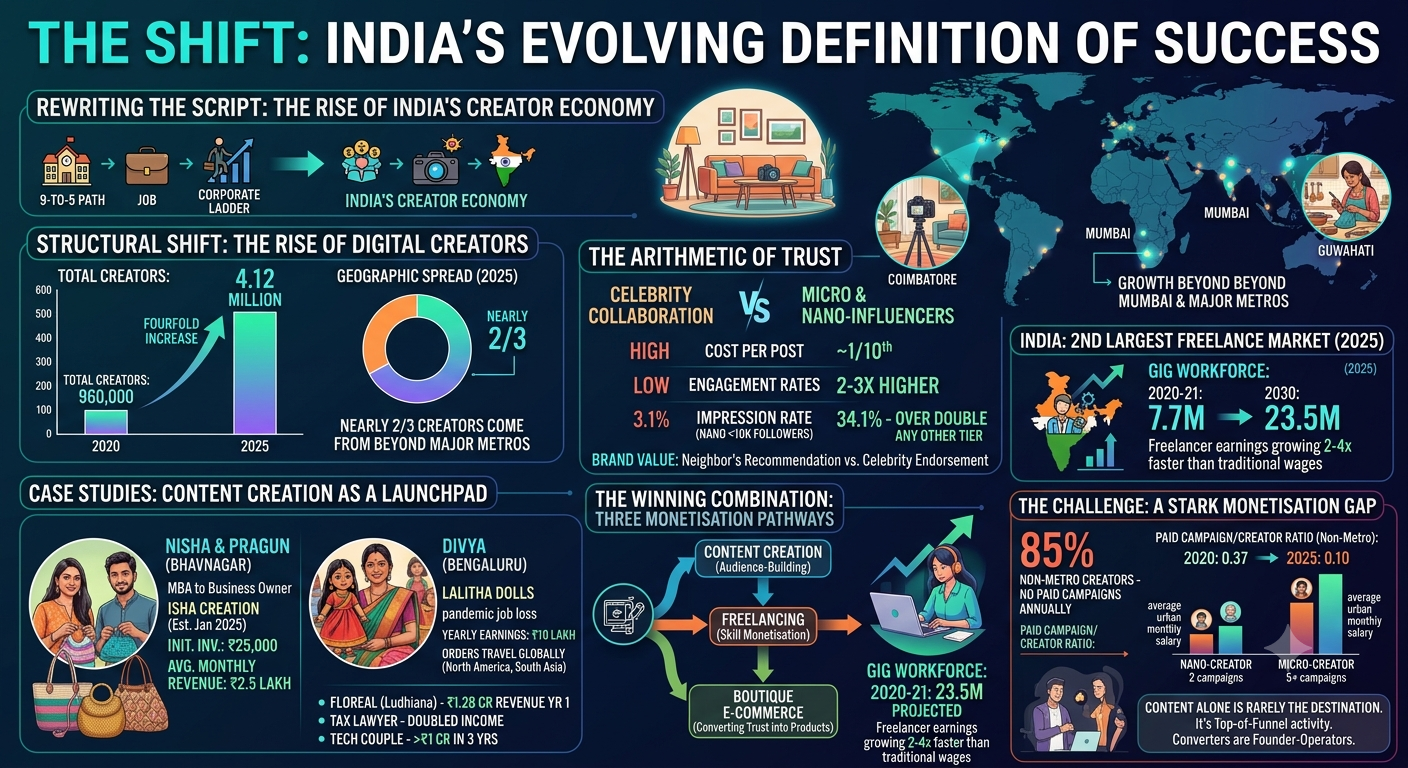
For generations, the Indian definition of success followed a predictable path: excel in school, land a stable government or corporate job, and spend the next four decades climbing a well-defined ladder. That script is now being rewritten—not in corporate boardrooms, but in bedrooms in Indore, living rooms in Coimbatore, and kitchens in Guwahati. India’s creator economy, once brushed aside as a frivolous pursuit, has grown into a legitimate career option, and its most powerful engine is the micro-influencer.
The data points to a structural shift. India is now home to 4.12 million digital creators, up from just 960,000 in 2020—a more than fourfold increase in five years. Just as important is where this expansion is unfolding. Nearly two-thirds of India’s creators now come from beyond the major metros, showing that the digital economy has moved well past Mumbai, Delhi, and Bengaluru. The influencer marketing space, pegged at around ₹3,600 crore in 2024, is expected to approach ₹5,000 crore, with the strongest budget growth going to Tier-2 and Tier-3 cities—Indore, Coimbatore, and Guwahati among them.
Why this shift? The arithmetic of trust. A celebrity collaboration can cost as much as 150 nano and micro-creator posts combined, yet smaller creators often deliver engagement rates two to three times higher than their metro macro counterparts—at roughly one-tenth the cost per post. Even with under 10,000 followers, a nano-influencer can deliver a 34.1% impression rate, over double the rate of any other tier. Brands now understand that a neighbor’s recommendation feels like guidance, while a celebrity endorsement feels like advertising.
This is where entrepreneurship enters the picture. For a generation of Indians, content creation is not the final goal—it is the launchpad. The most compelling stories are those where a hobby, documented authentically, transforms into a revenue-generating business.
Consider Nisha and Pragun from Bhavnagar, Gujarat. Nisha, an MBA student, began crocheting bags as a hobby and posting her creations on Instagram. The appreciation quickly turned into demand. In January 2025, the couple launched Isha Creation, named after their three-year-old daughter, with an initial investment of just ₹25,000. Nisha learned crochet entirely through YouTube tutorials. Today, the brand generates an average monthly revenue of ₹2.5 lakh, fulfilling 4–5 orders daily, with sales split evenly between their website and Instagram. They expect to close the year with ₹20–24 lakh in annual revenue—no factories, no big funding, just skill, storytelling, and consistency.
Or take Divya from Bengaluru. When the pandemic cost her and her husband their teaching jobs, she turned to a childhood passion: designing ethnic dolls. After personalizing her daughter’s dolls in traditional Indian wear and uploading pictures online “for fun,” she received an order for 20 dolls within days. Today, her brand Lalitha Dolls earns ₹10 lakh annually and employs five women. Orders for her handcrafted dolls have travelled to customers in North Americas and South Asia.
These are not outliers. Shristi Arora’s Ludhiana-based crochet gifting brand Floreal generated ₹1.28 crore in revenue in its first year, selling around 20,000 products. A former tax lawyer earning ₹1 lakh a month quit to pursue content creation and now earns double her previous salary while enjoying personal freedom. A couple who left ₹35 lakh-per-year tech jobs built a creator business earning over ₹1 crore within three years.
The common thread is not luck but a strategic combination of three monetization pathways: content creation, freelancing, and boutique e-commerce.
Content creation builds the audience. Freelancing—whether in design, writing, video editing, or social media management—monetizes the skills developed along the way. And boutique e-commerce converts the trust earned into tangible products. India is now the second-largest freelance market in the world, with over 15 million active freelancers as of 2025. The gig workforce, which stood at 7.7 million in 2020–21, is projected to reach 23.5 million by 2030. Freelancers in India and the Philippines are seeing earnings grow two to four times faster than traditional wages.
This convergence has made the traditional 9-to-5 feel increasingly restrictive to a generation that values autonomy over security. A typical corporate job offers steady income and structured growth, but work-life balance often “takes a backseat as you fall into the trap of routine,” as one entrepreneur who doubled his income after leaving a ₹12 LPA job put it. Entrepreneurship brings chaos and uncertainty, but it also brings ownership and accelerated learning—a trade-off millions are now willing to make.
Yet the picture is not uniformly rosy. The latest study and reports reveal a stark monetization gap. Nearly 85 percent of non-metro creators do not secure even a single paid campaign annually. A nano-creator completing two campaigns earns only about 20 percent of the average urban monthly salary. Only a micro-creator completing five campaigns crosses the rural wage threshold. The causes are systemic: audiences outside major cities have less disposable income, content standards can be uneven, and many creators lack agency backing. Between 2020 and 2025, the ratio of paid campaigns to non-metro creators fell from 0.37 to 0.10, even as their ranks swelled—a sign of fiercer competition and scarcer monetization avenues.
The lesson is clear: content creation alone is rarely the destination. It is the audience-building phase. The entrepreneurs who succeed are those who treat it as a top-of-funnel activity, converting attention into products, services, or freelance income. The most economically significant cohort is the 2.1 percent of non-metro creators who complete five or more campaigns annually—these are the ones building sustainable businesses.
For aspiring creators, the playbook is becoming clearer. First, choose a niche where authenticity is an advantage—beauty, fashion, food, regional culture, or a specific craft. Second, build a skill that can be freelanced independently of follower count. Third, create a product or service that your audience can buy directly. The most resilient creators are not just influencers; they are founder-operators running lean, bootstrapped ventures.
India’s youth are voting with their smartphones. They are choosing ring lights over fluorescent office lights, audience trust over corporate titles, and ownership over appraisals. The micro-influencer economy is not a fleeting trend—it is the infrastructure of a new Indian Dream, one where a hobby in Bhavnagar can reach a customer in Boston, and a crochet hook can build a family enterprise. The 9-to-5 is not dead. But for millions, it is no longer the only path to a respectable life.
Disclaimer: The opinions and views expressed in this article/column are those of the author(s) and do not necessarily reflect the views or positions of South Asian Herald.
Related posts:
 India’s October Trade Slump Deepens as U.S. Tariffs Bite, Imports Surge on Gold Frenzy
 What Two Decades of Market Data Reveal About India and the US
 India’s Markets Hold Steady Despite $1.5 Billion FPI Outflows and a Spiking Import Bill
 The Big Fat Indian Wedding: A $78 Billion Celebration of Culture and Commerce