Join WhatsApp Channel

“He will win who knows when to fight and when not to fight.”
— Sun Tzu, The Art of War, Chapter III
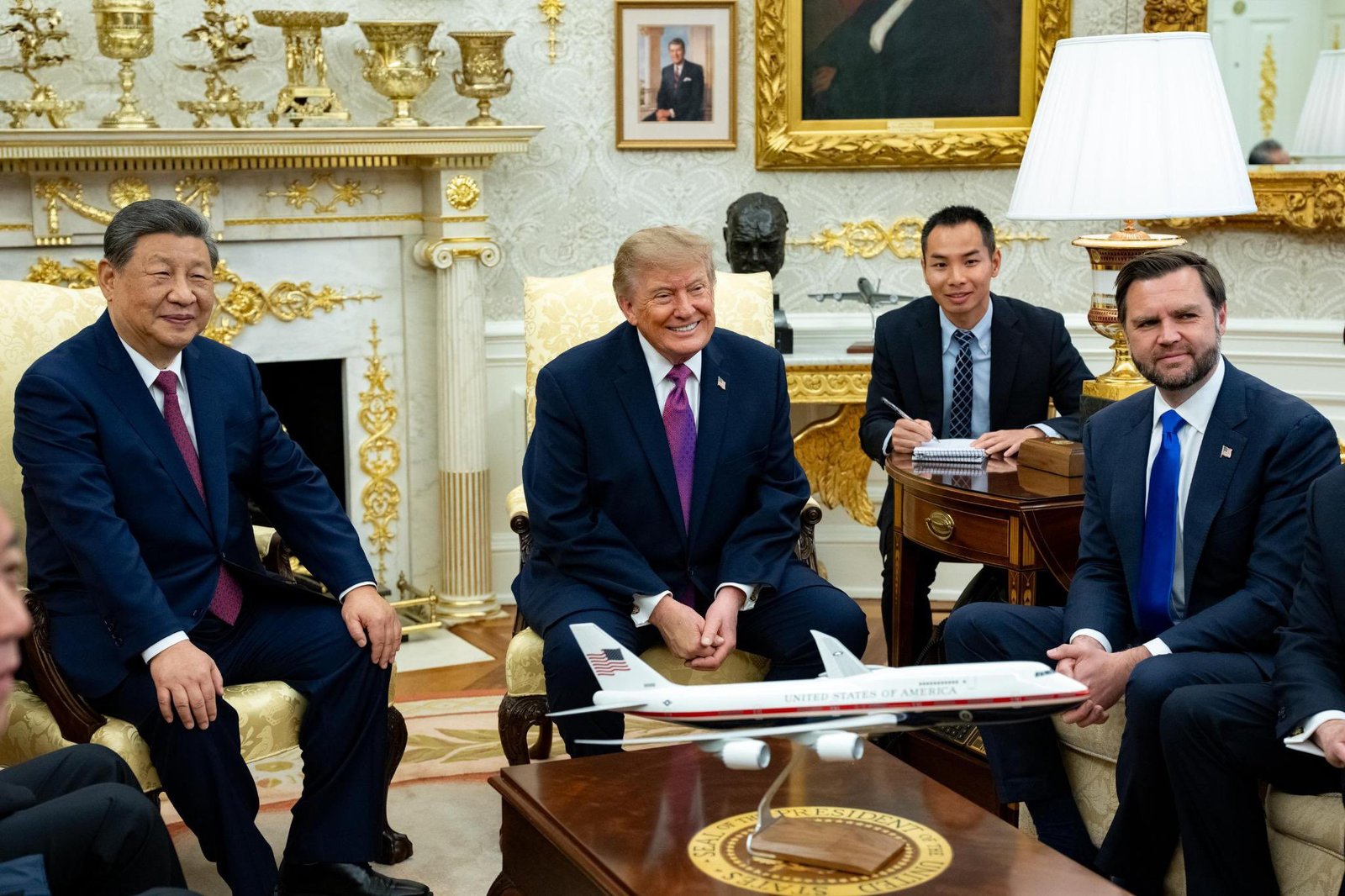
When Xi Jinping’s aircraft touched down at Joint Base Andrews on September 23, Donald Trump was waiting on the tarmac, an uncommon presidential gesture that gave the visit a personal start.
American and Chinese flags fluttered outside the White House the following morning. Military bands played on the South Lawn. A B-2 Spirit bomber swept overhead, accompanied by four F-22 Raptors, a striking display of American military power as Trump welcomed the leader of China.
Four months earlier, the roles were reversed. During Trump’s state visit to Beijing, Xi inquired whether China and the United States could avoid the “Thucydides Trap,” which posits that conflict becomes more likely when a rising power challenges an established one. Now, Xi was in Washington, attending a black-tie state dinner with the Trumps, observed by prominent American business and technology leaders.
Much had changed since the bitter tariff exchanges between the two countries. Disputes over Taiwan, technology, trade and influence across the Indo-Pacific remained, and the Washington summit produced no grand bargain. Discussions nevertheless ranged from agricultural purchases and rare earths to artificial intelligence and military contacts.
Ahead of the summit, China scholar Srikanth Kondapalli described the emerging U.S. approach as an effort to “reduce competition” and bring greater stability to relations with Beijing.
Xi had arrived in Washington only days after visiting New Delhi for the BRICS summit, his first trip to India in seven years. His visit came amid a cautious thaw in India-China relations, with both sides restoring some of the links disrupted after the 2020 border clashes. From New Delhi, Xi flew into another relationship that had also moved from confrontation toward careful engagement.
For India, the question is, where does this leave New Delhi?
Much of the past decade has seen India and the United States draw closer as Washington’s concerns about China have grown. The Indo-Pacific, Quad, defense cooperation, technology partnerships and supply-chain diversification all gained momentum partly because Washington and New Delhi shared an interest in preventing Chinese dominance in Asia.
As Beijing became more assertive across the region and Indian and Chinese troops confronted each other along their disputed Himalayan frontier, New Delhi found in the United States a partner with technology, military capability and diplomatic weight that could widen India’s room for maneuver.
Trump’s return to office has put that convergence to a more difficult test.
Pakistan has returned to Washington’s calculations. India’s relationship with Russia is still a source of friction. Tariffs and trade have tested the partnership, while American pressure over India’s purchases of Russian energy has added another point of disagreement.
Commerce Minister Piyush Goyal is in the United States this week, still trying to secure an interim trade agreement after months of negotiations. Prime Minister Narendra Modi and Trump spoke on September 30 and reaffirmed the strategic partnership, covering trade, defense, energy and critical technologies.
A U.S.-China condominium is hardly around the corner. China remains the country with the greatest economic, technological and military capacity to challenge American primacy across several domains simultaneously. Taiwan is a dangerous fault line, while semiconductors, rare earths and advanced technologies continue to divide the two countries.
Washington does not need a grand agreement with Beijing for others to feel the effects. The summit extended the trade truce, produced movement on agricultural trade and opened further discussions on rare earths and artificial intelligence. Each served an immediate interest without resolving the larger rivalry.
When the eagles and dragons talk, New Delhi cannot afford to hear only the language of rivalry.
India cannot build its China strategy on the permanence of U.S.-China hostility. Its own relationship with Beijing shows why. High-level political engagement has resumed after the chill that followed the 2020 border crisis. Direct flights have returned, and business links are being restored. Thousands of troops, however, remain deployed along the frontier. The boundary dispute is unresolved, China’s relationship with Pakistan continues to trouble New Delhi, and Indian industry remains dependent on Chinese supply chains in several important sectors.
Whatever course Washington and Beijing take, China will remain on India’s border and in its strategic calculations.
Washington competes with Beijing while receiving Xi at a state dinner. India works with the United States, Japan and Australia in the Quad while sitting with China in BRICS. Beijing seeks a calmer relationship with New Delhi while maintaining its close partnership with Islamabad.
India’s flexibility within the emerging multipolar order will depend on the economic, technological and military weight it brings to these relationships.
Few relationships will matter more than the one with the United States. Completing the trade agreement would remove a major source of friction, while cooperation in semiconductors, artificial intelligence, critical minerals, defense manufacturing and the Indo-Pacific should continue. India has little to gain from allowing disagreements with Washington to weaken a relationship built over more than two decades.
New Delhi also needs to keep talking to Beijing. Stabilizing the border, maintaining communication and expanding economic engagement where Indian interests are protected need not obscure the serious differences between the two countries.
India also needs greater capacity at home. Reliance on foreign semiconductors, critical minerals, energy routes, defense systems and manufacturing inputs constrains India’s foreign-policy options. Multipolarity offers India room to maneuver only if it has the capacity to use that room.
EAM Jaishankar described the United States and China as remaining in “a competitive mode,” while countries such as India are trying to “de-risk” and “diversify” to secure their own interests. He also cautioned that there are “limits to what two of them can agree upon.”
India should not fear a calmer relationship between America and China. Conflict between the two largest economies would tear through Asian security, trade and supply chains, with consequences India could not escape.
A more stable U.S.-China relationship may be welcome in New Delhi, but agreements between Washington and Beijing will be determined by their interests, not India’s.
Trump waiting on the tarmac to welcome Xi was also a reminder of how great-power politics works. Countries compete, negotiate and accommodate when their interests dictate it.
India has prepared for great-power rivalry. It must also prepare for great-power bargains.
Disclaimer: The opinions and views expressed in this article/column are those of the author(s) and do not necessarily reflect the views or positions of South Asian Herald.
Related posts:
 Capital Latitude: Trump, Xi, and the Future of U.S.-China Relations
 Modi-Xi in New Delhi: BRICS Creates a New Opening for India-China Relations
 Dragon and Elephant’s Dance: China’s Consumer as India’s Next Big Opportunity
 India’s Expanding Defense Ties with Europe and Bangladesh’s Strategic Balancing in South Asia