Join WhatsApp Channel

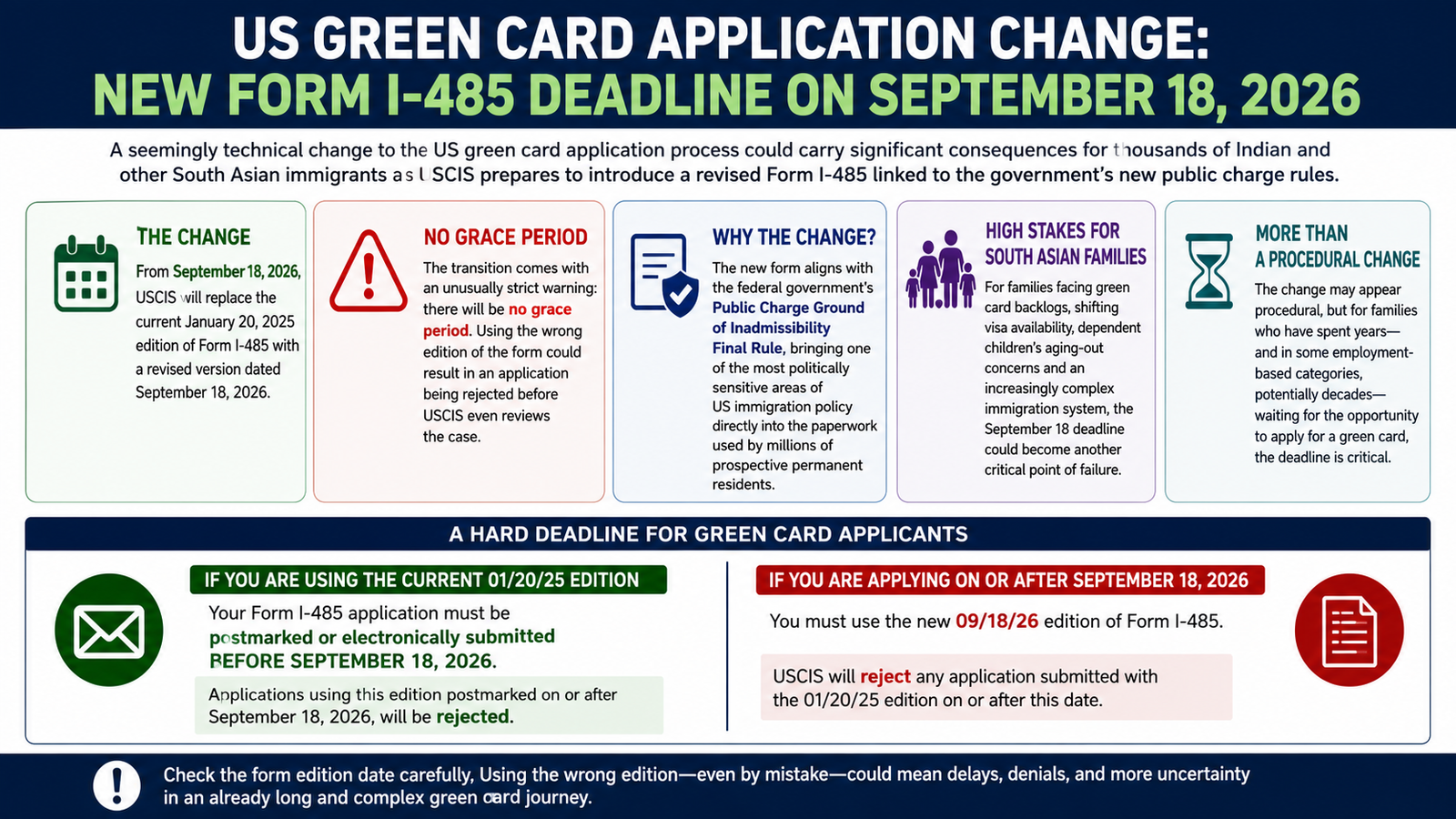
A seemingly technical change to the US green card application process could carry significant consequences for thousands of Indian and other South Asian immigrants preparing to take the final step toward permanent residence, as US Citizenship and Immigration Services prepares to introduce a revised Form I-485 linked to the government’s new public charge rules.
From September 18, 2026, USCIS will replace the current January 20, 2025, edition of Form I-485, the application used to register permanent residence or adjust immigration status, with a revised version dated September 18, 2026.
The transition, however, comes with an unusually strict warning: there will be no grace period.
For South Asian immigrants already navigating employment-based green card backlogs, shifting visa availability, dependent children’s aging-out concerns and an increasingly complex immigration system, using the wrong edition of a form could result in an application being rejected before USCIS even begins considering the merits of the case.
The new form has been revised to align with the federal government’s recently announced Public Charge Ground of Inadmissibility Final Rule, bringing one of the most politically sensitive areas of US immigration policy directly into the paperwork used by millions of prospective permanent residents.
The change may appear procedural, but for families who have spent years — and in some employment-based categories, potentially decades — waiting for the opportunity to apply for a green card, the September 18 deadline could become another critical point of failure in an already unforgiving immigration process.
A hard deadline for green card applicants
USCIS has drawn a clear line between applications filed before and after September 18.
Applicants using the current 01/20/25 edition of Form I-485 must ensure that their application is postmarked or electronically submitted before September 18, 2026. The same form will be rejected if it is postmarked or electronically submitted on or after September 18.
Meanwhile, the revised 09/18/26 edition cannot be filed early. USCIS will accept it only if it is postmarked or electronically submitted on or after September 18.
The agency has released a preview version of the new form and its instructions to give applicants and immigration attorneys time to prepare, but it has made clear that reviewing the new form before the deadline is not the same as being allowed to submit it.
USCIS Form I-485 information and revised form preview
The absence of a transition period means South Asian applicants will have to pay close attention to the timing of their filings. An applicant who prepares an I-485 package weeks in advance but submits an outdated edition on September 18 could see the application rejected. Conversely, someone attempting to submit the new version before its effective date could also face rejection.
For an immigrant population accustomed to monitoring visa bulletin dates, priority dates and employment authorization deadlines, the edition date printed on a government form has now become another crucial date to watch.
Why the change matters particularly to Indians
The implications are especially significant for Indian nationals, who make up one of the largest groups of employment-based immigrants in the United States and have faced some of the longest waits in the green card system.
For many highly skilled Indian professionals working in the technology, healthcare, engineering and financial sectors, filing Form I-485 is not simply another immigration application. It is the culmination of a process that may have begun years earlier with an H-1B visa, an employer-sponsored immigrant petition and a long wait for a priority date to become current.
When that filing window finally opens, the opportunity can be time-sensitive.
Visa bulletin movements can alter the availability of immigrant visa numbers, and applicants often assemble extensive filing packages involving employment records, birth and marriage certificates, medical examinations, financial documentation and applications for dependent family members.
A rejected application because the wrong edition of Form I-485 was used could therefore produce consequences extending beyond a simple administrative inconvenience. Depending on the circumstances, it could delay adjustment processing, require the preparation of a new filing package and create uncertainty for applicants whose immigration status or related work authorization is approaching a critical deadline.
The risk is amplified for Indian families because employment-based green card applications frequently involve spouses and children. In a system where delays can stretch across years, families must often coordinate multiple applications and supporting documents at the same time.
A form revision affecting the principal applicant can therefore affect an entire household.
South Asian diaspora faces another layer of immigration complexity
The impact will not be confined to Indian professionals.
Pakistani, Bangladeshi, Nepali, Sri Lankan and other South Asian immigrants applying for permanent residence through family-based, employment-based or other eligible categories may also encounter the revised requirements.
For many South Asian families, immigration paperwork is already a complicated exercise involving applicants across different legal categories and households with mixed immigration status. A spouse may be on a temporary work visa, another family member may be seeking adjustment of status and a child may have a separate immigration timeline.
The introduction of a revised I-485 adds another administrative layer to a process in which even small filing errors can have disproportionate consequences.
Immigration attorneys and South Asian community organizations are therefore likely to spend the weeks before September 18 urging prospective applicants to check the edition date of their forms and avoid relying on documents downloaded months earlier or obtained from unofficial sources.
The safest course for applicants will be to use forms obtained directly from USCIS and verify the edition date immediately before submission.
Public charge returns to the center of the green card process
The revision is linked directly to the government’s newly announced Public Charge Ground of Inadmissibility Final Rule, making the change potentially more significant than a routine redesign of an immigration form.
Public charge rules broadly concern whether a noncitizen applying for admission or permanent residence may be considered likely to become dependent on public resources. The issue has repeatedly generated political controversy because changes in how the government interprets public charge can affect the type of financial and benefits-related information immigration applicants are required to disclose.
Public Charge Ground of Inadmissibility Final Rule
For South Asian immigrant families, the issue can carry wider implications than the green card application itself.
Many immigrant households operate within complex financial structures that may include a principal visa holder, a dependent spouse, children studying in the United States and relatives who have arrived through family-based immigration channels. Questions concerning household income, financial support and access to public assistance can therefore become sensitive and potentially confusing.
The revised Form I-485 will provide one of the first major practical indications of how the new public charge framework is expected to function within the adjustment-of-status process.
Applicants will need to study not only the form itself but also the accompanying instructions to understand what new information, declarations or supporting evidence may be required.
The September 18 filing trap
The biggest immediate concern is likely to be the transition date itself.
USCIS has effectively created three separate rules for applicants filing around September 18:
- The 01/20/25 edition will be accepted only if it is postmarked or electronically submitted before September 18, 2026.
- The 01/20/25 edition will be rejected if it is postmarked or electronically submitted on or after September 18, 2026.
- The new 09/18/26 edition will be accepted only if it is postmarked or electronically submitted on or after September 18, 2026.
That leaves no overlap period during which applicants can safely use either version.
For South Asian immigrants who may have already spent months gathering documents, obtaining translations, securing medical examinations and coordinating paperwork from relatives in India, Pakistan, Bangladesh, Nepal or Sri Lanka, a form change close to the filing date could require another review of an already complex package.
Applicants mailing documents around the deadline will also need to pay particular attention to when USCIS considers the application filed. USCIS has specifically tied acceptance to the postmark date for mailed applications and the submission date for electronic filings.
This makes the distinction between September 17 and September 18 especially important.
Families, employers and immigration lawyers must recalibrate
The impact of the revised form is also likely to be felt by US employers sponsoring South Asian professionals for permanent residence.
Companies that have spent years supporting an employee through the employment-based immigration process may have adjustment-of-status cases ready for filing around the transition date. Human resource departments, immigration law firms and corporate mobility teams will have to ensure that filing packages are synchronized with the new USCIS requirements.
For Indian technology professionals, whose employers frequently manage large volumes of employment-based immigration cases, even a short period of confusion over the new form could create operational challenges.
Immigration attorneys will also need to review whether changes associated with the public charge rule require new documentation or different answers from applicants whose cases were prepared using the outgoing form.
The preview version released by USCIS gives lawyers and applicants an opportunity to make that comparison before September 18. But because the new edition cannot be filed early, applicants close to completing their cases face a practical decision: file the current version before the deadline if eligible and ready, or wait and submit the revised form after the new rules take effect.
Another reminder that paperwork can determine immigration outcomes
The I-485 change illustrates a broader reality of the US immigration system: major consequences can flow from what appears to be a minor administrative detail.
For South Asian immigrants, immigration strategy often revolves around the most visible issues — H-1B visas, family sponsorship, employment-based quotas, visa bulletin backlogs and green card waiting periods. Yet procedural changes, including a revised form edition, can be equally consequential when an application is ready to be filed.
An applicant may have an approved immigrant petition, an available visa number and a complete set of supporting documents, but USCIS can still reject the filing if the wrong edition of the application form is used.
That is particularly significant for immigrant communities where many families rely on immigration consultants, attorneys, employers or community networks for information. Applicants using older forms stored on computers or circulated through unofficial channels could be particularly vulnerable to the September 18 cutoff.
The USCIS announcement is therefore likely to trigger a fresh round of advisories across South Asian diaspora organizations and immigration law networks in the coming weeks.
What South Asian applicants should do now
For prospective green card applicants, the immediate priority is to determine when they expect to file.
Those whose applications are complete and ready for submission before September 18 can use the January 20, 2025, edition, provided it is properly postmarked or electronically submitted before the deadline.
Those planning to file on or after September 18 should review the preview version of the September 18, 2026, edition and prepare their documentation accordingly, while ensuring that the new form is not submitted before its official effective date.
Applicants should also check the edition date on every version of Form I-485 used in preparing their applications and obtain the latest form directly from USCIS rather than relying on an old download.
For the South Asian diaspora, the message is especially important: after years of waiting for a green card opportunity, the final stage of the journey could now hinge on something as basic — but as consequential — as filing the correct form on the correct day.
The revised Form I-485 is expected to bring the new public charge framework more directly into the adjustment-of-status process. But its first and most immediate impact will be procedural. September 18, 2026, will be a hard dividing line: applications filed before that date must use the old form, while those filed from that date onward must use the new one.
For thousands of South Asian immigrants hoping that their long wait for permanent residence is finally nearing an end, that distinction could prove far more than a bureaucratic technicality.