Join WhatsApp Channel

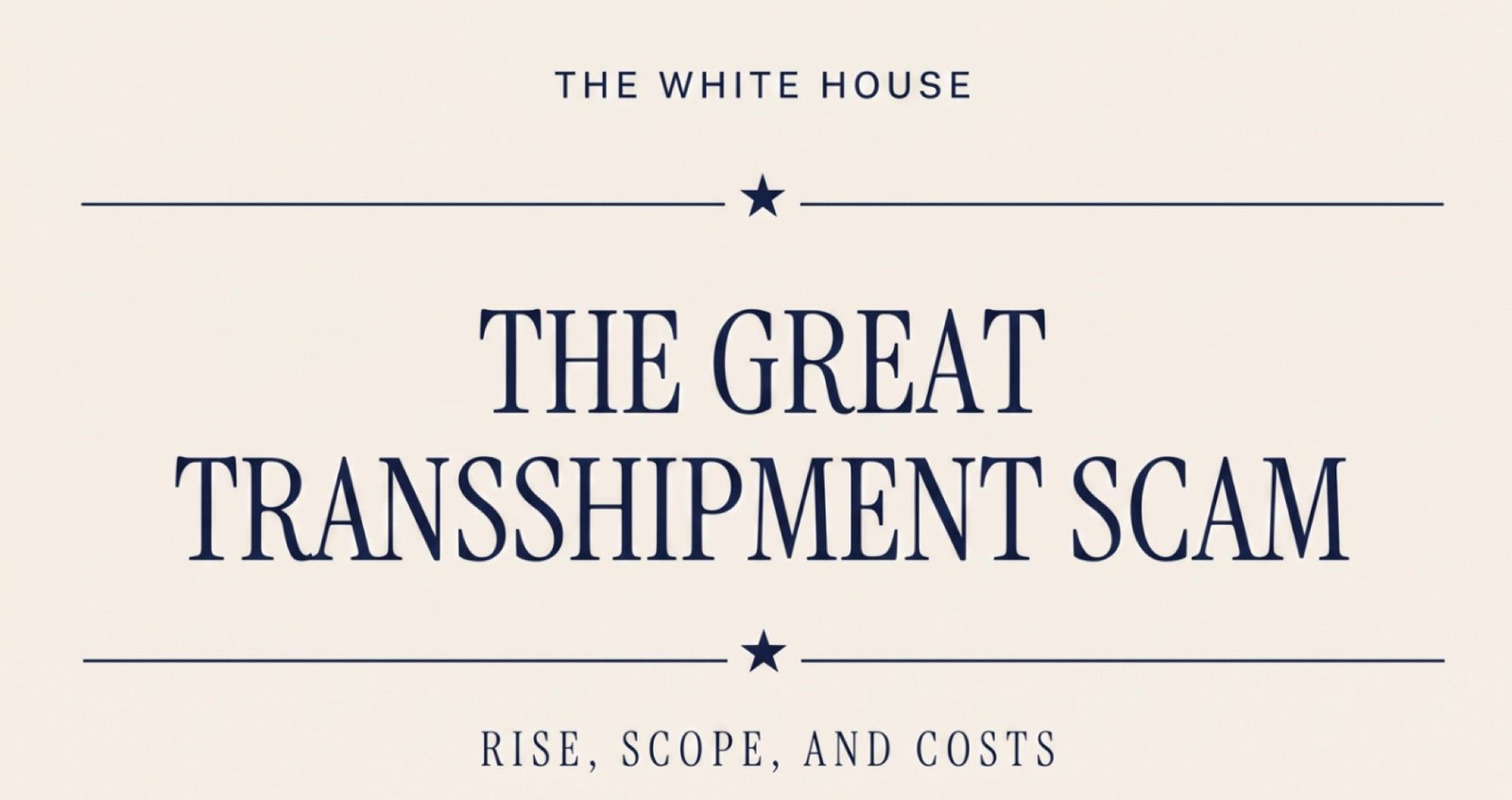
A White House report accusing China of using a vast global network to circumvent U.S. tariffs has placed India among countries considered at the highest risk of transshipment, prompting calls from Indian trade experts for evidence-based scrutiny rather than broad allegations.
The 25-page report, The Great Transshipment Scam: Rise, Scope, and Costs, released on August 13 by the White House Office of Trade and Manufacturing Policy headed by Peter Navarro, alleges that Chinese exporters are routing goods through more than 40 countries to avoid higher U.S. duties imposed since 2018.
The report argues that while direct Chinese exports to the United States have declined, Chinese products are increasingly being relabeled, repackaged or minimally processed in third countries before entering the U.S. market under different origins.
However, the Global Trade Research Initiative (GTRI), an Indian trade think tank, said the report relies heavily on aggregate trade patterns and does not provide shipment-level evidence linking India to fraudulent trade practices.
According to the White House report, U.S. imports from China fell from $525.8 billion in 2017 to $327.5 billion in 2025. During the same period, total U.S. imports rose sharply from $2.41 trillion to $3.50 trillion, suggesting that imports shifted to other countries rather than being replaced by domestic American production.
GTRI founder Ajay Srivastava said the data indicate that U.S. tariff policies changed the source of imports but failed to reduce America’s dependence on foreign goods. He argued that China has adapted by increasing exports of components and intermediate goods to manufacturing hubs such as India, Vietnam and Mexico, which then process or assemble them into finished products.
The White House report places India in its highest-risk “Tier 1” category alongside Canada, the European Union, Israel, Japan, Mexico, South Korea and Taiwan. It cites a U.S. Commerce Department estimate that $67 billion worth of goods were transshipped through India, Mexico and Vietnam in 2025, allegedly resulting in $28 billion in lost tariff revenue.
However, the report does not disclose India’s share of the alleged trade, identify any Indian exporter or provide details of a specific fraudulent shipment.
Particular attention is drawn to India’s Pune-Gujarat-Chennai manufacturing corridor for pumps and compressors under tariff codes HS 8413 and HS 8414. GTRI contends that India possesses substantial domestic manufacturing capacity in these sectors.
In FY2026, India exported liquid pumps worth $1.61 billion globally, including $414.5 million to the United States, while importing $326.4 million worth from China. Exports of air pumps and gas compressors totaled $1.48 billion worldwide, including $335.4 million to the U.S., while imports from China stood at $1.63 billion.
GTRI said these figures demonstrate the existence of a significant domestic manufacturing base and weaken assumptions that Indian exports to the United States are merely rerouted Chinese goods.
The think tank also criticized the report for expanding the definition of transshipment to include assembly, testing, finishing and component integration, activities commonly associated with global value chains and legitimate manufacturing.
Trade experts note that under international rules, products that undergo substantial transformation in a country can qualify as originating there, even if some components are imported.
GTRI urged the Indian government to seek country-, product- and shipment-level evidence from Washington and conduct its own verification of sectors identified in the report. Such an exercise, it said, would help detect any misuse while protecting legitimate Indian exporters from unsupported allegations.
The report comes at a time when India is seeking to expand exports to the United States and deepen its role in global manufacturing supply chains, making the outcome of any U.S. scrutiny particularly significant for Indian industry.