Join WhatsApp Channel

||“As Napoleon said, ‘To know a nation’s geography is to know its foreign policy.’” || – Robert D. Kaplan, The Revenge of Geography
Ancient texts described Bhāratavarṣa (India) as “the land that lies to the north of the ocean and to the south of the Himalayas.” For centuries, that description defined India’s geographic imagination. Himalayas formed its continental frontier, while the Indian Ocean marked its maritime horizon.
Nicholas Spykman once maintained that geography is “the most fundamental factor in the foreign policy of states because it is the most permanent.” Mountains and oceans rarely move, but the meaning assigned to geography does. Although climate change, technology, supply chains, and new maritime corridors are altering the routes by which power flows, geography itself has not changed and so India’s understanding of it must too.
India’s focus on the Indo-Pacific has expanded its outlook to the east, and now a similar shift is happening. Arctic developments are broadening India’s strategic horizon, even if the country’s policy debate has yet to catch up.
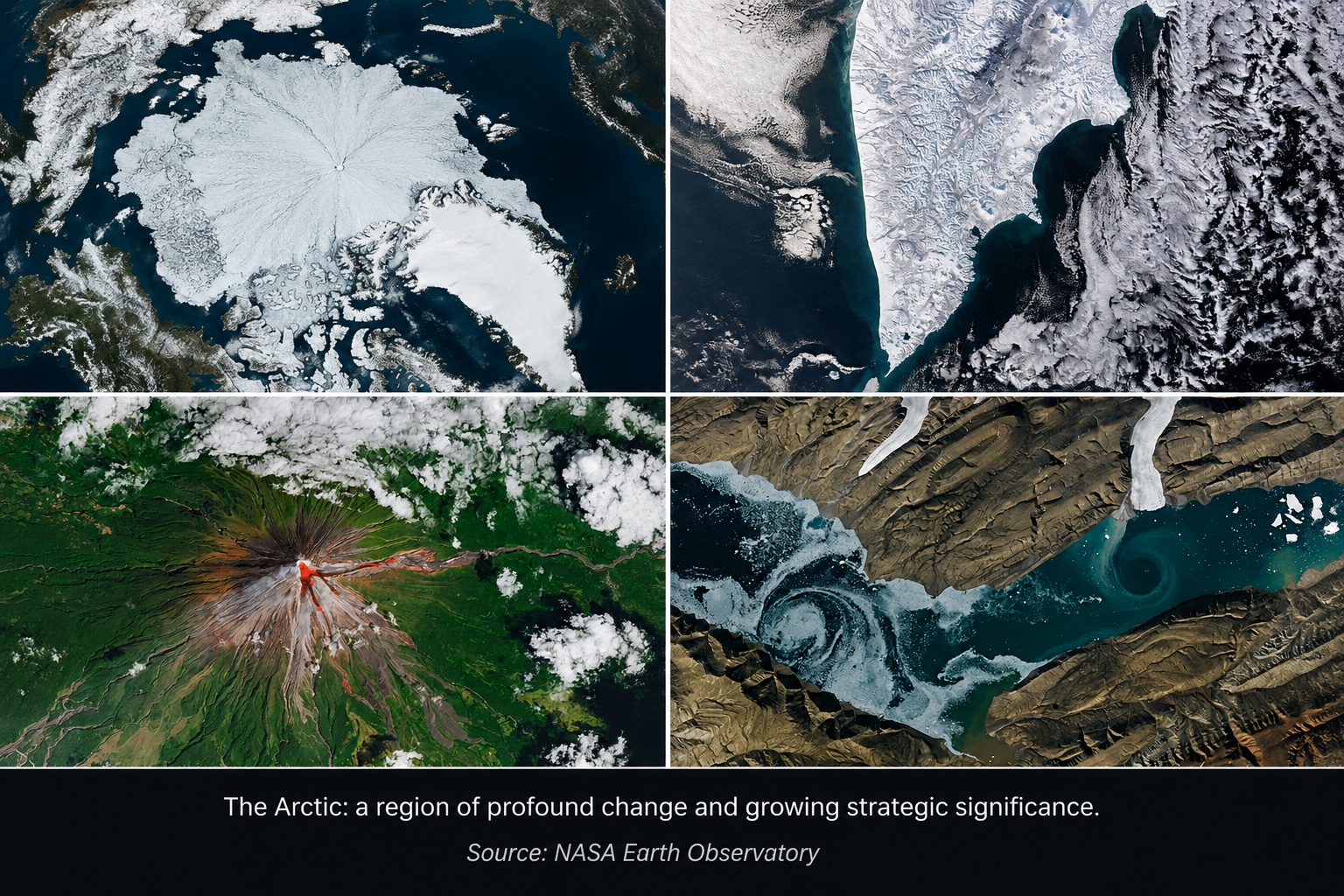
People often think of the Arctic in terms of glaciers, scientific missions, and climate studies. But that view is no longer complete. New shipping routes, energy resources, critical minerals, digital infrastructure, undersea data cables, and geopolitical competition are steadily transforming the region into one of the world’s emerging theaters. Distance no longer determines relevance.
Beyond its environmental importance, the Arctic has emerged as an important geopolitical arena. India does not need to become an Arctic power. Arctic developments are now too consequential for India to remain a distant observer.
Warmer temperatures have made Russia’s Northern Sea Route easier to use at certain times of the year, creating a new sea path between Europe and Asia. These routes will not replace the Suez Canal or the Strait of Malacca, and that is not expected. However, recent disruptions in the Red Sea have shown the risks of concentrating global commerce through a handful of maritime chokepoints.
Now, governments and shipping companies want their routes to be resilient, not just efficient. Even if Indian ships do not use the northern routes much, these new options still change global trade by making it less dependent on the usual busy sea lanes.
Estimates by the U.S. Geological Survey (USGS) suggest that the Arctic houses substantial reserves of hydrocarbons as well as critical minerals needed for batteries, semiconductors, clean energy technologies, and advanced manufacturing. Access to those resources is rapidly becoming an economic and strategic priority as countries seek to secure supply chains and reduce vulnerabilities.
Competition in the Arctic is no longer a future possibility; it is already underway. Russia has spent years consolidating its presence across the High North through military bases, air defense systems, nuclear submarine facilities, and the world’s largest fleet of icebreakers, while treating the Northern Sea Route as both a strategic and economic corridor.
NATO has responded by fundamentally reshaping its Arctic posture. Finland’s and Sweden’s accession means that seven of the eight Arctic states are now NATO members, bringing greater military coordination and sustained attention to the region.
China, despite having no Arctic coastline, has declared itself a “near-Arctic state” and is steadily expanding its presence through scientific research, commercial investments, and the Polar Silk Road. Major powers are already positioning themselves for long-term influence in the Arctic. India need not match their approaches, but it cannot afford to arrive after the strategic landscape has already been shaped.
At the Third India-Nordic Summit in Oslo this May, leaders recognized the “growing inter-linkages between the Arctic and Indo-Pacific regions.” Two months later, India and Russia agreed to work more closely on the Northern Sea Route and to have more discussions about Arctic issues. Prime Minister Modi also affirmed that India would “deepen our cooperation in Arctic and polar research.”
Himadri, India’s research station at Svalbard, has operated since 2008, while the 2022 Arctic Policy established a framework for scientific cooperation and sustainable engagement. Those investments have given India scientific credibility and diplomatic legitimacy in the region. The next step is to expand beyond science while keeping the trust that scientific work has built.
India would be mistaken to approach the Arctic primarily through a military lens. Competition is certainly growing, but India’s comparative advantage lies elsewhere. Scientific credibility, trusted partnerships, commercial engagement, maritime connectivity, critical mineral diplomacy, and responsible statecraft correspond more closely with India’s strengths and long-term interests. That approach also reflects India’s preference for shaping emerging regions through cooperation, connectivity, and institution-building rather than bloc politics.
India’s engagement in the High North is a natural part of its Indo-Pacific strategy. New sea routes, energy links, mineral supply chains, digital networks, and trade paths have connected areas that once seemed far apart. Choices made in the Arctic will increasingly affect India’s policies. Looking north is therefore not a distraction from the Indo-Pacific, but a recognition that the Indo-Pacific itself no longer exists in strategic isolation.
India spent the past decade learning to think beyond the Indian Ocean. The next challenge is learning to think beyond the Indo-Pacific.
Beyond the Indo-Pacific lies another frontier that India can no longer afford to ignore.
Disclaimer: The opinions and views expressed in this article/column are those of the author(s) and do not necessarily reflect the views or positions of South Asian Herald.