Join WhatsApp Channel

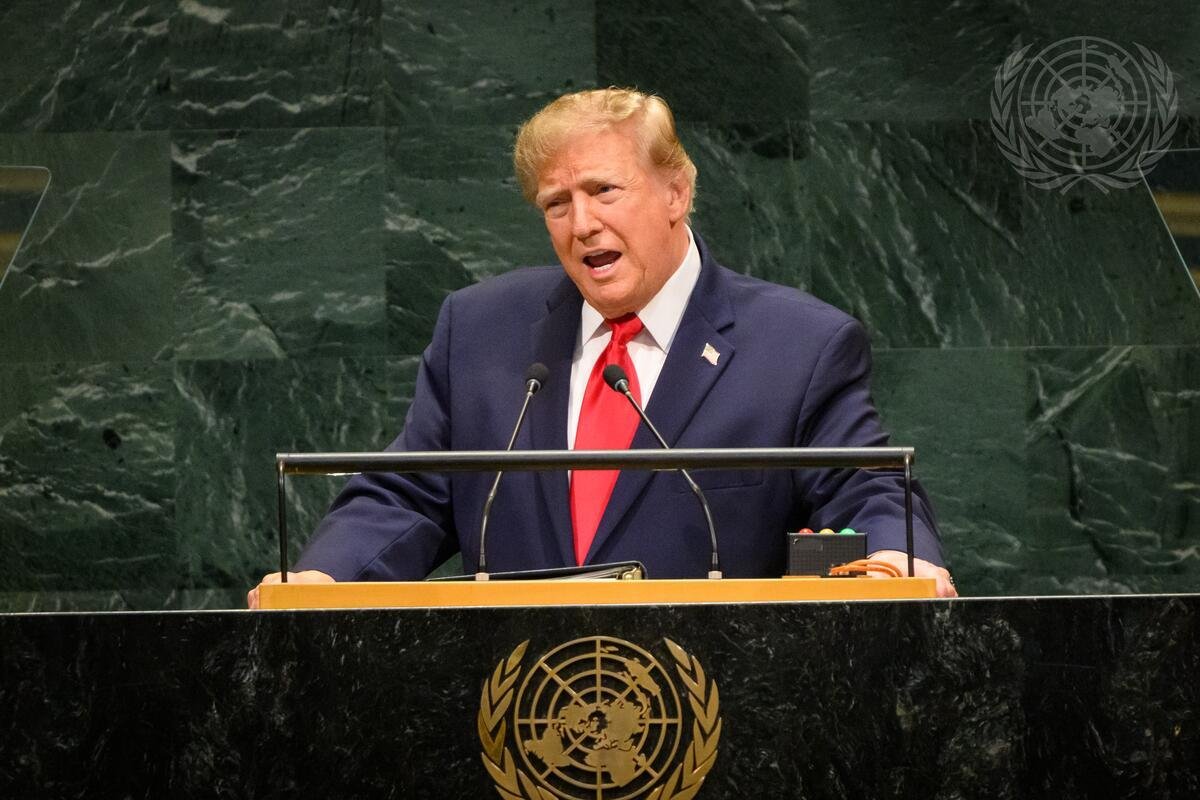
United Nations, New York: President Donald Trump told world leaders at the 81st session of the United Nations General Assembly (UNGA) on September 22, 2026, in New York that his relationships with foreign leaders, combined with the use or threat of tariffs, helped his administration resolve eight wars and advance several peace initiatives around the world.
Trump presented trade pressure and personal diplomacy as central components of his foreign policy, arguing that they allowed his administration to intervene in conflicts that had persisted for years or even decades. He cited disputes involving Cambodia and Thailand, Kosovo and Serbia, the Democratic Republic of the Congo and Rwanda, Pakistan and India, Armenia and Azerbaijan, and the war in Gaza.
“Since I took office, it has been my great honor to settle eight wars and, in so doing, become friendly with the leaders of many of those countries,” Trump said. “It was a great honor to do it. Numerous of these wars have gone on for many years and even decades.”
The President said the agreements were possible because of his relationships with the leaders involved, as well as the economic influence of the United States.
“The reason I was able to make these settlements was the use of my relationships, very special relationships to this day, very special trade,” he said, adding that tariffs, the threat of tariffs and other forms of pressure were applied depending on the country and circumstances.
Trump said leaders from several countries had written to thank him for his involvement. He pointed to remarks by Pakistani Prime Minister Shehbaz Sharif, who, according to Trump, credited the President with helping save as many as 30 million lives.
Trump described Sharif as a “terrific man” and cited similar expressions of appreciation from the leaders of Azerbaijan, Armenia, Cambodia and Rwanda.
According to Trump, the Azerbaijani President said the U.S. President accomplished in six months what others had considered impossible. “It was an absolute miracle that nobody thought could be done,” Trump said.
Trump also cited the Armenian Prime Minister as saying the diplomatic breakthrough between Armenia and Azerbaijan would not have been possible without the president’s personal involvement and commitment to peace.
Referring to tensions between Cambodia and Thailand, Trump said Cambodian Prime Minister had praised his “extraordinary statesmanship” and his efforts to prevent a wider confrontation through “visionary, innovative diplomacy.”
“This timely intervention, which averted a potentially devastating conflict, was vital in preventing a great loss of lives and paved the way toward the restoration of peace,” Trump said, quoting the Cambodian leader.
Trump also highlighted the agreement involving Rwanda and the Democratic Republic of the Congo. He said the Rwandan President recognized that the United States had identified an opportunity to contribute to peace and acted quickly.
“This conflict has lasted for 32 years,” Trump said. “Millions and millions of people have died. We got it settled. We’ve seen countless mediations and efforts, but none has succeeded in resolving the underlying issues.”
The President then addressed the continuing war between Russia and Ukraine, saying the United States was working closely with both countries to reach a resolution.
“It’s going to happen, I think, more quickly than people understand,” he said.
Trump said approximately 25,000 people, most of them soldiers, were dying every month in the war. He described battlefield images as disturbing and said the continuing loss of life underscored the need for an agreement.
“And I look at those battlefield pictures, and I really don’t want to see them anymore,” Trump said. “It’s so horrible to see 25,000 a month. Both sides.”
He also referred to legislation passed by Congress that expanded his authority to impose tariffs related to the conflict. Trump said he would use those powers if necessary to pressure the parties toward ending the war.
“It’s time to stop the killing,” he said.
Economy and domestic record
Turning to domestic policy, Trump portrayed the United States as economically and militarily stronger than when he returned to office. He credited tax reductions, deregulation, private investment and increased employment for what he characterized as a broad national resurgence.
“Our economy is the envy of the world. Our military is the most powerful on Earth. Our technology is second to none, and we are leading in virtually everything,” Trump said. “Our energy is fueling the planet. America is rising. Our nation is growing. Our power is expanding.”
Trump said more than 1 million private-sector jobs had been created since he took office and asserted that more Americans were working than at any previous point. He also said the national poverty rate had fallen to a historic low, with 1.5 million people moving out of poverty during the previous year.
The President credited his administration’s regulatory and tax policies with encouraging investment. He said U.S. stock markets had reached record levels and claimed the country had secured $21 trillion in investment commitments from around the world.
“Two years ago, our country was dead, and now we have the hottest country anywhere in the world,” he said.
Trump also highlighted immigration enforcement and public safety. He said the administration had transformed what he described as a dangerous southern border into the most secure border in U.S. history. He further claimed that no undocumented migrants had been admitted into the country during the previous 16 months.
On crime, Trump said the United States had recorded a significant decline in violent offenses and that the murder rate had fallen to its lowest level in 125 years. He credited federal interventions in Memphis, New Orleans and Washington, D.C., with producing sharp reductions in crime.
Iran and regional security
A major portion of Trump’s address focused on Iran, which he accused of destabilizing the Middle East through its nuclear activities, missile development and support for armed groups.
Trump said he had offered Tehran economic cooperation in exchange for ending its nuclear program and withdrawing support for terrorism. According to the president, Iranian leaders rejected that proposal.
“I will never allow Iran to have a nuclear weapon,” Trump said.
He said the United States subsequently launched Operation Midnight Hammer against Iranian nuclear facilities. Trump characterized the operation as having destroyed Iran’s nuclear program, although his address did not provide an independent assessment of the extent of the damage.
The President said Iran continued developing missiles and drones capable of threatening U.S. service members, neighboring countries and parts of Europe. He also linked Tehran to the October 7 attack in Israel, noting that the third anniversary of the assault was approaching.
Trump said Iran was facing severe economic hardship and extraordinarily high inflation. At the same time, he left open the possibility of a future diplomatic settlement that could allow Iran to rebuild its economy.
“Will a deal be made with Iran that lets them rebuild and create a far greater country than it ever was before?” he asked.
Trump also delivered a direct warning that the United States was prepared to use overwhelming force if diplomacy failed. He said he nevertheless believed an agreement could be reached after the U.S. midterm elections, suggesting that Iranian leaders were waiting to assess the domestic political environment.
The President thanked the U.N. Security Council for condemning attacks on commercial shipping that he attributed to Iran. He said the U.S. Navy had escorted more than 1 billion barrels of oil through the Strait of Hormuz and that oil shipments had increased since the war began.
Gaza and Middle East reconstruction
On Gaza, Trump welcomed the Security Council’s endorsement of what he described as the administration’s 20-point peace plan and its approval of a Board of Peace. He said nearly 30 countries had joined the initiative, which he chairs.
Trump said participating countries had committed billions of dollars for humanitarian relief and reconstruction. He identified Morocco, Bahrain, Qatar, Kuwait, Kazakhstan, Saudi Arabia, Turkey and Uzbekistan among the contributors.
“That money goes right to the source, right where they need it, and they desperately need it,” Trump said.
He also thanked Indonesia, Morocco, Albania, Kosovo, Kazakhstan, Egypt and Jordan for committing troops, police personnel or training assistance to help stabilize Gaza.
Trump included the Gaza agreement among the conflicts he said his administration had helped resolve. He emphasized that the arrangement covered the return of all hostages, both living and dead.
Greenland security agreement
Trump announced what he described as an unprecedented agreement with Denmark and Greenland concerning the strategically important Arctic territory.
Under the arrangement outlined by Trump, the United States would receive permanent authority to address security requirements in Greenland. He said the agreement would prevent American adversaries from establishing a military presence or making sensitive investments there without U.S. approval.
“This agreement, made with the Kingdom of Denmark, an incredible, beautiful country, and the Greenland people itself, gives the United States permanent control over security and all other needs,” Trump said.
He said the United States planned to develop a larger military presence in Greenland, including two major bases. Trump argued that the arrangement would strengthen the defense of North America and Europe while expanding the U.S. presence in the Arctic and North Atlantic.
The President said the agreement would also strengthen NATO. He praised NATO Secretary-General Mark Rutte and pointed to the alliance’s increased defense-spending commitments as evidence of its growing capacity.
“This deal also protects Europe in addition to America and greatly protects them,” Trump said.
Criticism of international institutions
While praising the United Nations’ potential role in conflict resolution, Trump criticized parts of the organization’s structure and policy agenda.
He said the United States had worked with U.N. Ambassador Michael Waltz and other member states to reduce the organization’s budget by 15 percent in 2026 and eliminate more than 4,000 positions.
“The United Nations has great, great potential,” Trump said, while arguing that it should move away from policies promoted by unelected international officials.
Trump criticized a proposed international carbon levy on shipping, contending that it could have increased transportation costs by 10 to 20 percent. He also strongly rejected the authority of the International Criminal Court over Americans and urged countries belonging to the court to withdraw.
The President accused U.N. human rights officials of unfairly criticizing U.S. policies on immigration and gender issues. He also argued that large-scale migration could undermine national cultures and sovereignty.
“There is no human right to illegal immigration, but there is a right to remain a sovereign nation, and we want to remain a sovereign nation,” Trump said. “And so should you.”
While discussing artificial intelligence, the President mentioned he should instead be called “superintelligence.” He opposed establishing an international system to control the technology and said the United States would encourage its development while monitoring potential risks through the Justice Department.
“The United States leads the world in superintelligence and will continue to do so safely and responsibly,” he said.
Related posts:
 ‘We see it in citizens across the world peacefully choosing their future — from Ghana to India to South Korea’ says President Joe Biden during his UNGA Address
 Inside US-Iran Islamabad Agreement: Full Text of the 14-point MoU
 U.S. Launches Military Action in Iran as Indian American Lawmakers Question Legality of Strike
 The Pardon Gambit: Netanyahu’s Precarious Endgame