Join WhatsApp Channel

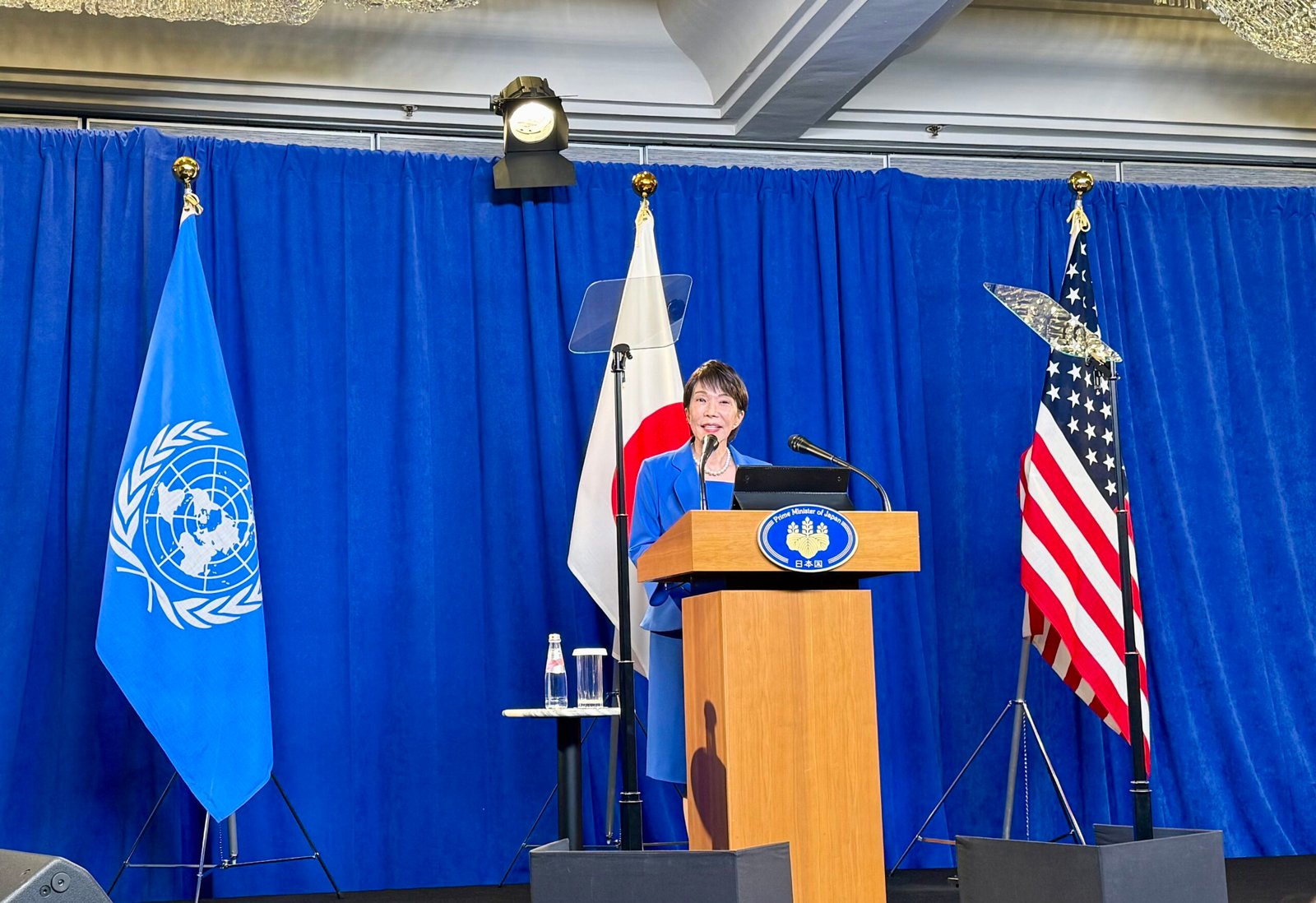
United Nations, New York: Japanese Prime Minister Sanae Takaichi has affirmed that Japan and India are pursuing “concrete initiatives” and share a common “strategic direction” as they deepen bilateral cooperation and advance the priorities of the Quad in the Indo-Pacific.
“Japan is working closely with India to advance concrete initiatives, as the Prime Minister [Narendra Modi] and I confirmed during my visit to India this July. Japan and India are special strategic and global partners that share a common strategic direction,” Prime Minister Takaichi told South Asian Herald during a September 23 news conference on the sidelines of the 81st session of the United Nations General Assembly in New York.
She was responding to a question about the Japan-India partnership within the Quad and how the two countries are working together to advance the grouping’s priorities across the Indo-Pacific.
“We will build a mutually complementary relationship that leverages each other’s strengths, focusing on such areas as security, including economic security, the economy, investment and innovation, and people-to-people exchanges,” she added.
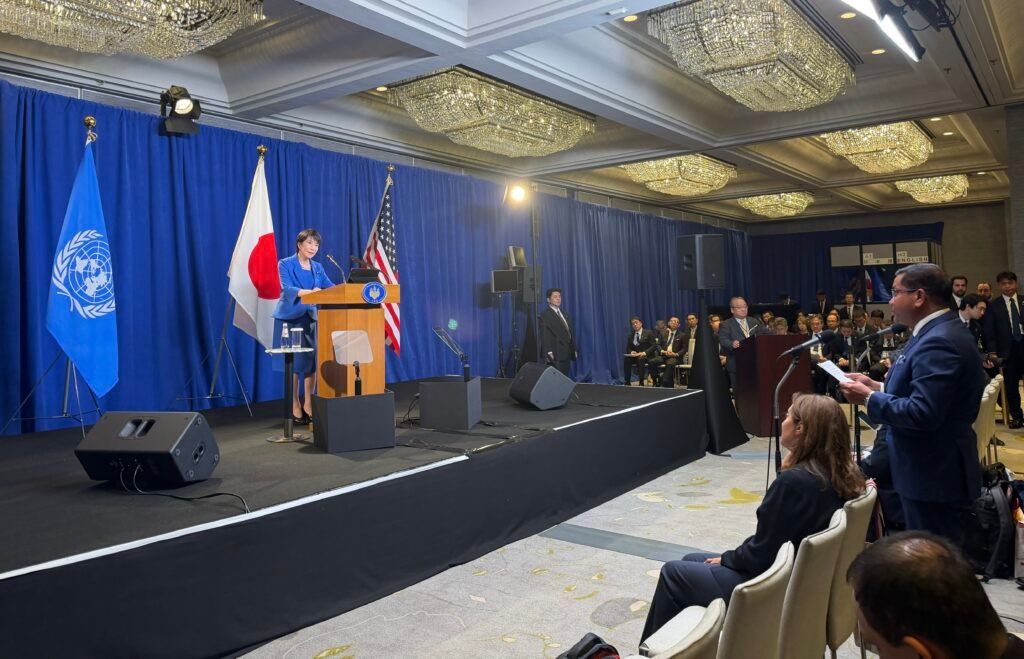
Discussing the work of India and Japan within the Quad, Takaichi described it as a framework comprising four countries including India that share “common values” and “possess the will and capacity” to respond to regional changes and advance concrete cooperation toward realizing a free and open Indo-Pacific, or FOIP.
The four countries have affirmed the importance of strengthening each nation’s ability to determine its own future freely and build resilience, she said, describing those principles as key elements of Japan’s updated vision for a free and open Indo-Pacific.
Takaichi also characterized South Asia as a region of considerable geopolitical importance and economic potential, saying cooperation with countries in the region is important to realizing the updated Indo-Pacific strategy.
“Building on Japan’s long-standing friendly relations with the countries of the region, we will continue to strengthen cooperation across a broad range of areas, including maritime security, the economy and investment, economic cooperation, and people-to-people exchanges,” she added.
In her opening remarks, Takaichi reflected on Japan’s seven decades of membership in the United Nations and the growing challenges confronting the international system.
“A little while ago, I delivered an address at the UN General Assembly General Debate. This year marks the milestone of the 70th anniversary of Japan’s accession to the United Nations. Now, however, the postwar free and open international order, with the United Nations at the center, is shaken significantly,” she said.
Takaichi acknowledged concerns that the United Nations is no longer able to fulfill its role in maintaining international peace and stability. She argued, however, that the current challenges have strengthened rather than diminished Japan’s commitment to multilateral cooperation.
“But even with that backdrop, or should I say, because of such a situation, I raise my voice to state as follows: Japan’s stance on multilateralism, Japan’s stance toward the United Nations, is unchanged,” she said.
Takaichi said her government has pursued what she described as strong Japanese diplomacy since she became prime minister. She noted that she announced Japan’s updated FOIP strategy in May as part of an integrated diplomatic approach.
“Since I became the prime minister, I have pursued strong Japanese diplomacy. In May of this year, I announced the updated FOIP,” she added. “We are advancing strategic diplomacy in an integrated way now. Japan, as a peace-loving nation, has worked together with the United Nations for the past 70 years. With this as a basis, we will carry out our responsibility to recover trust in the United Nations. The speech I gave at the general debate was a perfect opportunity for me to appeal for our resolve and to convey Japan’s plans for concrete contributions from two perspectives.”
The first area outlined by Takaichi involved responding to problems arising from increasingly tense international developments. She cited escalating tensions in the Middle East and the growing difficulty of maintaining free and safe passage through the Strait of Hormuz, which she described as an international public good.
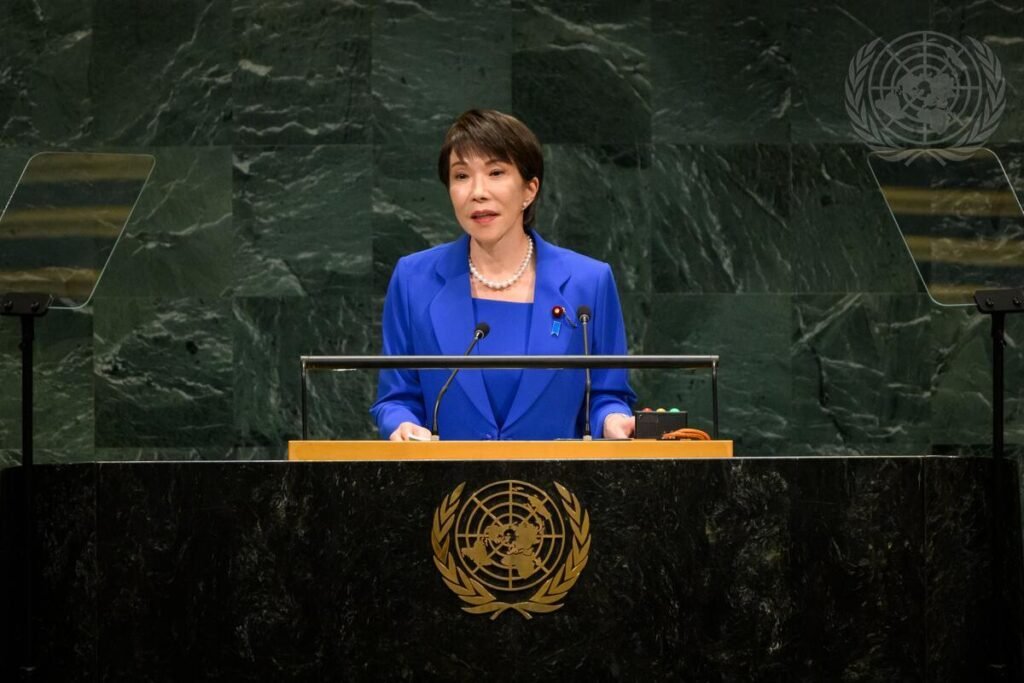
Japan will continue working with the international community and pursuing diplomatic efforts aimed at de-escalating tensions and stabilizing the broader Middle East, she said.
“Under the updated FOIP, I stated that, in addition to the Power Asia, Japan is currently formulating a comprehensive cooperation plan aimed at strengthening the energy and critical-goods resilience of the Gulf countries,” she added. “Moreover, I called for solidarity within the international community toward a world without nuclear weapons and appealed for the complete denuclearization of North Korea and a prompt solution to the abduction issue.”
Takaichi said attempts to “unilaterally” alter the status quo through force or coercion must never be tolerated anywhere in the world. She emphasized Japan’s commitment to the rule of law as a foundation for resolving international disputes.
That commitment, she said, is reflected in Japan’s consistent support for international judicial institutions and its contribution of judges to bodies including the International Court of Justice, the International Criminal Court and the International Tribunal for the Law of the Sea.
The Prime Minister then addressed Japan’s commitment to a multilateral system centered on the United Nations. She said Japan has sought to work in solidarity with the Global South to respond to worldwide challenges, including climate change, economic development and disaster risk reduction.
“I have appealed that Japan has been advancing efforts to work in solidarity with the Global South in addressing global issues. I urged that if Japan’s technological capabilities are utilized, climate change measures and economic growth can both be realized,” she said.
Takaichi emphasized that all countries must undertake serious efforts to address climate change. She also said Japan is working to become a world leader in disaster risk reduction by sharing its experience, knowledge and technology with other countries.
“I emphasized that I newly appointed a minister of state for international disaster risk reduction cooperation to show Japan’s intent to share our knowledge and technology to contribute to disaster risk reduction measures in the world,” she added. “I also announced our intent to hold the AI summit soon in Japan to realize trusted AI. In responding to the challenges faced by the international community, the United Nations must be reborn as a more resilient and effective United Nations.”
Takaichi called for reform of the UN Security Council, which she described as dysfunctional and no longer reflective of the realities of the international community.
“I also asked for the immediate review of the UN Charter, in other words, asked to delete the so-called enemy state clauses. Finally, Japan has consistently contributed to the peace and prosperity of international society as a peace-loving nation under the concept of an exclusively defense-oriented policy for the seven decades since accession to the United Nations. I emphasize that this policy will remain unchanged in the future,” she added.
The Prime Minister also discussed her meetings with UN Secretary-General António Guterres and the leaders of several countries during her visit to New York.
“In my meeting with Secretary-General Guterres, I expressed support for the United Nations reform he has advanced, while once again stressing the urgency of reforming the Security Council, which does not reflect the current realities of the international community,” she said. “I also called for increased representation of Japanese personnel in the United Nations. The secretary-general expressed appreciation for Japan’s strong commitment to and action in support of multilateralism.”
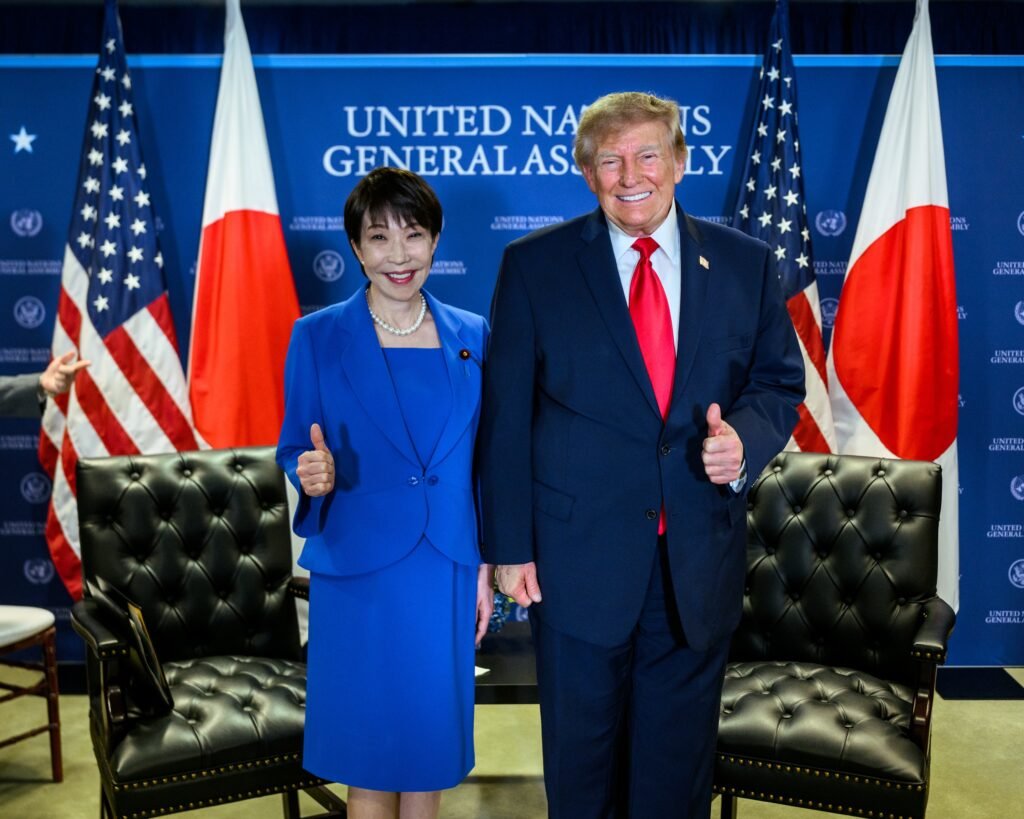
Takaichi said her meeting with President Donald Trump included discussions about the Japan-U.S. alliance and regional developments, including efforts to maintain a free and open Indo-Pacific.
“We had a candid discussion on the Japan-U.S. alliance and regional affairs, including a free and open Indo-Pacific, and concurred on further strengthening cooperation in the economy, security, and economic security, including AI, semiconductors, and critical minerals,” she said.
Against the backdrop of what she described as an increasingly difficult security environment in Asia, Takaichi said the meeting demonstrated the strength of the alliance between Japan and the United States.
“I am determined to make the Japan-U.S. alliance even more unwavering, so that both Japan and the United States become stronger and more prosperous, and for the peace and stability of the region,” she added.
Following a telephone conversation last month, Takaichi said she also held an in-person meeting with Turkish President Recep Tayyip Erdoğan to discuss bilateral relations and developments in the Middle East.
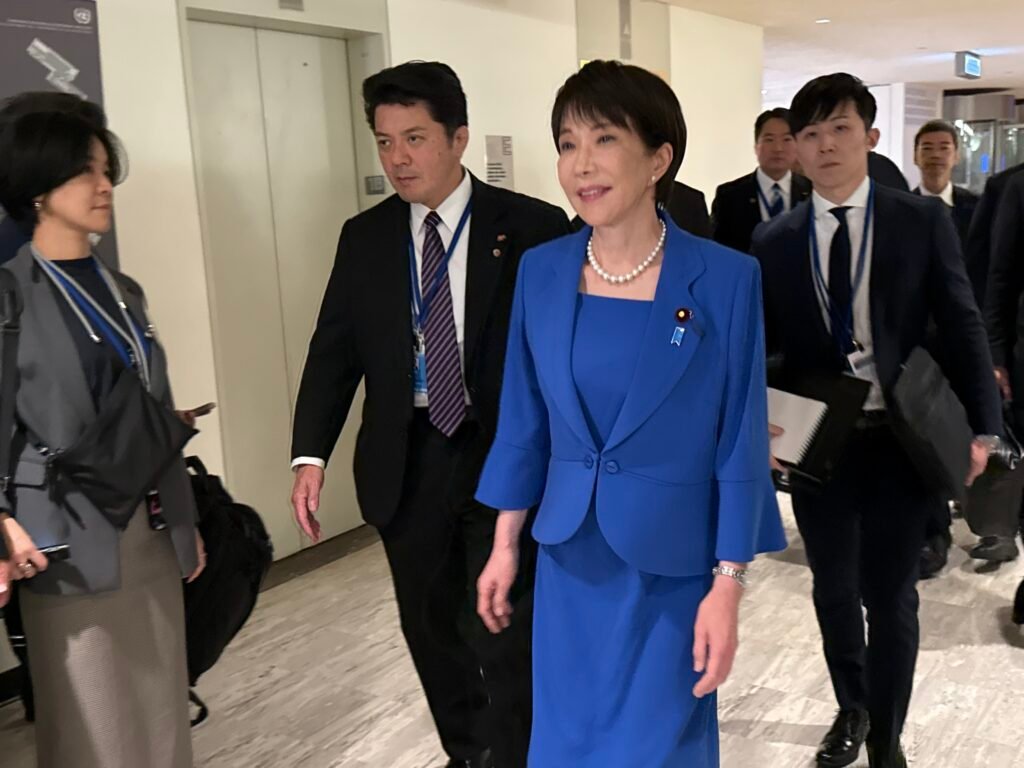
Takaichi said she emphasized the importance of quickly de-escalating and stabilizing the situation across the region. She also stressed the need to ensure free and safe navigation through the Strait of Hormuz without additional costs.
“President Erdoğan expressed support for Japan’s position, and we concurred that our two countries would work in close coordination,” she added.
During her summit meeting with Ukrainian President Volodymyr Zelenskyy, Takaichi reiterated Japan’s support for Ukraine and its intention to continue coordinating with the international community.
“I stated my thoughts to the effect that Japan stands with Ukraine, and that, in cooperation with the international community, we would continue support for Ukraine as well as sanctions on Russia, including in the field of energy toward this winter,” she said.
Zelenskyy expressed appreciation for Japan’s support and briefed Takaichi on Ukraine’s ongoing efforts, according to the prime minister.
Takaichi said she also held talks with Australian Prime Minister Anthony Albanese, British Prime Minister Andy Burnham, Trinidad and Tobago Prime Minister Kamla Persad-Bissessar and Bhutanese Prime Minister Tshering Tobgay.
She described the meetings as valuable opportunities to confirm plans for advancing Japan’s respective bilateral relationships through the end of the year. With ASEAN, APEC and G20 meetings ahead, Takaichi said Japan would continue strengthening coordination with its international partners.
“I will seize this series of diplomatic opportunities to deepen coordination with other countries and build momentum for jointly confronting the challenges facing the international community,” she added.