Join WhatsApp Channel

I’ve met hundreds of people who practice yoga, but only a small handful who truly live a yogic lifestyle. Yet one thing is strikingly common in this rare group: They look younger than their age and carry a natural vitality that no cream can replicate.
What is their secret?
To understand the real cheat code, we need to look inside our cells.
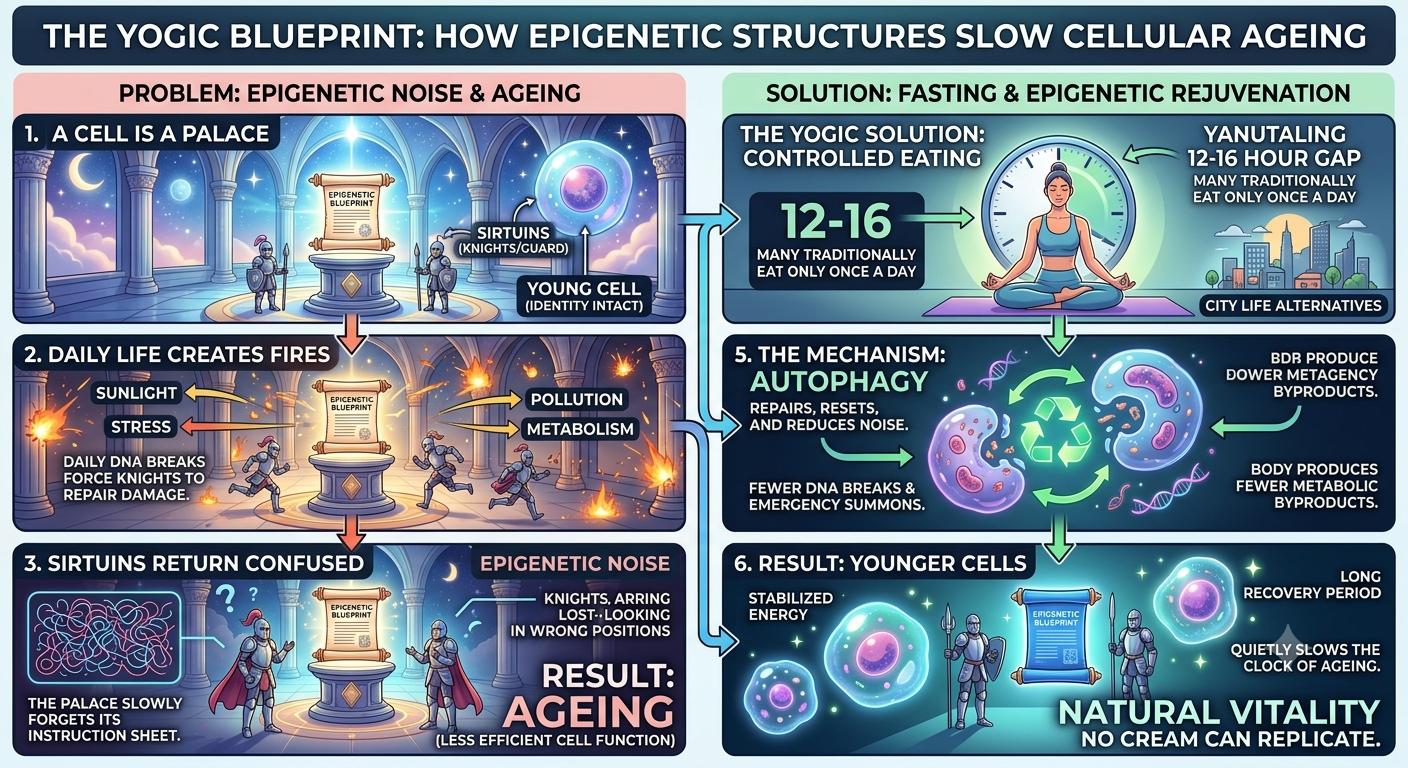
Every cell carries the same DNA, but what makes a skin cell behave differently from a liver cell is its epigenetic structure. These are chemical markings that tell the cell which genes to switch on and which to keep silent. Among the key protectors of this system are sirtuins, proteins often called longevity genes. Their job is to keep the cell’s internal order intact so it remembers its identity—its correct role and function. When a cell loses this sense of identity, it becomes less efficient, and that gradual loss of function is what we recognize as aging.
Think of a cell as a palace. The epigenetic blueprint is the instruction sheet that keeps the palace running. Sirtuins are the knights guarding this sheet. But daily life creates thousands of tiny DNA breaks through sunlight, stress, pollution, and even normal metabolism. Each break is like a fire in the countryside, forcing the knights to leave the throne room to repair the damage. When they return, they do not always find their exact place. Over time, this creates epigenetic noise, and the palace slowly forgets its instruction sheet. That forgetting is aging.
Logically, if we can help these sirtuins stay in the palace longer, the chance of losing them is lower. This is one of the keys to younger cells. But how do we do that?
Here comes the dramatic solution many yogis rely on: fasting. While yoga includes asana and pranayama, this rare group also has firm control over their eating habits, and many traditionally eat only once a day. In modern city life, that may not be practical, but the principle still works.
When we fast, the body produces fewer metabolic byproducts, which means fewer DNA breaks and fewer emergency summons for the knights. In science, this cleanup process is called autophagy. A simple gap of 12 to 16 hours between dinner and the next meal gives the body time to repair, reset, and reduce epigenetic noise. Even doing this once or twice a week is a powerful start. That extended recovery period helps clear cellular damage, stabilize energy, and quietly slow the clock of aging.
Disclaimer: The opinions and views expressed in this article/column are those of the author(s) and do not necessarily reflect the views or positions of South Asian Herald.
Related posts:
 ‘There are Plenty of Problems Begging to be Solved in Rare Diseases’
 A Decade of the International Day of Yoga (IDY): Yoga for One Earth, One Health
 Sunil Gavaskar Supports AAPI Stem Cell Donor Drive to Expand Registry for Blood Cancer Patients
 Australia Celebrates 11th International Day of Yoga with Over 55 Events Nationwide