Join WhatsApp Channel

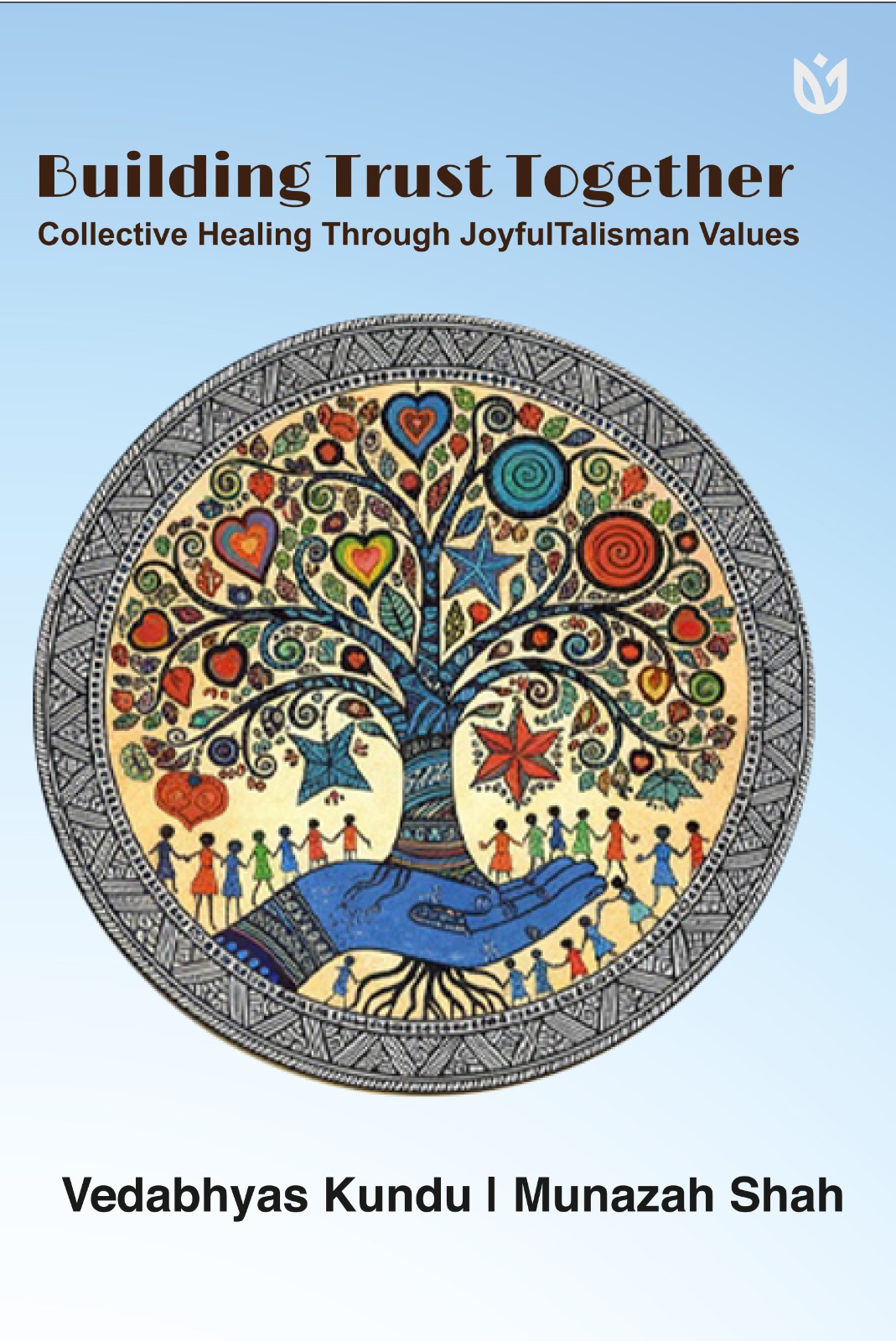
When the UN Secretary-General, António Guterres diagnosed the world as suffering from a “Trust Deficit Disorder,” the question of how trust is built, broken, and repaired ceased to be an academic curiosity and became a civilizational concern. It is into this terrain that Vedabhyas Kundu and Munazah Shah step with Building Trust Together: Collective Healing through JoyfulTalisman Values, a book that treats trust neither as a managerial technique nor as a psychological abstraction, but as a moral and spiritual practice — lived, wounded, and capable of healing.
The book extends the authors’ “JoyfulTalisman” philosophy, first developed in their earlier work, The JoyfulTalisman: Conversations on Human Values for a Joyful World. Inspired by Mahatma Gandhi’s Talisman, the framework rests on interlocking pillars: turning inward toward an “inner sanctuary,” cultivating “human interdependence literacy,” measuring one’s “nonviolent and solidarity footprints,” and nurturing an ethic of care. The book situates itself openly within a peace-education lineage.
The ten chapters move in a deliberate arc — from the why of trust, through its architecture and psychology, into its pathologies, and finally toward repair and renewal at the personal, familial, organizational, and societal levels. Chapter 1 opens with the Panchatantra fable of the Monkey and the Crocodile, using it, alongside Stephen M. R. Covey and Daisaku Ikeda, to argue that everything depends on trust. Chapter 2 identifies eight pillars of trust — reliability, interdependence, authenticity, sincerity and honesty, competence, care, accountability, and integrity — placed in dialogue with David Horsager’s well-known “Eight Pillars of Trust” framework.
Chapter 3, among the most engaging in the book, takes the form of a conversation with counselling psychologist Ishita Thapliyal, whose insights give the work its psychological texture: trust judgments form in under a second, yet mature only through “behavioral congruence”; mistrust is often “an adaptive response to unsafe environments” rather than a personal deficiency; and trust itself is a kind of “emotional breathing.” Chapter 4 distinguishes mistrust (anticipatory, self-protective) from distrust (evaluative, post-betrayal), and catalogues eleven conditions under which trust erodes. The invocation of Ulysses S. Grant — ruined by a trusted partner and lamenting that he could never trust again — grounds the discussion of betrayal trauma in lived history.
The book’s center of gravity lies in Chapters 5 through 7. Chapter 5 argues that all trust begins with self-trust — not blind certainty, but “the confidence that even when we make mistakes, we will respond with integrity.” Chapter 7 presents the volume’s principal original contribution: the JoyfulTalisman Trust Repair Model, built on five principles — inner sanctuary, compassionate clarity, nonviolent communication, interdependence literacy, and courageous stewardship of relationships — and operationalized through seven stages, from pausing and grounding, through naming the breach and empathic inquiry, to ownership, co-created safeguards, consistency over time, and restored shared meaning. Illustrated through case studies of a strained friendship and a workplace credit dispute, the model is accompanied by reflective prompts and, notably, an honest acknowledgement of when trust cannot be repaired: amid repeated dishonesty, unsafe environments, abuse, and denial of responsibility. This caveat guards the framework against the naïveté that afflicts much popular writing on reconciliation.
The final chapters apply the model outward: to families (Chapter 8), where trust is presented as the “emotional architecture” of psychological safety; to the workplace (Chapter 9), which contrasts extractive leadership with a servant-leadership model through a CEO undone by his own culture of fear; and to social trust (Chapter 10), which takes up the Guterres diagnosis at institutional and global scale. The concluding vision — that trust cascades across self, relational, and social levels, and that renewal at any one level requires inner moral realignment — gives the book a satisfying unity.
The book’s strengths are considerable. Its integrative range moves fluidly between the Panchatantra and the amygdala, between Thich Nhat Hanh and organizational behavior, drawing on Mahatma Gandhi, A P J Abdul Kalam, Daisaku Ikeda, and writers such as Covey and James Clear, lending it a genuinely intercultural voice. Its reframing of trust repair as “not the absence of rupture but the presence of repair” is both intellectually sound and practically consoling. Its conversational form — dialogic exchanges between the authors and also with Thapliyal — lends the book a warmth rare in the trust literature, complemented by reflection questions that make it usable in classrooms and workshops.
The book’s limitations deserve equally candid mention. Its evidentiary base is illustrative rather than empirical: the case studies are composed vignettes, and the Repair Model, though coherent and provides new insights, awaits validation against established trust-repair scholarship. The conversational style produces some repetition, particularly around the theme of interdependence. Chapter 10’s treatment of social trust remains largely at the level of moral exhortation; readers seeking engagement with the political economy of institutional distrust will find the diagnosis gestured at rather than examined in depth.
These limitations are, in a sense, the shadow cast by the book’s chosen genre. This is a work of applied moral philosophy and peace education, not a research monograph, and by that standard it succeeds admirably. Its central conviction — that trust “must be regenerated through the human conscience” rather than through systems alone — is a useful corrective, best read as a complement to institutional reform rather than a substitute for it.
Conclusion
Building Trust Together: Collective Healing through JoyfulTalisman Values is a humane, sincere, and quietly demanding book. It asks readers not merely to understand trust but to practice it: to pause before reacting, to name wounds without weaponizing them, to own errors without self-erasure, and to rebuild “promise by promise, act by act, time as our witness.”
Educators, counsellors, mediators, human-resource practitioners, and students of peace studies will find it immediately useful, while scholars of trust will find in the JoyfulTalisman Trust Repair Model a framework worth testing further. At a moment when cynicism has become a reflex, Kundu and Shah have written a book that treats trust as what it truly is: not a calculation, but a covenant.