
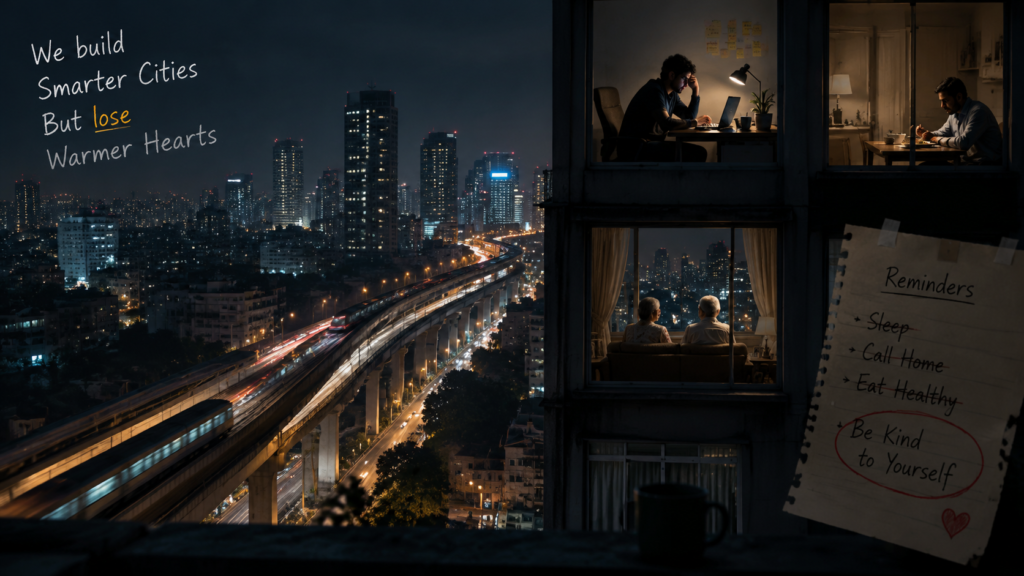
There is a peculiar silence that descends over India’s great cities long after midnight. The traffic thins, office towers surrender their lights one floor at a time, and thousands of apartment windows glow faintly against the darkness. Behind each window is a story we rarely hear—a young software engineer staring blankly at a laptop long after work has ended; a migrant executive eating dinner alone for the fifth night in a row; an elderly couple waiting for a son or daughter who lives only a few kilometers away but never seems to have the time to visit.
Our cities have never looked more alive. Yet, for far too many who inhabit them, they have never felt lonelier.
This is the contradiction that defines urban India. We are building smarter cities while quietly becoming more fragile people. Every flyover promises to shorten distance, every new metro line promises better connectivity, every luxury housing project advertises community living. And still, somewhere between ambition and achievement, we have lost something impossible to measure but devastating to live without—the feeling of belonging.
Perhaps that is why Bengaluru’s grim distinction of recording the highest suicide rate among India’s major cities in 2026 should haunt us long after the headlines fade. More than 2,400 people did not simply become statistics. They left behind unfinished dreams, unanswered messages, birthdays that will never again be celebrated and families condemned to spend the rest of their lives wondering whether one conversation, one embrace or one moment of kindness might have changed everything.
Advertisement
No city should become so efficient at creating wealth that it forgets how to preserve hope.
We often blame the obvious villains—traffic that steals hours from our lives, impossible rents, relentless deadlines and the endless race for the next appraisal. But these are merely the visible cracks. The deeper fracture lies within us. We have slowly accepted the dangerous belief that exhaustion is a badge of honor and that our value as human beings is determined by our productivity. We applaud people who never switch off, admire those who sacrifice sleep and call burnout “dedication,” until one day the body continues to function while the spirit quietly gives up.
The irony is heartbreaking. We have become obsessed with wellness. We count calories, track our heartbeats, wear devices that tell us how well we slept and spend fortunes trying to prolong our lives. Yet more than four out of five urban Indians admit they live with stress. We have learned to monitor every organ except the one that carries our fears, our grief and our loneliness.
Money, of course, weighs heavily. Rising rents, shrinking savings and uncertain jobs leave many living from one salary to the next. But there is another poverty spreading through our cities, one that no economic survey captures. It is the poverty of meaningful human connection. We know the names of people across continents through LinkedIn but not the names of those living across the hallway. We exchange hundreds of messages every day while silently hoping someone will ask, “How are you, really?”
Somewhere along the way, we stopped asking.
Perhaps because we feared the answer.
Mental health is often described as an invisible illness. Yet maybe it is invisible only because we have become experts at looking away. We smile in meetings, laugh over coffee, upload holiday photographs and reassure everyone that we are “doing fine,” even when we are carrying storms no one can see. The tragedy is not that suffering exists. The tragedy is that so much of it unfolds in complete silence.
Sometimes the only relief comes from escaping the city itself. A morning beneath old trees, a walk through a quiet park, the first sight of distant hills after weeks of concrete and glass—these moments remind us that peace was never meant to be a luxury. Nature asks nothing of us. It does not demand quarterly targets or performance ratings. It simply allows us to breathe.
But no park, however beautiful, can compensate for a society that has forgotten how to care.
India stands at a remarkable moment in its history, building world-class infrastructure and aspiring to become a global economic powerhouse. Yet the measure of a truly developed nation will never be found only in its highways, airports or stock markets. It will be found in whether the people returning home each evening feel that life is worth living when the lights go out and the noise finally fades.
For the greatest poverty is not the absence of money. It is the absence of hope. And no city, however prosperous, can truly call itself successful if it quietly teaches its people to survive, but forgets to show them how to live.
Disclaimer: The opinions and views expressed in this article/column are those of the author(s) and do not necessarily reflect the views or positions of South Asian Herald.