Join WhatsApp Channel

Students heading to American universities this fall face one of the year’s most expensive travel periods. But with the right strategy, families can save hundreds of dollars before classes even begin.
As thousands of Indian students prepare to leave for universities across the United States this August and September, many families are discovering that securing a visa may be easier than finding an affordable airline ticket.
The annual rush for the fall academic intake has once again pushed airfares sharply higher as students, tourists and business travelers compete for a limited number of seats during one of the busiest periods in international aviation. For students already facing tuition fees, accommodation deposits and insurance costs, the difference between booking early and waiting until the last minute can amount to several hundred dollars.
Industry estimates suggest that one-way economy fares from India to major American cities during the peak travel season typically range between $900 and $1,500 (approximately Rs 75,000 to Rs 1.25 lakh). In periods of exceptionally strong demand, fares on popular routes have climbed above $1,800 (around Rs 1.5 lakh). During quieter months, however, similar tickets are often available for $550 to $900 (Rs 46,000 to Rs 75,000), illustrating how dramatically prices change depending on when students travel.
The reason is simple. Most American universities begin their fall semester between the last week of August and the first week of September. International students are encouraged to arrive a week or two early to attend orientation programs, settle into accommodation and complete campus formalities. At the same time, US immigration regulations prohibit students travelling on an F-1 visa from entering the country more than 30 days before the program start date printed on their Form I-20. That narrow travel window compresses demand into just a few weeks, creating a predictable annual surge that airlines have become increasingly adept at monetizing.
Unlike fixed pricing of the past, airlines today rely on sophisticated revenue management systems that monitor bookings in real time. Every ticket sold reduces the number of seats available in lower-priced fare categories. As flights fill up, travelers are automatically offered more expensive tickets. The sharpest increases generally occur within three weeks of departure, particularly during the final seven to fourteen days before a flight.
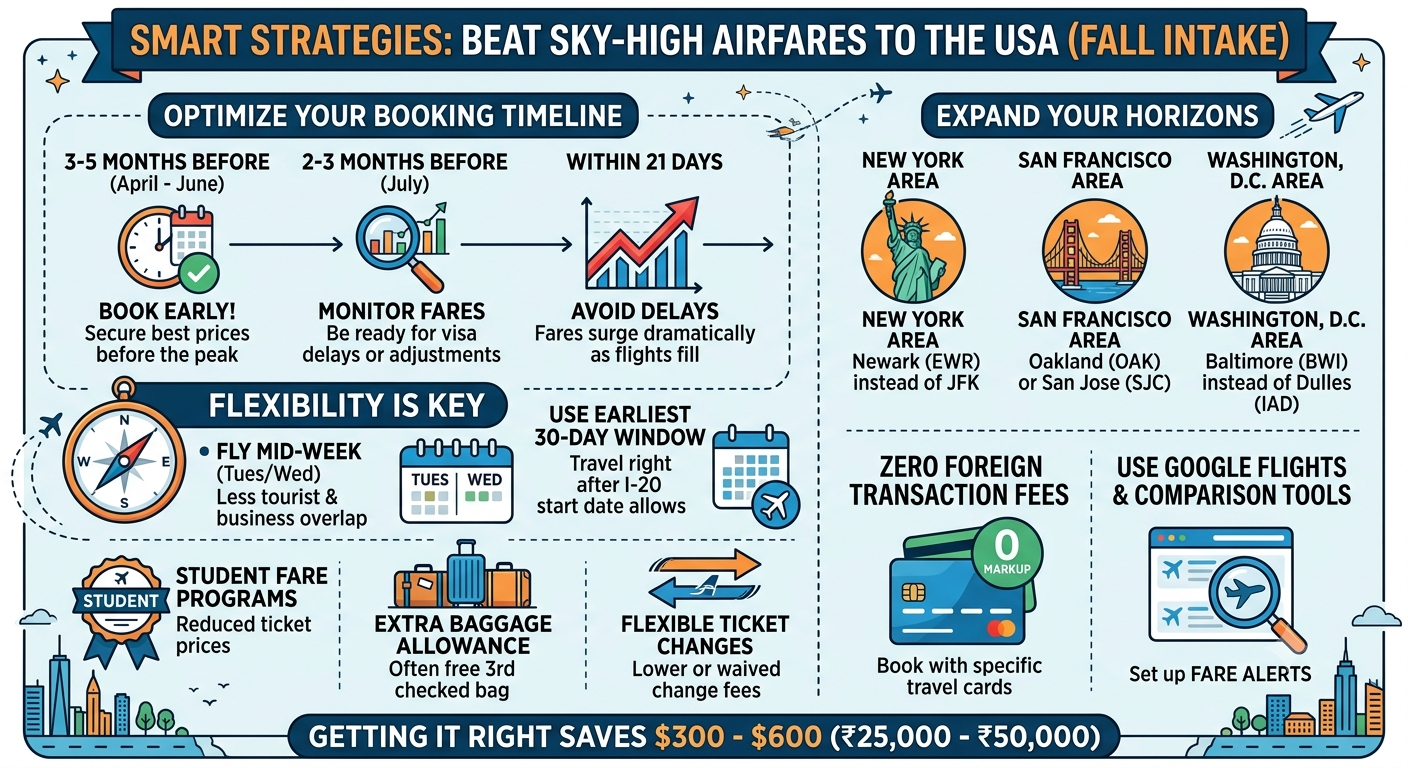
Travel specialists say the most effective way to beat these price increases is also the simplest: book early. Students travelling during the August-September window should ideally reserve their tickets three to five months before departure. Those who wait until visa formalities are completed or postpone bookings in the hope that fares will fall often discover the opposite. Delaying travel plans until July or August can add $250 to $600 (roughly Rs 20,000 to Rs 50,000) to the cost of a one-way ticket.
Flexibility can also translate into meaningful savings. Shifting a departure by even two or three days can produce noticeably lower fares, particularly when travelling on Tuesdays or Wednesdays instead of weekends. Students whose universities permit an earlier arrival within the 30-day entry rule may also benefit from travelling before the busiest week of departures.
Destination choices matter as well. Flying into an alternative airport and taking a short domestic connection can often reduce overall travel costs. Students heading to New York, for example, may find Newark less expensive than John F. Kennedy International Airport. Similar savings are sometimes available by flying into Oakland instead of San Francisco or Baltimore instead of Washington, D.C.
Technology has become one of the student’s most valuable allies in this increasingly competitive market. Travel experts recommend setting up fare alerts on Google Flights immediately after receiving an admission offer or visa approval. The service automatically tracks ticket prices and sends notifications when fares rise or fall. Combined with comparison platforms that allow travelers to monitor multiple airlines simultaneously, price alerts enable students to act quickly when favorable fares appear.
Another overlooked opportunity lies in student-specific airline programs. Several international carriers operating between India and North America offer discounted student fares, additional checked baggage allowances and more flexible ticket change policies. While the advertised fare may not always be the lowest available, the added baggage and flexibility often deliver greater overall value, particularly for students relocating with several suitcases.
Financial planning should extend beyond the airfare itself. Banking experts advise students to use payment cards with low or zero foreign transaction fees when purchasing tickets or making international payments. Avoiding foreign exchange mark-ups of two to four per cent can save additional money on a purchase worth more than $1,000. After arriving in the United States, students can begin building their American credit history through student-focused credit cards that offer travel rewards and cashback on everyday spending.
The busiest routes continue to originate from Delhi, Mumbai, Bengaluru, Hyderabad and Chennai, with students typically flying into New York, Boston, Chicago, Dallas, Washington, San Francisco and Los Angeles before connecting onward to university towns across the country. Flights through Middle Eastern hubs such as Dubai, Doha and Abu Dhabi, as well as European gateways including Frankfurt and London, remain among the most popular options because they offer competitive pricing and extensive connectivity.
For families already budgeting tens of thousands of dollars for higher education abroad, airfare is one of the few costs that can still be managed through careful planning. Historical pricing patterns consistently show that tickets become progressively more expensive as the start of the academic year approaches. Students who monitor fares early, remain flexible with travel dates and take advantage of student-friendly airline benefits stand the best chance of avoiding the annual airfare spike.
The lesson is increasingly clear. In an era of dynamic pricing, buying a plane ticket is no longer just about choosing a destination. For students heading to the United States, it has become an exercise in timing, technology and planning—and getting it right could leave them with $300 to $600 (Rs 25,000 to Rs 50,000) more to spend on the far greater challenges that await once they step onto campus.