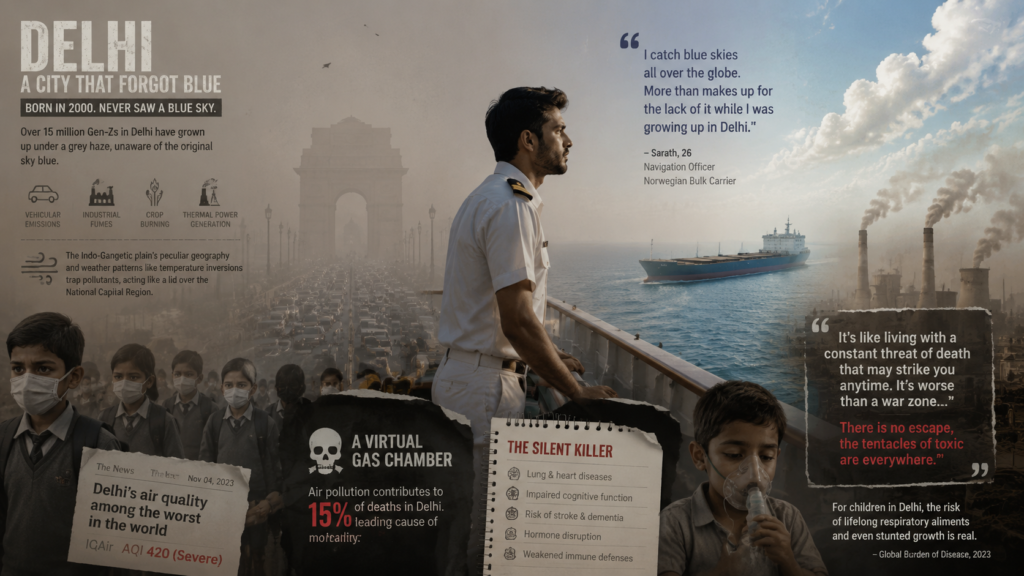
Born in 2000, Sarath grew up in the city of Delhi. He does not remember spotting a blue sky ever since.
Today, Sarath, who is 26 years old, joins over 15 million other Gen Zs born in Delhi since then, who have only seen a grey haze above them. Not that they miss the original sky blue as many of them accept the ashen pale grey above the national capital as the only normal, thanks to a combination of contributing factors ranging from vehicular emissions, fumes spewing from industrial belts to crop burning by farmers and usage of thermal energy for power generation for its energy guzzling urban sprawls—which some even call it the travails of ‘development.’
“Another reason for the persistent lack of azure is the peculiar geography of the Indo-Gangetic plain, combined with weather patterns like temperature inversions, which act like a lid, keeping smog and suspended particles stagnant over the National Capital Region,’’ says Sarath, who is today a navigation officer in a Norwegian bulk carrier. Yes, he catches blue skies all over the globe as he traverses the global seas for the good part of a year and, with sheer luck, more than makes up for the lack of it while he was growing up in Delhi.
Today, Delhi, India’s capital, has become a virtual gas chamber and the all-familiar miasma contributes to 15 percent of deaths in the capital city – making it the leading cause of mortality and the biggest threat to its residents. The air quality, one of the worst in the world, is a key cause for lung and heart diseases as well as impaired cognitive function, increasing risks of stroke and dementia, hormone disruption and weakening of immune defenses, among others. And for the children growing up in Delhi, they run the risk of developing lifelong respiratory ailments and even stunted growth, Global Burden of Disease data found in 2023.
Advertisement
“It’s like living with a constant threat of death that may strike you anytime. It’s worse than a war zone… There is no escape; the tentacles of toxic gas are reaching out for you …. always,’’ says businessman Pankaj Arora, who drives about 14 km each day to his establishment in Delhi’s industrial belt of Okhla from Mayur Vihar where he resides.
The worst part of the narrative is that the quagmire of pollution is moving pan India too, accounting for nearly 2.18 million deaths per year in the country, second only to China, according to research published by the British Medical Journal. The University of Chicago’s Air Quality Life Index notes that of the more than 510 million people who live in northern India (nearly 40 percent of India’s population) are “on track” to lose 7.6 years of their lives on average. In other words, air pollution has become a serious problem in several Indian cities with rapid industrialization coupled with weak enforcement of environmental laws taking its toll, despite the rapid pace of ‘development’ in the past few decades.
There are certain proactive responses from the government’s part too as they accelerate steps for a transition to clean energy, improving public transport networks, and enhancing last-mile connectivity with zero-emission options. Recently, (on July 01) the Delhi state government notified its Delhi Electric Vehicle (EV) Policy, 2026 with immediate effect. The policy is set to remain in operation till 31 March 2030, during which the government expects to promote a clean, modern, and pollution-free transport system. The document will also make EVs more popular in the city and expand battery charging and battery-swapping infrastructure. To help reduce dependency on conventional fuels, the new policy outlines financial incentives, institutional monitoring, digital transparency and environmental responsibility that would go a long way in improving air quality. Citizens and institutions can apply for electric vehicle purchase incentives and other benefits online and track the real-time status of their applications.
The new policy aims to speed up the transition to cleaner mobility; however, the automobile manufacturers are seeing certain challenges under the new policy-induced landscape, according to a Morgan Stanley report. Manufacturers heavily reliant on internal combustion engine (ICE) portfolios, such as Eicher Motors, face significant pressure to accelerate their EV launches to maintain market share as opposed to pure EV players like Ola Electric and Ather Energy. The risk of other states adopting this template is pressuring manufacturers to pivot their production lines, says Vijay Anthwal, a Delhi-based engineer and an entrepreneur. ‘’Moving from Internal Combustion Engine (ICE) vehicles to Electric Vehicles (EVs) requires re-engineering assembly lines. Companies must balance the production of legacy vehicles while heavily investing in dedicated EV platforms and new engineering disciplines,’’ explains Anthwal.
The policy, backed by a Rs 150 billion outlay, is likely to intensify competition in the electric two-wheeler market. The exclusion of hybrid vehicles from incentives signals a policy preference for pure electric technology over transitional powertrains, a move that could influence future product planning and investment decisions across the industry. Delhi’s Chief Minister Rekha Gupta said the government plans to spend around Rs 80 billion on EV infrastructure and road waivers, while the broader policy package includes tax breaks, purchase subsidies and benefits linked to scrapping older vehicles. The policy also proposes expanding Delhi’s charging infrastructure from 9,000 charging slots to 38,000 by 2028.
If all vehicles were to transition to EVs, will Delhi breathe clean? Can the millennials see the elusive blue sky? Not entirely, says Amitabh Singhal, a Delhi old timer whose ancestors lived in the city for centuries. “While transport is a major contributor, other sources would continue to pollute. Experts say that pollution levels would fall significantly over time as a transition to EVs not just addresses tailpipe emissions but also dust on the road. Heavy-duty vehicles and trucks are major polluters too. So why focus on private vehicles? As EVs replace polluting ones, we should also ensure that we shift from private individual vehicle ownership and usage to public transportation systems,” says Singhal.
The decision on whether we will be able to breathe clean air in future will depend on how we implement the policies available on paper and how well we coordinate across sectors, governance structures and regulatory bodies to bring the blue back to Delhi.
And meanwhile, many Delhi elders like us envisage and dream the following transformation for the Dilwaalon Ki Dili (city of hearts) in the near future, wishful thinking you may call it:
- Crystal-clear skies stretching across the horizon, with the Yamuna River reflecting shades of blue instead of grey.
- The infamous winter smog replaced by crisp air carrying the scent of flowering neem and bougainvillaea.
- Roads dominated by electric buses, bicycles, and pedestrians rather than smoke-spewing diesel vehicles.
- Dedicated cycling lanes connecting Connaught Place to Dwarka
- Shaded walking boulevards make commuting a joy.
- Noise pollution drops dramatically, replaced by the gentle hum of e-rickshaws.
- Buildings as living ecosystems, crowned with vertical gardens and solar panels.
- Rooftop farms supplying fresh vegetables to local markets, reducing dependence on long-distance transport.
- Migratory birds returning to the Yamuna while biodiversity flourishes in restored wetlands.
- Parks like Lodhi Gardens and Deer Park expand into urban forests.
- Health indices improve dramatically as asthma, bronchitis, and heart disease rates plummet.
Disclaimer: The opinions and views expressed in this article/column are those of the author(s) and do not necessarily reflect the views or positions of South Asian Herald.