 Join WhatsApp Channel

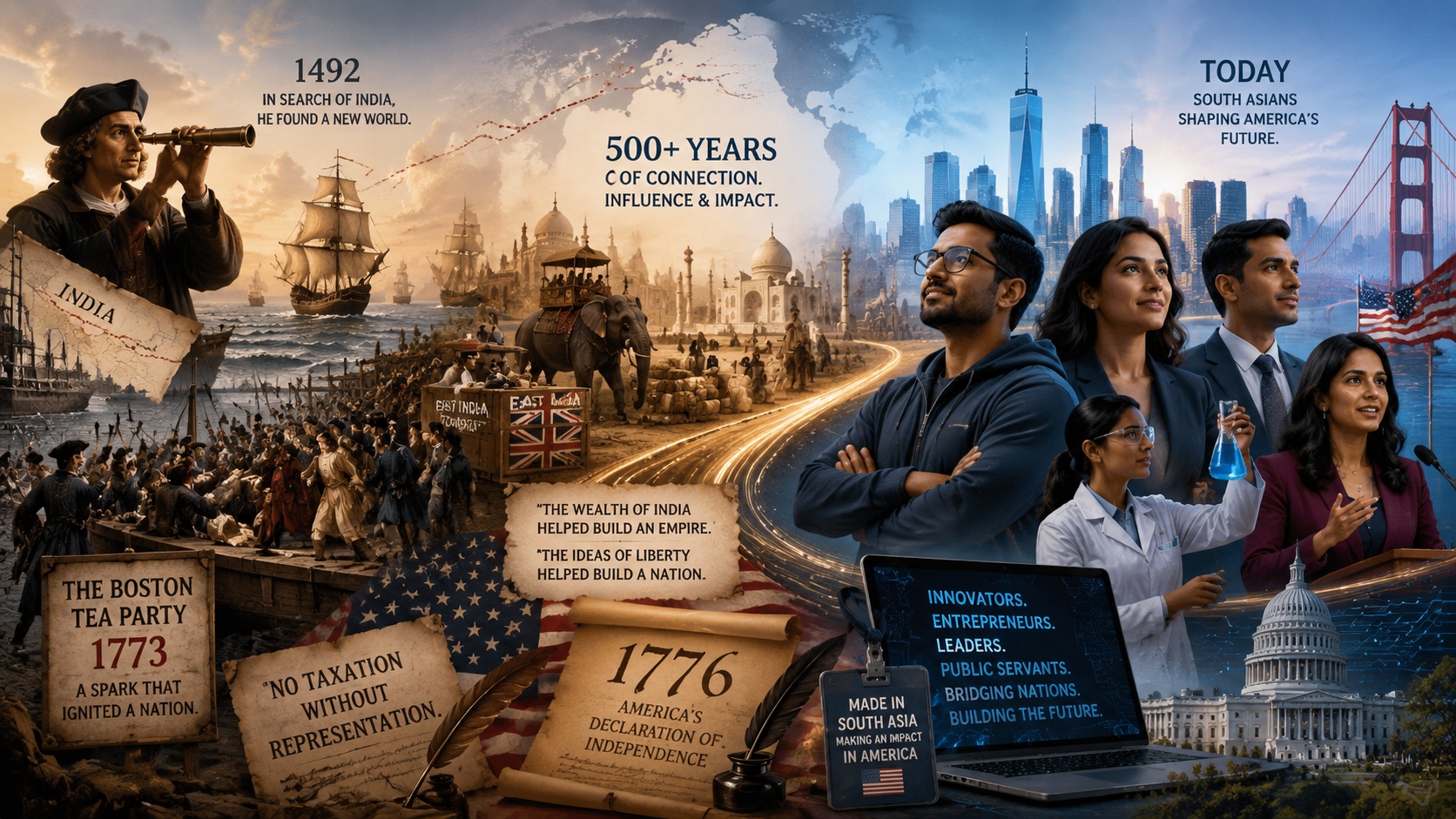
In one of history’s great ironies, America was discovered because a European explorer was looking for India.
In 1492, Christopher Columbus sailed westward in search of a shorter sea route to the riches of India—its spices, textiles and trade. He never reached the subcontinent. Instead, he stumbled upon an unknown continent to Europeans and changed the course of world history.
More than five centuries later, as the United States marks the 250th anniversary of its independence, that historical accident offers a powerful reminder: India and the broader South Asian region have been intertwined with America’s story from the very beginning.
Long before Silicon Valley CEOs, Indian-American lawmakers and South Asian entrepreneurs became symbols of modern America, the subcontinent was already influencing the forces that created the United States itself.
The tea that ignited the Boston Tea Party came through the British East India Company. The imperial practices perfected in Bengal became cautionary tales for American revolutionaries. The wealth extracted from India helped finance the British Empire that the thirteen colonies eventually rebelled against.
Today, 250 years after the American Revolution, the descendants of the very region Columbus sought to claim have become one of the most influential communities in the United States—leading technology giants, shaping public policy, driving scientific innovation, and increasingly defining the future relationship between Washington and South Asia.
This is not merely an immigration story.
It is a story about how a region once viewed by the West as a distant colony became an indispensable pillar of American economic, technological and political power.
The Subcontinent in America’s Founding Story
The traditional American independence narrative rarely mentions South Asia.
It should.
The British East India Company, whose monopoly over tea sales enraged American colonists, stood at the centre of one of the most consequential events leading to the Revolution—the Boston Tea Party of 1773.
For many American revolutionaries, India represented a warning.
They saw how the East India Company had transformed Bengal into a source of immense wealth through political control and economic exploitation. Thinkers such as Thomas Paine argued that Britain’s conduct in India demonstrated what unchecked imperial power could become.
Even militarily, the Indian subcontinent shaped the wider struggle. Britain was simultaneously fighting costly wars against the Kingdom of Mysore under Hyder Ali and Tipu Sultan, forcing London to divide resources across continents.
The story of American independence, therefore, was never exclusively American. It was part of a larger global contest in which India played a largely forgotten role.
America Becomes a Classroom for Indian Nationalists
As the nineteenth century progressed, the influence began flowing in the opposite direction.
American thinkers such as Ralph Waldo Emerson and Henry David Thoreau drew inspiration from Indian philosophy. Decades later, Mahatma Gandhi would cite Thoreau’s writings on civil disobedience as an important influence on his own political thought.
In 1893, Swami Vivekananda arrived in Chicago and delivered a speech that transformed American perceptions of India. His opening words—”Sisters and Brothers of America”—received a standing ovation and introduced millions of Americans to Indian spiritual traditions.
The United States soon became an important platform for Indian nationalism.
Lala Lajpat Rai toured America seeking support for India’s freedom movement. The Ghadar Party, founded in California in 1913, mobilized Indian immigrants against British rule and transformed the American West Coast into a center of anti-colonial activism.
By the time India achieved independence in 1947, American democratic ideals had already left a profound imprint on Indian political thought, while Indian intellectuals and activists had spent decades engaging American society.
The Community That Outperformed Every Expectation
The real transformation began after America’s immigration reforms of 1965.
When highly skilled migrants from India, Pakistan, Bangladesh, Sri Lanka and Nepal began arriving in larger numbers, few predicted they would become one of the most successful immigrant groups in American history.
Today, South Asians account for less than 2 percent of the U.S. population but exercise influence that far exceeds their demographic weight.
Indian Americans alone number more than 5 million.
Their median household income exceeds $150,000 annually—among the highest of any ethnic group in America.
Nearly 80 percent hold bachelor’s degrees or higher.
South Asians are disproportionately represented in medicine, engineering, finance, academia and entrepreneurship.
Their success is not confined to individual achievement.
It has reshaped entire sectors of the American economy.
The CEOs Running Corporate America
No immigrant community has had a more visible impact on modern corporate America.
At a time when technology defines geopolitical power, some of the world’s most influential companies are led by executives of South Asian origin.
Sundar Pichai oversees Google and its parent company Alphabet.
Satya Nadella leads Microsoft.
Arvind Krishna heads IBM.
Shantanu Narayen runs Adobe.
Together, these firms influence everything from artificial intelligence and cloud computing to cybersecurity and digital communications.
Their combined market value runs into trillions of dollars.
The irony is difficult to miss.
The descendants of people once governed by British colonial rule now lead companies that define the digital infrastructure of the modern world.
From Ellis Island to Capitol Hill
Political influence followed economic success.
The election of Vice President Kamala Harris marked a historic milestone for South Asian representation in American politics.
Today, lawmakers such as Ro Khanna, Pramila Jayapal, Raja Krishnamoorthi and Ami Bera play influential roles in debates over technology, trade, national security and foreign policy.
South Asians are increasingly found not only in boardrooms but also in the institutions where American power is exercised.
The Next 25 Years
- As America enters its second quarter millennium, the South Asian story is entering a new phase.
- The first generation came seeking opportunity.
- The second built wealth and influence.
- The third is beginning to shape institutions.
India is expected to become one of the world’s three largest economies within the next decade. South Asian Americans already occupy key positions in artificial intelligence, quantum computing, biotechnology, clean energy and advanced manufacturing—the industries likely to define the global balance of power in the twenty-first century.
At the same time, more than 300,000 Indian students study in American universities, while thousands of entrepreneurs, scientists and investors move between the United States and South Asia each year.
The relationship is no longer simply about immigration. It is about co-creating the future.
Two hundred and fifty years ago, Columbus sailed in search of India and accidentally found America.
Today, America’s future may be shaped in part by the descendants of the very people he was trying to reach. That is not merely a historical irony. It is one of the defining geopolitical realities of the twenty-first century.
Related posts:
 Indians, Pakistanis and South Asians: A Shared Heritage
 Branding Sri Lanka: Reclaiming the Narrative of the Pearl of the Indian Ocean
 CHCC India Mission Gains Momentum as BC Premier Prepares Trade Visit to Strengthen Canada–India Economic Ties
 The Aroma of Home: Assam’s Joha Rice Finds Its Way to Diaspora Kitchens in Europe
