Join WhatsApp Channel

India’s legal system is wobbling by its own weight.
Billed as one of the oldest justice systems that had evolved over centuries, today India’s legal system at best mirrors the themes of Charles Dickens’ novel Bleak House, which parodies the fictional law case Jarndyce and Jarndyce that drags on for generations until the estate is entirely consumed by the legal costs themselves. India today sits on a breathtaking pileup of about 50 million cases, choking its courts, slowing the speed of justice delivery to an agonizing crawl.
A glance through the tip of the ice- berg court cases that had occupied the judiciary in modern India will give an idea of its painfully sluggish pace:
The Berhampore Bank case took 72 years to conclude and stands as India’s longest-running legal battle.
A 92-year-old ‘bedridden ‘man, convicted in a 1980 honor killing case, was asked to go to jail after 36 years by the Supreme Court
After about 59 cine goers perished in a massive blaze in a cinema hall in New Delhi in 1997, and it took the courts 18 years to furnish a verdict, while the prime accused, Ansal brothers, the real estate barons, were let off with a fine.
In one of the worst instances of custodial violence, 42 men belonging to a certain community were killed by a specialized armed force in Uttar Pradesh in 1987. It took 31 years for the Delhi High Court to convict the accused, many of whom had already retired or died. In December 2024, the Supreme Court of India granted bail to eight of these convicts.
Thousands died as toxic gas spewed from the Union Carbide India Limited pesticide plant in Bhopal in 1984. The lengthy judicial aftermath was heavily criticized; the prime accused received light sentences, and affected victims are still fighting for adequate compensation.
Nirbhaya Gang-Rape Case (2012) — While this case resulted finally in capital punishment for the accused, it took an arduous 8-year appeals process. The delay and extensive loopholes in the appeals process highlighted the critical need for faster, more effective judicial mechanisms for rape victims in India.
Called the Best Bakery Case, where a bakery was burned down, killing 14 people. The original trial court acquitted all 21 accused due to witnesses turning hostile. The Supreme Court eventually ordered a retrial in Mumbai, which found nine of the accused guilty; out of the nine, only five were finally acquitted.
In one of the most brutal examples of caste violence, upper castes massacred 58 men and women of the landless peasant community in 1997. In 2010, a lower court convicted 26 of the accused, including a death sentence to 16. But just three years later, the high court overturned the lower court’s ruling and acquitted all 26 convicts, stating that the witnesses were not reliable.
In 1999, after a lawyer, Tungnath Chaturvedi, filed a case against a rail ticketing officer for overcharging, it took 120 hearings over 23 years to get a final verdict.
There are many, many more such cases abounding in the judicial landscape in the country, and the reasons for the above malaise are manifold. Say, for example, India has one of the world’s lowest ratios of judges having one judge per 21 million of its people, while in the United States, there is a judge for every 150 people. India had been striving hard to target at least 50 judges per million people, but an abysmal lack of funding to absorb more judges, improve court facilities and digitize procedures has slowed down such initiatives. There are endemic delays plaguing both criminal and civil cases, as about 77 percent of prisoners in India are awaiting trial, compared with one in three worldwide. Land disputes and other civil cases number about 11 million, of which many are more than five years old.
Another reason for the slowness could be blamed on the British legacy of inheriting a rigid system and archaic rules, even as lawyers make endless oral arguments and produce lengthy written submissions. Despite government committees trying to curtail written testimonies and time-consuming procedures in examining witnesses, nothing much has moved in that direction.
According to the new WJP Rule of Law Index 2025. The global rule of law recession has accelerated. It says a stark 68% of countries declined in their rule of law in 2025, compared to 57% in the previous year, including India. India’s overall rule of law score decreased 1.7% in this year’s Index. It ranks 86th out of 143 countries worldwide. The Index shows that judiciaries are losing ground to executive overreach, with rising political interference across justice systems. Indicators measuring whether the judiciary limits executive power and whether civil and criminal justice are free from improper government influence declined in 61%, 67%, and 62% of countries, respectively.
’The judicial process should never be harsher than the punishment. But today, for many Indians, it is. Justice delayed is not just justice denied — it is justice undone. The innocent man who walks out of jail after years of waiting doesn’t come out free; he comes out broken. Maybe it’s time we asked ourselves: when did the process of seeking justice become more painful than the crime itself? When did we start accepting suffering as part of the system?
Because until we fix that, every courtroom, every jail, every delay will continue to whisper the same truth — in India, it’s not always the verdict that punishes you. It’s this slow, painfully enduring, relentless process in itself that punishes both the accused and society, ‘’ according to Anand Prasad, one of the finest legal minds.
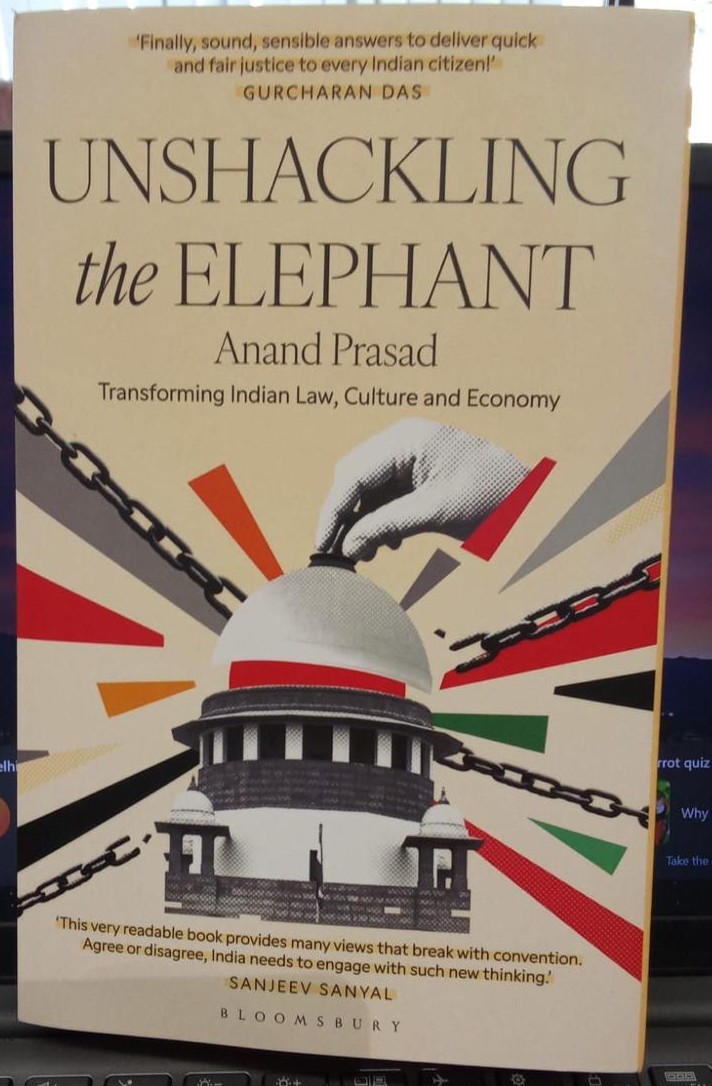
In his recently published book ‘Unshackling the Elephant’ Anand Prasad proposes a blueprint for revamping India’s legal system. He examines the structural challenges within India’s legal system – from delays in justice delivery and weak contract enforcement to questions around judicial accountability and state power. He argues for reforms that make the law more accessible, responsive and aligned with the realities of ordinary citizens, while also sparking debate on issues such as sovereign immunity, public interest litigation, and individual freedoms.
The book is a call to look closer – at the delays, the decay, and the faith that still endures.
Unshackling the Elephant exposes the deep flaws in the justice system-its colonial legacy, inefficiency and disconnect from Indian values. Anand Prasad proposes sweeping changes: judicial accountability, AI-powered courts, changes to usher in ease in doing business, stronger victim rights and a shift towards culturally rooted legal principles. He offers a visionary and occasionally disruptive roadmap to restore justice, transparency and public trust. Anand observes that there is a loss of credibility in the legal system today, and people are finding ways to sidestep the legal system and find solutions outside it through a combination of bribery or violence.
Published by Bloomsbury India, the book is both a mirror and a manifesto for reforming one of the country’s most critical institutions. Drawing from over three decades of legal practice across commercial, transactional, and constitutional law, Anand Prasad takes readers inside India’s courts to reveal both the ideals that shaped them and the structural flaws that now impede their purpose. Written with honesty and clarity, Unshackling the Elephant invites policymakers, lawyers, and citizens alike to rethink how justice can be made accessible, transparent, and truly equitable.
“Each of the topics in the book could easily form the basis of a detailed report or PhD thesis. I hope the book opens the minds of policymakers and those in charge of the state’s affairs — and encourages blue-sky thinking on transforming India through a focused set of legal reforms. Most importantly, I hope it helps the thinking people of our nation understand the reasoning that drives our current legal framework, and how there might be more culturally aligned ways to rethink justice in India,” explains Anand Prasad.
Adding a few suggestions, advocate Rajan Khosla says the Indian judiciary should be separated from its colonial foundation and infused with the principles of jurisprudence, which are rooted in India’s diverse communities, along with the best global principles of jurisprudence. Arbitration and Mediation should be improved and integrated into the justice delivery system in order to unburden the courts. Decolonization of the laws and the judicial system is the first step to improving the justice delivery system. With nearly four decades of distinguished legal practice before the Supreme Court of India, High Court of Delhi, and various tribunals, Khosla brings exceptional expertise in public law, regulatory matters, governance, and consumer advocacy. He currently serves as Senior Panel Counsel for the Union of India.
But winds of optimism are still blowing in India. According to a study by Washington-based Development Data Lab, which analyzed 5 million criminal cases between 2010 and 2018 in India revealed that judges were non-partial towards groups from their own communities. Neither was there gender bias from judges, and most importantly, judges did not display favoritism on the basis of religion. According to Gallup, Indians are more confident in their courts than their counterparts living in the US, UK and other countries.
The India Justice Report of 2025 reveals that southern states topped the Judiciary Ranking– as a measure of their performance on capacity metrics in the judiciary. Scoring out of 10, Kerala topped with 7.43 points, followed by Telangana (6.91), Tamil Nadu (6.72), Karnataka (6.70), and Andhra Pradesh (6.68). Southern judiciaries use budgets more efficiently, invest more in court infrastructure and maintain better staff-to-case ratios than their northern counterparts.
In Kerala, a machine-learning of filings and case management system that tightens schedules, helping speed up judges’ work, has been introduced. Anand Prasad adds that an algorithm could come in handy to dispatch the huge number of cases. What gets done in 4 years could be done in 4-6 weeks. Other parts of the world are successfully using such cutting-edge technology to clear backlogs; why can’t it be done in India and make the job easier for judges?
There is still time and scope for a comprehensive revamp of the judicial system. Crippling case backlogs, widespread vacancies, systemic delays that disproportionately impact vulnerable populations, clearing of millions of pending cases, enforcing contracts efficiently, and finally restoring public trust in the rule of law are the needs of the hour. And most importantly, to ensure that the system should not be ensnared in a Dickensian world like in the case of Jarndyce and Jarndyce, where a lawsuit goes on for generations and “becomes so complicated that no man alive knows what it means.”
Disclaimer: The opinions and views expressed in this article/column are those of the author(s) and do not necessarily reflect the views or positions of South Asian Herald.
Related posts:
 Global Experts Address Crisis of Judicial Independence at New York City Bar Association
 Ali Najmi Appointed Chair of New York City Mayor’s Advisory Committee on the Judiciary as Mamdani Signs Transparency Order
 When Does Prolonged Detention Engage Article 21?
 Alina Habba Disqualified as New Jersey Attorney After Appeals Court Finds Appointment Violated Federal Law