Join WhatsApp Channel

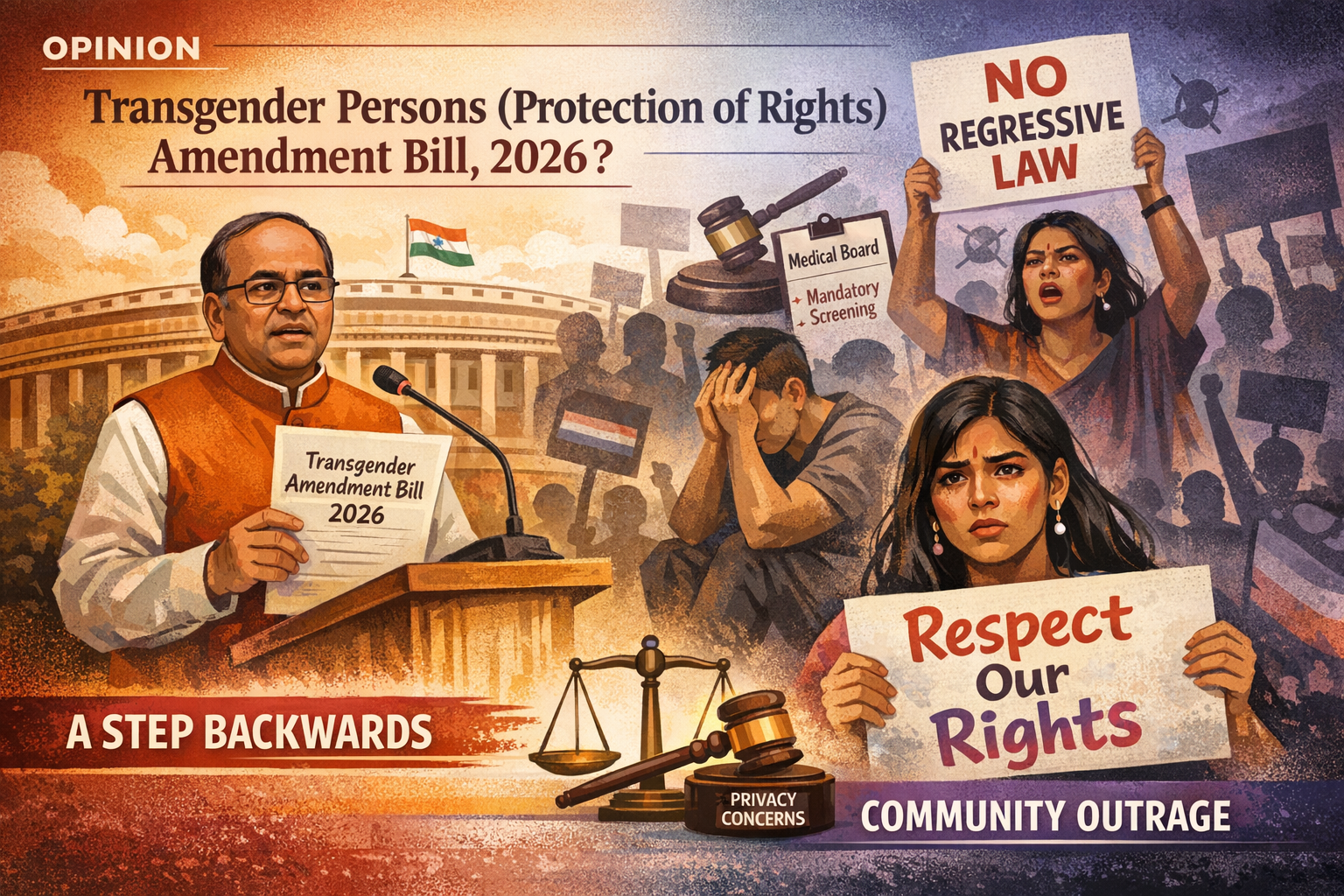
What is Transgender Persons (Protection of Rights) Amendment Bill, 2026?
On March 12, 2026, Dr. Virendra Kumar, Union Minister for Social Justice and Empowerment introduced the “Transgender Persons (Protection of Rights) Amendment Bill, 2026)” in Lok Sabha. The bill seeks to amend the Transgender Persons (Protection of Rights) Act, 2019 which was enacted after a lot of protests by the community for its identification and protection. This bill has drawn serious condemnation from the transgender community for its flawed and regressive provisions.
A Step Backwards
One of the major changes introduced is the change in the definition of ‘transgender’. The 2019 Act defined transgender as a person whose gender does not match with the gender assigned to that person at birth. This definition is in accordance with the judgement of National Legal Services Authority vs. Union of India (2014), wherein the Supreme Court laid down the right of self-determination of one’s own gender.
However, the amendment strips away this right of self-determination by narrowing the definition of transgender. The amendment not only excludes people with different sexual orientations or identities but also seeks its retrospective application which will create a plethora of problems for people who have already obtained identity certificates under the 2019 Act.
Further, the amendment bill requires the District Magistrate to confer with the medical board before issuing the certificate of identity as a transgender person, which is not a requirement under the 2019 Act. This is again inconsistent with the judgement of NALSA vs. UOI, since the presence of medical professionals in the process would violate the right of transgender people as identification of one’s own gender vests with the person and not the state.
The Bill also includes within its scope the people who have been forced or deceived into adopting or presenting themselves as transgender through acts such as mutilation, emasculation, castration, amputation, or other surgical, chemical, or hormonal procedures. However, there is no credible evidence or documented pattern of such conduct in India. By framing the law around this speculative harm, the provision risks reinforcing harmful stereotypes that portray transgender communities as manipulative, rather than addressing the well-documented violence and discrimination actually faced by transgender persons.
Scrutinizing the Constitutionality of the Amendment
The Supreme Court in NALSA vs. UOI held that the right to freedom of speech and expression under Article 19(1)(a) of the Constitution includes one’s right to expression of his self-identified gender since gender identity lies at the core of the right to bodily autonomy, dignity and personal integrity. It also highlighted that Article 21 providing for the right to life and liberty, protects the privacy and dignity of transgender people. The bill requires the disclosure of personal details before the medical professionals which raises serious concerns about privacy under Article 21.
The Court also stated that it cannot follow the Corbett Principle of “Biological Test” which emerged in the UK, but it prefers to follow the psyche of the person in determining the sex and gender thereby preferring the “Psychological Test.” Additionally International Covenants like UDHR, ICCPR, Yogyakarta Principles recognize the right to expression, dignity and bodily autonomy. The amendment bill grossly contradicts not just the verdict rendered in NALSA thereby violating Articles 19 and 21 but also goes against the international agreements.
The Way Forward
The bill undermines the constitutional principles and is an attempt to overturn the reforms brought for the transgender community over the years. It needs to be ensured that a law seeking to protect the rights of community does not become a tool for its exploitation. The bill therefore requires serious reconsideration and rigorous debate in the Parliament if the legislature truly wants to safeguard the rights of the transgender community.
Disclaimer: The opinions and views expressed in this article/column are those of the author(s) and do not necessarily reflect the views or positions of South Asian Herald.